
Torque wrenches have been a staple of mechanical assembly and maintenance work for decades. They are reliable, portable, and capable of delivering accurate torque across a wide range of applications. However, there comes a point where increasing torque requirements, operator fatigue, and workplace safety considerations make it worthwhile to consider upgrading to a powered torque tool.
Understanding when that transition makes sense can improve productivity, reduce injuries, and ensure more consistent torque application.
The Practical Limits of a Hand Torque Wrench
Most technicians are familiar with click-type mechanical torque wrenches ranging from a few Newton metres up to several hundred Newton metres. As torque requirements increase, the physical size of the wrench must also increase.
A 1,500 Nm torque wrench is already a substantial piece of equipment. It is long, heavy, and often requires considerable effort from the operator. Above this level, things become increasingly impractical.
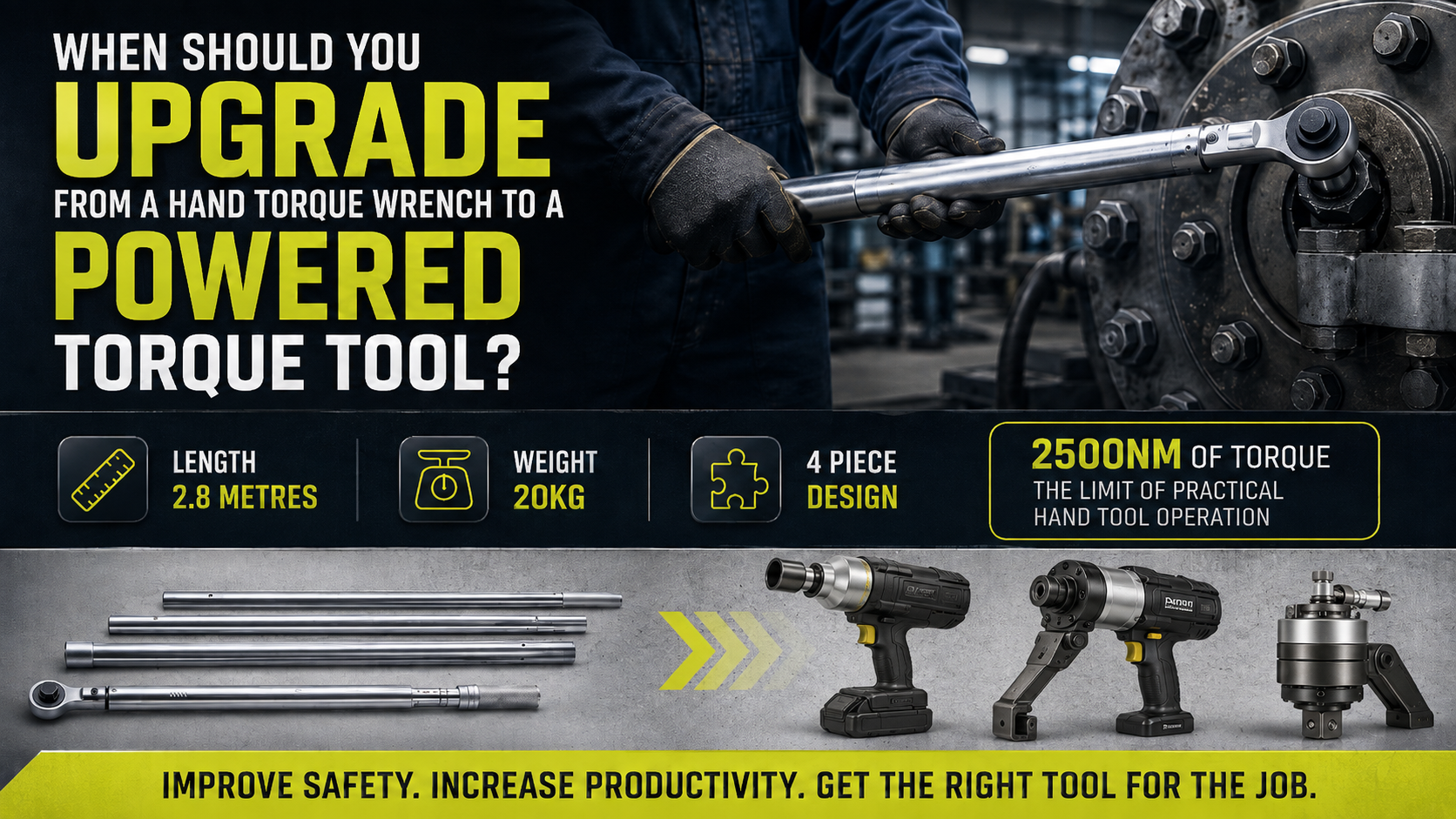
Recently, a customer approached us wanting calibration of a Mighty Seven 2,500 Nm torque wrench. This tool is a beast, weighing almost 20kg and 2.8m in length. Unfortunately, calibration was not possible. Most commercial torque wrench calibration systems and reference standards are designed around the practical limits of mechanical torque wrenches, with many topping out at approximately 1,500 Nm.
The issue is not simply calibration capability. A 2,500 Nm hand torque wrench presents several real-world challenges:
Length
To generate 2,500 Nm manually, the wrench requires an extremely long handle. This makes the tool awkward to manoeuvre in confined spaces and difficult to transport.
Weight
High-capacity torque wrenches are often constructed with heavy-duty components to withstand the forces involved. The resulting tool can be cumbersome for a single operator to handle safely.
Operator Effort
Applying 2,500 Nm by hand requires significant physical force. Depending on handle length, operators may need to use much of their body weight to achieve the required torque.
Safety Risks
Large manual torque applications increase the risk of slips, loss of balance, and musculoskeletal injuries. If the operator loses footing or the tool suddenly releases, the consequences can be serious.
Torque Multipliers: A Useful Intermediate Step
Before investing in powered torque equipment, many organisations find torque multipliers to be an effective intermediate solution.
A torque multiplier uses a planetary gearbox arrangement to multiply the input torque provided by the operator. For example, a 5:1 multiplier allows 100 Nm applied at the input to generate approximately 500 Nm at the output.
Benefits of torque multipliers include:
- Reduced operator effort
- Improved safety
- Greater achievable torque
- Lower capital cost compared with powered tools
- Portability for field work
Torque multipliers are particularly popular in industries such as mining, heavy transport, construction, and power generation where large bolted joints are common.
For occasional high-torque applications, a torque multiplier may provide all the capability required without the expense of powered tooling.
When Powered Torque Tools Become the Better Option
As torque requirements continue to increase, powered torque tools become increasingly attractive.
Powered torque tools are available in several forms, including:
- Battery-powered torque wrenches
- Electric torque tools
- Pneumatic torque tools
- Hydraulic torque wrenches
These systems deliver torque using a motor or hydraulic mechanism rather than relying solely on operator effort.
Signs that it may be time to upgrade include:
Regular Torque Requirements Above 1,000 Nm
While manual tools can achieve these values, the physical demands become increasingly significant. Powered systems can apply the same torque with far less effort.
High Volume Work
If operators are repeatedly tightening large fasteners throughout the day, productivity gains from powered tools can be substantial.
Safety Concerns
Reducing manual force requirements lowers the risk of strains, sprains, and workplace injuries.
Consistency Requirements
Powered torque tools often provide improved repeatability and can include electronic monitoring, torque recording, and traceability features.
Difficult Access Conditions
In many situations, the physical space required to swing a large manual torque wrench simply does not exist. Powered tools often require less operator movement and can be used in tighter locations.
Comparing the Options
| Solution | Best For | Advantages | Limitations |
|---|---|---|---|
| Mechanical Torque Wrench | General maintenance and assembly | Portable, simple, economical | Operator effort increases with torque |
| Torque Multiplier | Occasional high-torque applications | Lower effort, cost-effective | Slower operation |
| Battery/Electric Torque Tool | Medium to high-volume work | Fast, portable, repeatable | Higher purchase cost |
| Hydraulic Torque Wrench | Very high torque applications | Extremely high torque capability | More complex equipment |
Choosing the Right Tool for the Job
There is no single torque solution that suits every application. For many workshops, a conventional mechanical torque wrench remains the ideal choice. As torque requirements grow, a torque multiplier can bridge the gap effectively.
However, once torque levels approach the upper limits of practical manual operation, particularly above 1,500 Nm, powered torque tools often become the safer, more productive, and more economical long-term solution.
The 2,500 Nm torque wrench we recently encountered highlights this reality. While such tools exist, their size, weight, calibration challenges, and operator demands often make alternative solutions far more practical.
If your team is regularly working at these torque levels, it may be time to consider whether a torque multiplier or powered torque system could improve both safety and efficiency.
Contact us to discuss your calibration requirements and the most suitable torque equipment for your application.