
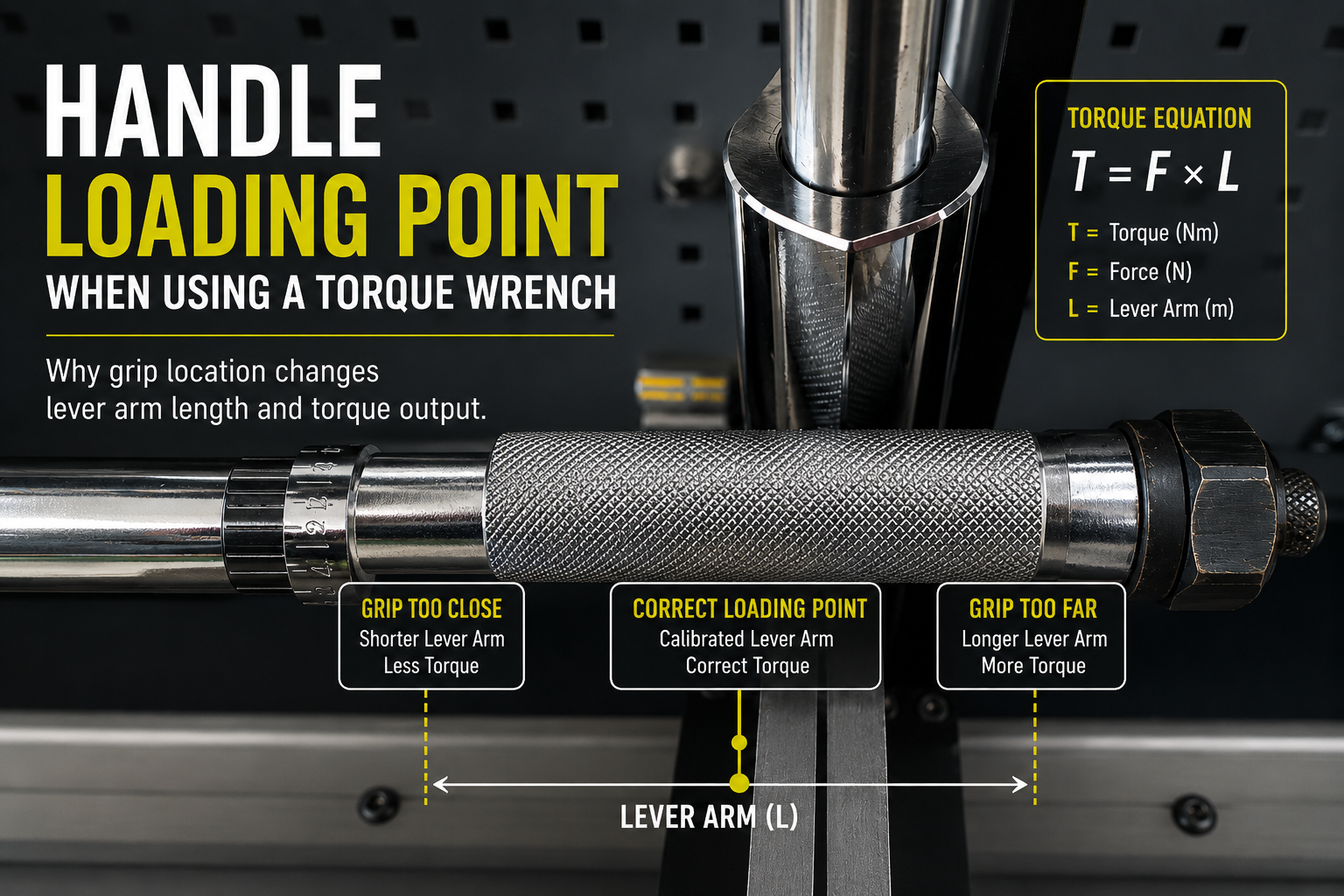
Applying force at the correct location on a torque wrench is essential for achieving accurate torque results. While many users focus on calibration intervals, tool condition, and operating technique, one of the most common causes of inaccurate torque application is simply gripping the wrench in the wrong place.
Understanding why the handle loading point matters can help prevent under-tightening or over-tightening of critical fasteners.
What Is the Handle Loading Point?
Most torque wrenches are designed and calibrated to be loaded at a specific point on the handle. This is usually the centre of the hand grip and is often marked by a knurled section, moulded grip, or handle pivot point.
During calibration, force is applied at this designated location. The torque wrench’s accuracy is therefore based on the assumption that the user will apply force at the same point during normal use.
Understanding the Lever Arm Principle
Torque is created when a force is applied at a distance from a pivot point.
The torque produced depends on two factors:
- The amount of force applied
- The distance from the centre of the drive to the point where the force is applied
This distance is known as the lever arm.
If the loading point changes, the effective lever arm changes. As a result, the torque delivered to the fastener also changes.
What Happens If You Grip Further Back?
If you apply force beyond the intended handle loading point, the lever arm becomes longer.
This means that for the same amount of force, more torque is produced than intended.
For example, if a torque wrench is calibrated with a 500 mm lever arm but the operator applies force at 550 mm, the wrench will generate more torque than the calibration assumes.
The result can be over-tightened fasteners, damaged threads, distorted components, or excessive bolt preload.
What Happens If You Grip Closer to the Head?
Applying force closer to the ratchet head shortens the effective lever arm.
In this case, the same effort produces less torque than intended.
The user may believe the correct torque has been achieved when the actual torque applied to the fastener is lower than required.
This can lead to loose joints, insufficient preload, vibration-related failures, and potential safety concerns in critical applications.
Common Situations That Affect Loading Point Accuracy
Several workplace habits can unintentionally alter the loading point:
- Holding the very end of the handle for extra leverage
- Choking up on the wrench in confined spaces
- Using extension pipes or cheater bars
- Pulling with two hands at different positions
- Applying force against the side of the handle
Any of these practices can change the effective lever arm and affect the torque applied to the fastener.
Best Practice for Accurate Torque Application
To achieve the best possible accuracy:
- Hold the torque wrench at the designated grip area.
- Apply force smoothly and steadily.
- Pull perpendicular to the wrench where practical.
- Avoid using cheater bars unless specifically permitted by the manufacturer.
- Ensure operators understand the importance of the loading point during training.
These simple practices help ensure that the torque delivered in the field matches the torque established during calibration.
Conclusion
The handle loading point is a critical factor in torque wrench accuracy. Torque wrenches are calibrated based on a specific lever arm length, and changing where force is applied changes that lever arm.
Even a perfectly calibrated torque wrench can produce incorrect results if the operator applies force at a different location than intended. By understanding and respecting the designated loading point, users can achieve more reliable torque application and reduce the risk of fastener failures.
Contact us to discuss your calibration requirements and ensure your torque equipment continues to deliver accurate and reliable results.