
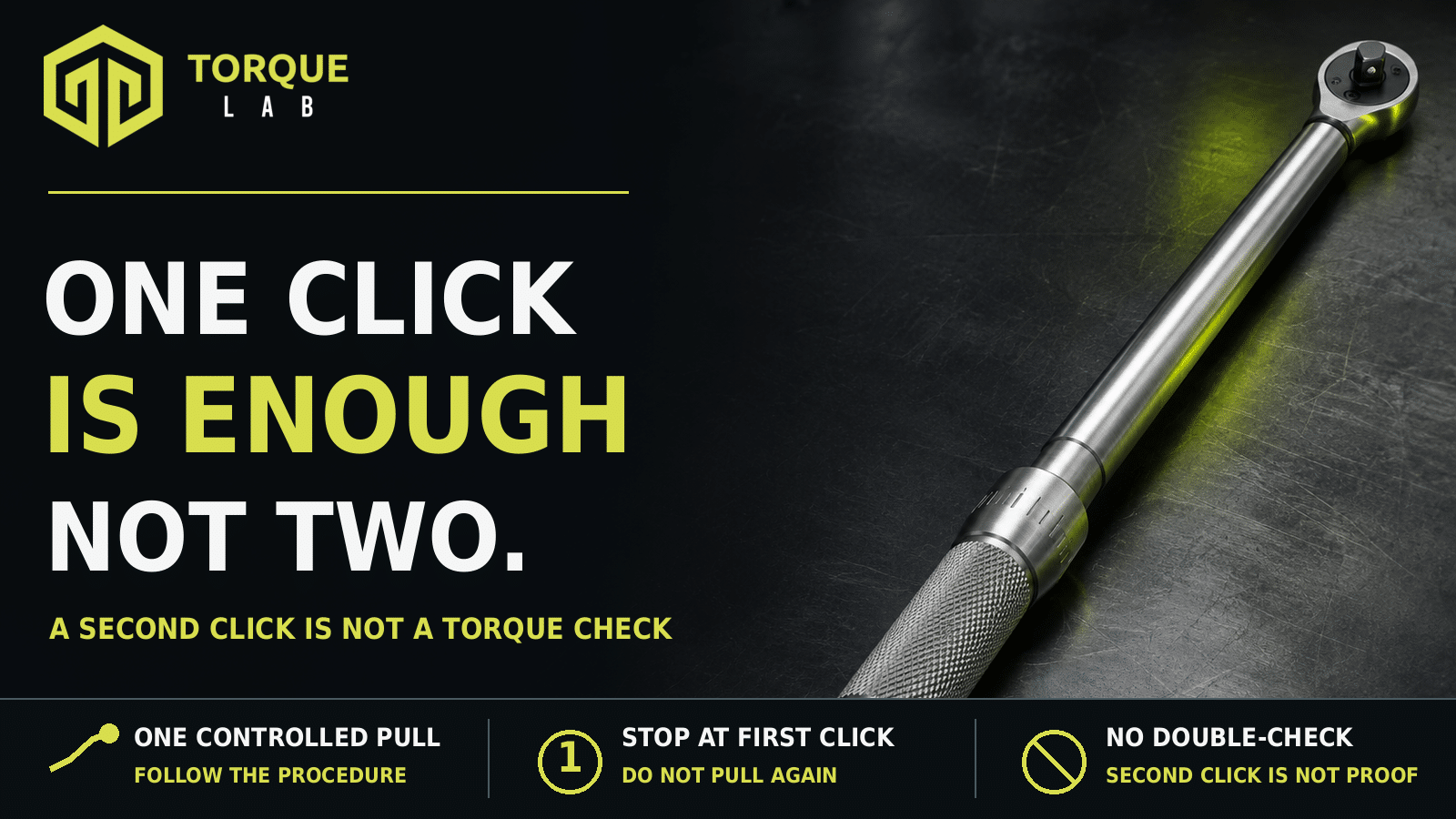
Double-clicking a torque wrench is the habit of tightening a fastener until a click-type wrench releases, then deliberately pulling it to a second click “for good measure”. Although the extra pull may feel reassuring, one click is enough when you use a conventional click-type wrench correctly. A second torque wrench click is not an independent method of rechecking bolt torque.
The important distinction is that a second click does not automatically mean the fastener has received additional torque. Nevertheless, repeating the operation can create an unnecessary risk, particularly if the fastener rotates further.
Why do people double-click a torque wrench?
For some operators, the first click seems too subtle. They want to be certain they heard or felt it. Others have developed a habit of checking their work with a second pull, almost as if the wrench were confirming the first result.
However, a conventional click-type torque wrench does not provide two independent checks of the same fastener. Its release mechanism signals that the applied torque has reached the tool’s setting under the conditions of that pull. It does not assess whether the fastener was previously tightened correctly, and it does not directly measure bolt tension.
What actually happens at the second click?
When a click-type wrench reaches its set torque, its mechanism releases or deflects to produce the familiar signal. The operator should stop applying force promptly.
If the operator releases the wrench, resets their grip and pulls again, the mechanism may produce another click at approximately the same set torque. However, the behaviour of the joint matters.
There are two important possibilities:
- The fastener does not rotate further. The wrench can reach its release point again without necessarily increasing the fastener’s final tightening torque or preload. Therefore, it is misleading to claim that every second click automatically over-tightens a bolt.
- The fastener rotates further. The second pull becomes another tightening operation. Depending on the joint, this additional movement can change the clamping force and may take the assembly beyond its intended tightening condition.
In addition, if the operator keeps pulling after either click, they may apply torque beyond the intended setting. That is a separate technique error: failing to stop at the release signal.
The problem with double-clicking a torque wrench is uncertainty, not a guaranteed extra percentage of torque. You cannot infer a fixed amount of over-tightening from the number of clicks alone.
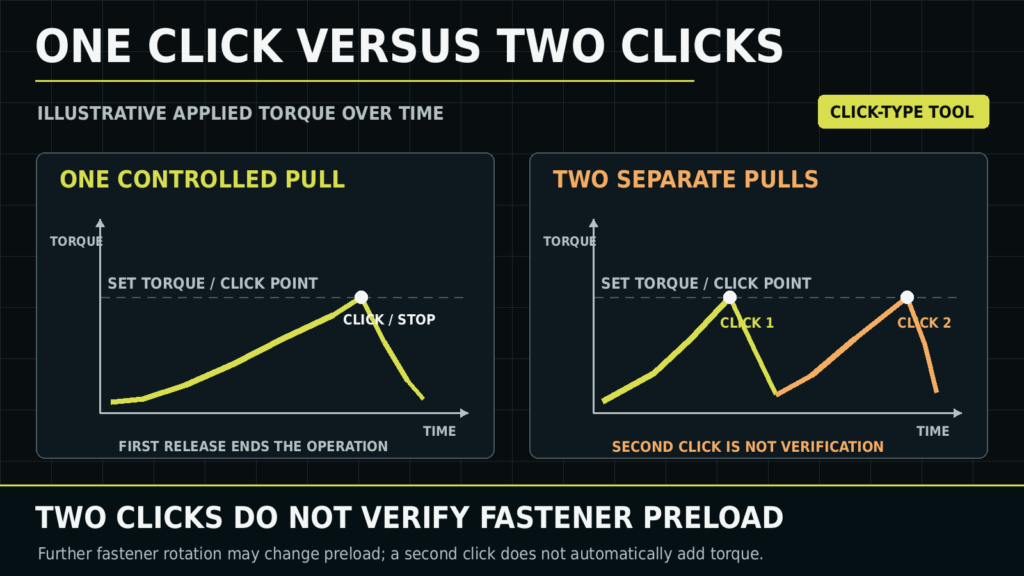
Illustration: Both applications can cause the wrench to reach its release setting. Two clicks are two release events, not two independent measurements of bolt preload. The traces are illustrative, not measured calibration data.
Why the second torque wrench click is not a verification
There is an important difference between operating a torque wrench and measuring the condition of an assembled joint.
A click-type wrench responds to the torque applied during the current pull. It cannot tell you how much clamping force is present in the bolt or whether the first tightening operation achieved the required joint condition. Friction, lubrication, joint stiffness, embedment and previous tightening history all affect the relationship between applied torque and preload.
Likewise, rechecking bolt torque by pulling on an already-tightened fastener is not the same as repeating a controlled tightening from the specified starting condition. Static friction and the torque needed to restart fastener movement can differ from the torque encountered while the fastener was turning.
Consequently, hearing a second click does not establish that the first tightening was accurate. It simply establishes that the wrench’s mechanism responded during the second application.
Does “one click is enough” mean you should never check a fastener?
No. There are legitimate inspection and verification procedures for bolted joints. However, use a method that the assembly manufacturer specifies or that has undergone suitable validation for the joint.
For example, a documented procedure might involve a controlled re-tightening sequence, torque-angle monitoring or another specified method of assessing the assembly. Do not confuse those techniques with an informal second click.
Some critical fasteners also have replacement, lubrication or tightening-sequence requirements. If you interrupted a tightening operation or did not follow the specified procedure, consult the equipment manufacturer’s instructions before attempting to correct it. Simply loosening and re-tightening a critical fastener may not restore its intended condition.
How to avoid double-clicking a torque wrench
For a conventional manually operated click-type wrench, follow the tool and assembly manufacturers’ instructions. In general:
- Confirm the torque specification. Check the correct value, units and any prescribed tightening sequence.
- Set the wrench accurately. Check that you have set it within its specified operating range and secured the adjustment where required.
- Position the tool correctly. Seat the socket fully and grip the wrench at the designated loading point.
- Apply force smoothly. Use one controlled pull, without jerking or bouncing the wrench.
- Stop at the first click. Release the applied force as soon as the mechanism signals.
- Resist the “one more for good measure” habit. If there is a genuine reason to question the result, use the appropriate inspection or rework procedure instead of automatically clicking again.
The phrase one click is enough is a useful reminder, but it assumes the correct tool, setting, technique and tightening procedure. It is not a substitute for those requirements.
What calibration can and cannot tell you
Regular calibration helps establish whether a torque wrench performs within the relevant requirements under controlled test conditions. ISO 6789-1:2017 addresses design and quality conformance testing of hand torque tools, while ISO 6789-2:2017 addresses calibration and measurement uncertainty.
These standards do not mean that two clicks constitute a compliant method of checking a tightened fastener. Nor does a calibration certificate measure the preload of the joint on which the wrench is later used.
Even a correctly calibrated wrench cannot prevent an operator from deliberately repeating the pull or continuing to apply force after a click. Correct technique and appropriate calibration are both necessary parts of reliable torque control.
If you want to understand how your wrench is performing, learn more about our torque wrench calibration services.
The takeaway: one controlled pull, not two clicks
Double-clicking a torque wrench does not provide extra assurance. A second pull may leave the joint unchanged, or it may rotate the fastener further and alter the joint condition. Either way, the second torque wrench click is not a reliable substitute for an approved method of rechecking bolt torque.
Use the correct tightening procedure, apply force smoothly and stop at the first release. One click is enough when you carry out the operation correctly.
Authoritative references
- ISO 6789-1:2017 — Hand torque tools: Requirements and methods for design conformance testing and quality conformance testing.
- ISO 6789-2:2017 — Hand torque tools: Requirements for calibration and determination of measurement uncertainty.
- PTB, DKD-L 10-1 (2020) — Determination of individual measurement uncertainty components according to DIN EN ISO 6789-2:2017.
Contact us to discuss your calibration requirements.