
Torque wrench unit conversion matters whenever a fastener specification and a tool use different units. Confusing foot pounds vs inch pounds can create a twelvefold difference in the intended setting. This torque conversion chart covers the main torque wrench units and explains Nm to ft lb conversion (more precisely, N·m to lbf·ft) using factors published by the US National Institute of Standards and Technology (NIST).
Even though a torque wrench performs correctly during calibration, someone can still cause a tightening error by selecting the wrong units. Therefore, always check the unit as carefully as the number.
How torque wrench unit conversion works
Torque is the moment produced by a force acting at a distance from an axis. The coherent International System of Units (SI) unit for torque is the newton metre (N·m), as identified in the BIPM’s SI Brochure.
Although lbf·ft and lbf·in are not SI units, authoritative conversion factors let technicians express their values in N·m consistently.
However, many torque wrenches and tightening specifications also use pound-force foot (lbf·ft), pound-force inch (lbf·in) or older kilogram-force units. For example, some tools have two physical scales; others let you select a unit on an electronic display.
The important distinction is that lbf means pound-force, not simply pounds of mass. Likewise, kilogram-force (kgf) is a force unit, not a kilogram of mass (kg). In addition, informal labels such as “ft-lb”, “in-lb” and “kg-cm” appear in practice, but they can be ambiguous. Confirm the intended unit in the equipment documentation.
Official torque conversion chart: NIST factors
The following torque conversion chart uses the factors in NIST Special Publication 811, Appendix B.9, under Moment of Force or Torque.
| Convert from | Multiply by | Result |
|---|---|---|
| 1 pound-force foot (lbf·ft) | 1.355818 | N·m |
| 1 pound-force inch (lbf·in) | 0.1129848 | N·m |
| 1 kilogram-force metre (kgf·m) | 9.80665 | N·m |
| 1 kilogram-force centimetre (kgf·cm) | 0.0980665 | N·m |
Source note: In fact, NIST publishes the first three factors directly. The kgf·cm value follows exactly from its kgf·m factor because 1 cm = 0.01 m. NIST rounds the lbf·ft and lbf·in factors for publication; the kilogram-force factors shown here are exact under the conventional definition of kilogram-force.
To convert in the opposite direction, divide the N·m value by the corresponding factor. For quick reference:
- 1 N·m ≈ 0.737562 lbf·ft.
- 1 N·m ≈ 8.850746 lbf·in.
- 1 lbf·ft = 12 lbf·in, exactly.
However, the reverse factors are approximate decimal values. In addition, avoid treating the number of digits in a conversion factor as a claim about your wrench’s accuracy. NIST explains the distinction between exact and rounded conversion factors in its SI conversion guidance.
Foot pounds vs inch pounds: the twelvefold mistake
Foot pounds vs inch pounds are easy to confuse because both describe pound-force acting through a distance. However, a foot contains exactly 12 inches, so 1 lbf·ft equals exactly 12 lbf·in.
For example, consider two settings that both show the number 80:
- 80 lbf·ft ≈ 108.47 N·m.
- 80 lbf·in ≈ 9.04 N·m.
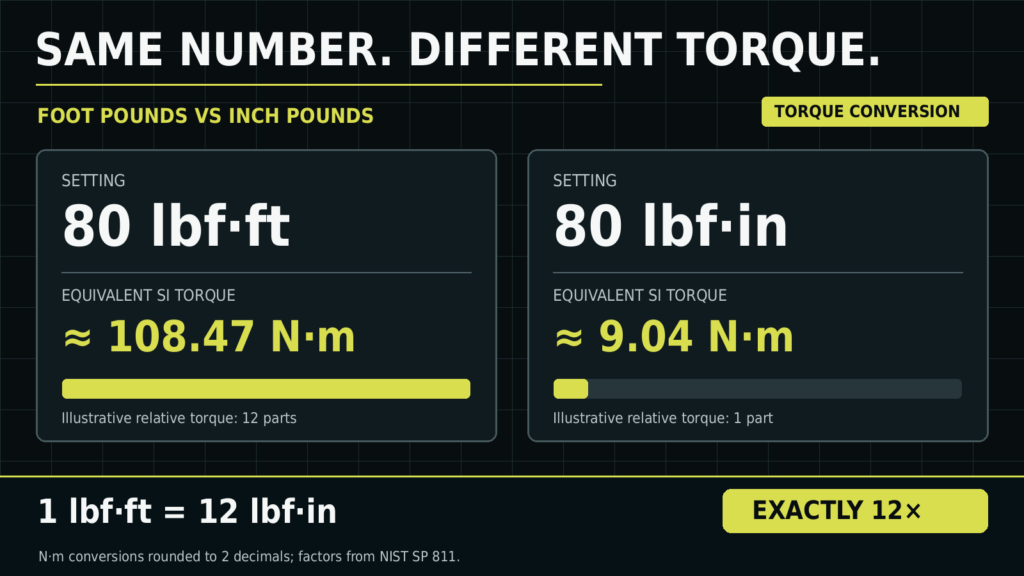
The same number does not mean the same torque. These N·m equivalents are rounded to two decimal places.
Consequently, you cannot transfer the numerical setting from one scale to another without converting it. This is particularly important when a workshop uses both large torque wrenches and low-torque screwdrivers.
Nm to ft lb conversion: a practical setting example
For example, suppose a fastener manufacturer specifies 100 N·m, but your torque wrench has only an lbf·ft scale. The correct Nm to ft lb conversion is:
100 N·m ÷ 1.355818 ≈ 73.7562 lbf·ft
Therefore, the equivalent target is approximately 73.76 lbf·ft before you round it to a setting the wrench can actually display or indicate.
If you mistakenly dial in 100 lbf·ft, that setting corresponds to approximately 135.58 N·m—or 35.58% above the specified nominal torque. In other words, the example compares nominal setpoints; it does not predict the exact torque a particular tool will deliver.
For routine work, a trusted torque conversion chart helps. Nevertheless, check the calculation, then round to the wrench’s available scale division or display resolution. Follow the fastener and tool manufacturers’ instructions when selecting the final setting.
Watch for kilogram-force and smaller torque units
In addition, some torque screwdrivers and older tools use N·cm, mN·m, kgf·cm or kgf·m. As a result, a misplaced prefix can change the intended torque dramatically:
- 100 N·cm = 1 N·m, exactly.
- 1,000 mN·m = 1 N·m, exactly.
- 1 kgf·cm = 0.0980665 N·m, exactly.
The kgf conversion uses standard gravity, 9.80665 m/s², by definition. It does not use the local gravitational acceleration at the site where someone performs a calibration. Also, never assume that a “kg” marking on a torque scale means kgf unless the manufacturer’s documentation confirms it.
How to prevent torque wrench unit conversion errors
Before tightening a critical fastener, follow this short check:
- Read the full specification. Record the required torque and its unit together.
- Identify the wrench’s unit. Check printed, stamped or engraved scale markings, or the selected electronic display mode.
- Convert only when necessary. Use an authoritative factor rather than a remembered approximation.
- Keep precision during calculation. Round once, at the end, to a setting the tool supports.
- Check the range. Make sure the target sits within the tool’s specified operating range.
- Verify the final setting. Read the scale or screen head-on and recheck the unit before applying torque.
Electronic torque wrenches may perform conversions internally. However, an electronic display cannot prevent a mistake if you select the wrong unit mode. A digital readout makes the selected number clearer, but you still need to verify the unit shown beside it.
Calibration and correct units work together
Calibration evaluates the performance of a torque wrench under defined conditions. It does not automatically detect a workshop’s incorrect unit conversion or a technician’s wrong scale selection.
Therefore, good tightening practice combines appropriate torque wrench calibration, correct unit conversion and a final check of the setting. If you remember one thing about foot pounds vs inch pounds, remember the exact 12:1 relationship. And for Nm to ft lb conversion, use the authoritative factors rather than guessing.
References
- Bureau International des Poids et Mesures (BIPM), The International System of Units (SI Brochure), 9th edition, revised June 2026. Identifies N·m as the coherent SI unit for moment of force (torque).
- National Institute of Standards and Technology (NIST), Guide for the Use of the International System of Units (SI), SP 811, Appendix B.9. Lists conversion factors for lbf·ft, lbf·in and kgf·m.
- NIST, SP 811, Appendix B: Conversion Factors. Explains published factors, rounding and precision.
A reliable torque conversion chart is useful, but checking the displayed unit is essential.
Contact us to discuss your calibration requirements.