
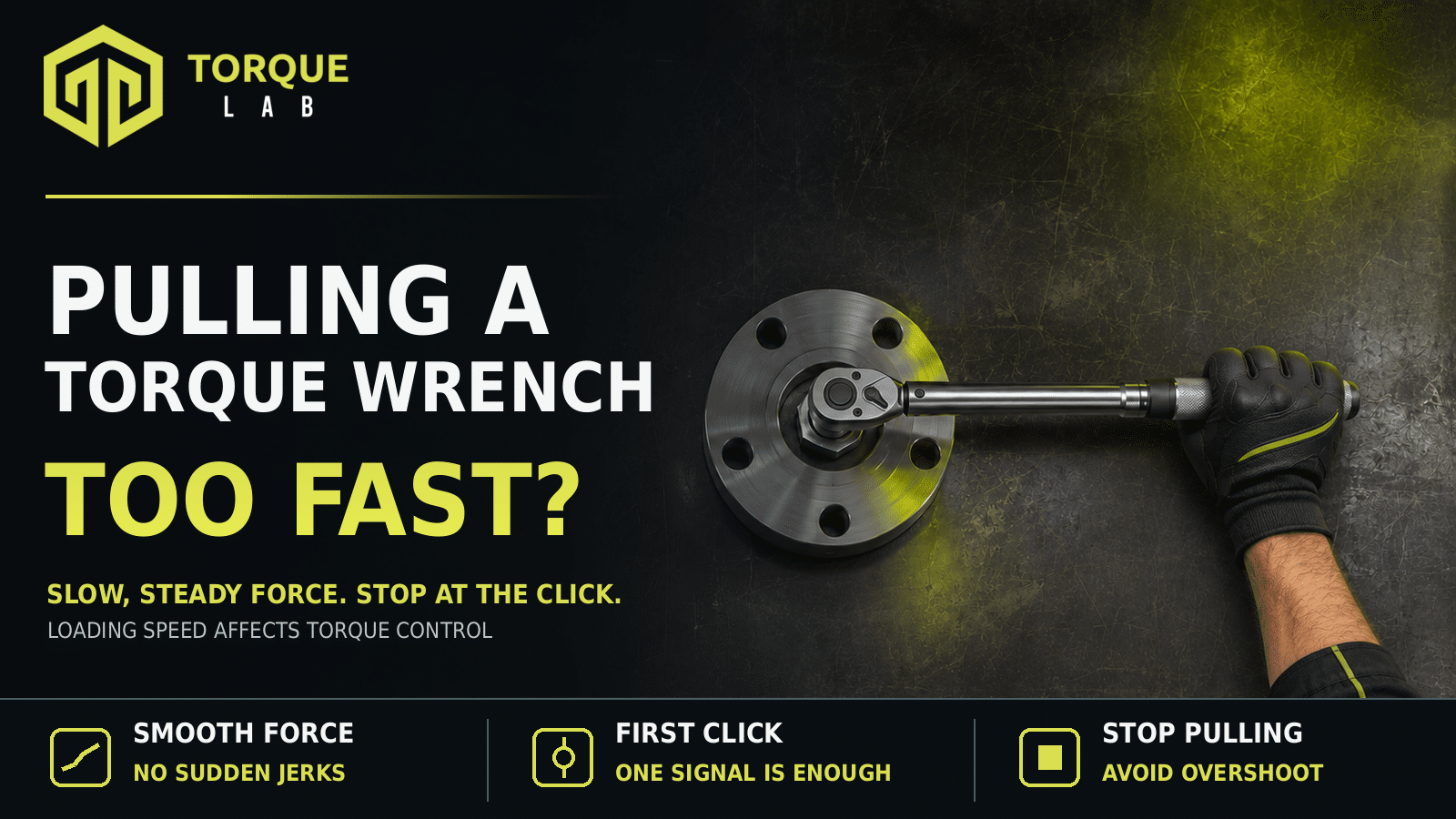
Pulling a torque wrench too fast can lead to torque overshoot: a fastener may continue to receive torque after a click-type wrench signals its set value.
Torque wrench loading speed matters because the operator needs time to react to the click and stop applying force. Even a correctly calibrated wrench cannot prevent every error in how someone uses it.
The general rule for a conventional click-type torque wrench is simple: apply force smoothly and steadily, then stop at the first click.
Why pulling a torque wrench too fast causes errors
A click-type torque wrench contains a mechanism that responds when the applied torque reaches the tool’s setting.
However, the operator supplies the force, and the mechanism cannot necessarily prevent that force from continuing into the fastener.
When someone pulls quickly or jerks the handle, torque can rise rapidly. The wrench may signal at its set value, but the operator’s hand and arm may still be moving.
Consequently, the person can continue tightening for a moment after the click and deliver more torque than intended.
This is an operator-induced error, rather than proof that the wrench itself has an incorrect calibration.
Importantly, the amount of additional torque is not a fixed percentage. It depends on the tool, joint, operator and speed of application.
The torque wrench click is a signal, not a brake
The familiar click often comes with a small movement or change in resistance at the wrench head.
It tells the operator to stop pulling immediately.
However, not all torque tools limit transmitted torque in the same way.
A conventional click-type wrench provides a signal, while certain slipping or clutch-controlled tools are specifically designed to limit further torque transmission.
Therefore, operators should understand which type of mechanism their tool uses.
A conventional torque wrench should click only once during a tightening operation. Repeatedly pulling until the tool clicks again can further turn the fastener and may increase the applied torque.
Multiple clicks do not improve the accuracy of the original tightening.
How pulling speed affects the result
The following diagram illustrates two different approaches to the same torque setting.
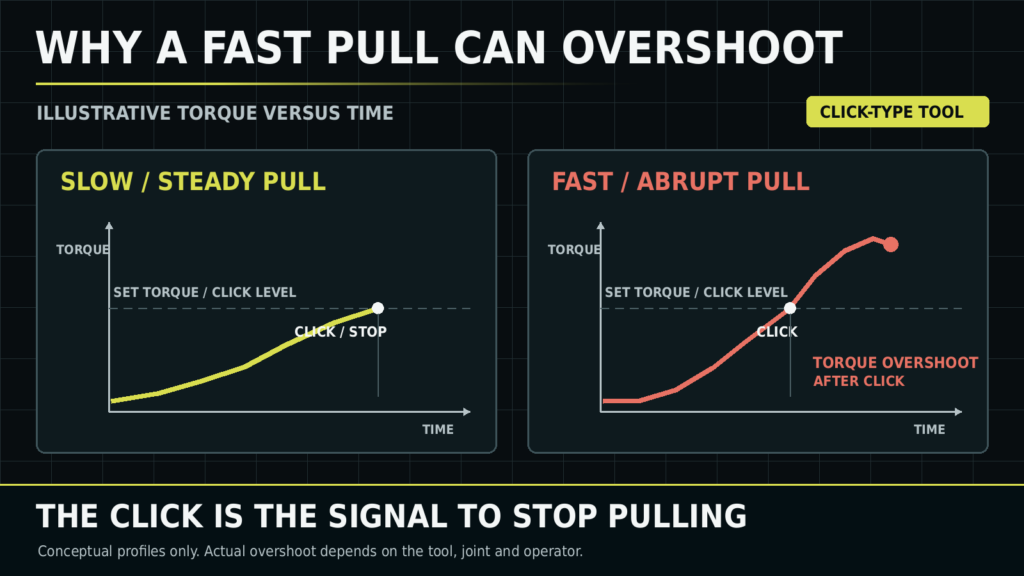
With a controlled pull, the operator increases torque steadily and stops when the wrench signals.
With an abrupt pull, torque increases more rapidly. Although the tool signals at the set value, the operator may continue applying force before reacting.
As a result, the final peak torque may exceed the intended setting.
These curves illustrate the principle rather than actual calibration measurements. The amount of overshoot varies with the tool, joint and operator.
Factors that make torque overshoot more likely
Several factors can make it harder to stop at the intended torque:
- Sudden force: A sharp pull or jerk gives the operator less opportunity to respond to the release signal.
- Joint stiffness: Torque can rise rapidly with relatively little additional rotation on a stiff joint.
- Poor access: An awkward working position can make the wrench harder to control.
- Incorrect hand position: Holding the wrench away from its specified loading point can introduce another source of error.
- Missed signals: Noise, gloves or an unfamiliar release mechanism may make a light click harder to recognise.
Consequently, two technicians using the same wrench and setting may achieve different results if their operating techniques differ.
Torque wrench loading speed during calibration
Loading rate also matters during calibration and testing.
ISO 6789-1:2017 specifies requirements and methods for conformance testing of hand torque tools.
Its testing method controls the rate at which torque increases as the tool approaches its target.
In particular, the standard addresses the time taken to apply the final 20% of the target torque. The applicable requirements depend on the tool type and torque range.
ISO 6789-2:2017 covers calibration and the determination of measurement uncertainty.
Controlled loading helps laboratories produce repeatable measurements and evaluate tool performance under defined conditions.
Some torque tools, particularly certain torque screwdrivers and release mechanisms, can show sensitivity to loading rate.
However, laboratory loading-rate requirements should not be interpreted as a universal instruction to complete every tightening operation in a fixed number of seconds.
For everyday use, operators should follow the tool manufacturer’s instructions and avoid sudden changes in force.
Can electronic torque wrenches still be pulled too fast?
Yes.
An electronic wrench may provide a digital torque reading, retain the peak measurement or produce an audible or visual signal when the target is reached.
However, these features do not necessarily prevent someone from continuing to apply force.
Some powered and clutch-controlled systems provide active torque limiting. A digital display alone does not.
Additionally, electronic torque wrenches may use different measurement modes, including peak and real-time readings.
Therefore, the correct operating technique remains important regardless of whether the tool has a mechanical or electronic display.
How to pull a torque wrench correctly
For a conventional manually operated click-type wrench, follow these steps unless the manufacturer specifies otherwise:
- Confirm the setting and units. Check the specified torque and ensure it falls within the wrench’s operating range.
- Fit the correct socket. Ensure it engages fully with the fastener.
- Use the specified loading point. Centre your hand on the marked position where the manufacturer requires it.
- Apply smooth, steady force. Avoid jerking or bouncing the wrench.
- Approach the target with control. Maintain a steady movement as the wrench nears its set value.
- Stop at the first click. Release your applied force promptly when the mechanism signals.
If you suspect that a critical fastener has been over-tightened, do not assume that simply backing it off restores the correct joint condition.
Instead, follow the assembly manufacturer’s procedure for inspection, loosening, replacement or retightening.
Why calibration alone cannot eliminate technique errors
Calibration assesses a torque wrench’s performance under defined measurement conditions.
It can identify a tool whose indication or release point differs from its setting.
However, calibration cannot ensure that every operator stops applying force at the correct moment during everyday use.
Likewise, the measurement uncertainty stated on a calibration certificate does not predict the additional torque an operator might apply after the wrench clicks.
Correct technique and appropriate calibration therefore work together.
If you need your equipment’s performance assessed, see our laboratory torque-tool services.
The takeaway: one controlled pull, one click
Pulling a torque wrench too fast increases the risk of passing the intended setting before the operator stops.
In contrast, a smooth, steady pull gives the operator more control as the tool approaches its release point.
The simplest principle is to apply torque steadily, recognise the first click and stop pulling immediately.
Contact us to discuss your calibration requirements.