
When choosing a torque wrench, one of the most overlooked specifications is accuracy class. It often looks technical on paper, but in practice it directly affects cost, performance, and whether the tool is actually suitable for your job.
So the real question is: what accuracy class do you actually need in a torque wrench?
Understanding Torque Wrench Accuracy
Torque wrench accuracy refers to how close the applied torque is to the value set on the tool. In simple terms, it tells you how much variation you can expect when using the wrench.
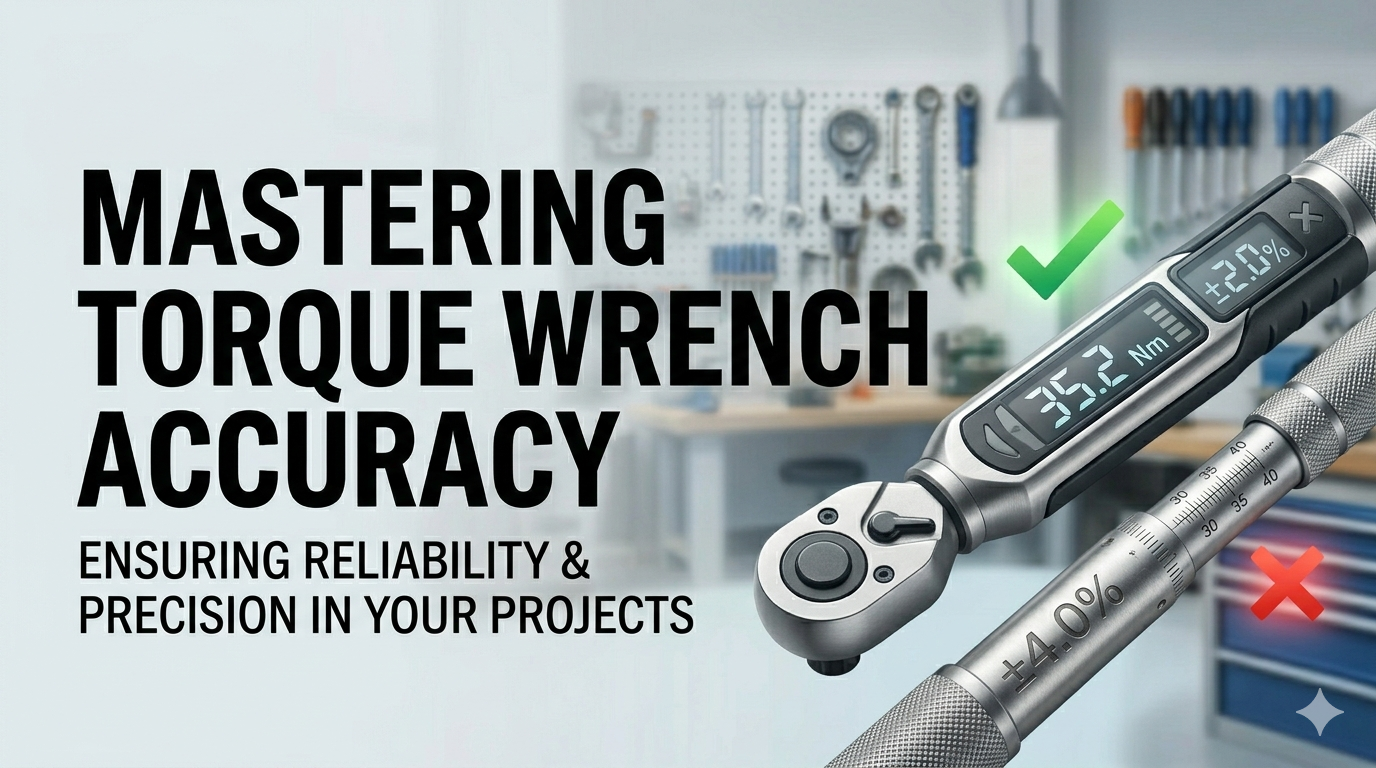
Most professional torque wrenches fall into common accuracy ranges such as ±4% or ±2%. While that difference might seem small, it can matter depending on the application.
Generally:
- ±4% is common for standard click-type torque wrenches
- ±2% is typical for higher-end or electronic torque wrenches
However, tighter accuracy is not automatically better for every situation.
What Accuracy Class Do You Actually Need in a Torque Wrench?
What accuracy class do you actually need in a torque wrench depends entirely on what you are working on.
For general mechanical work, automotive servicing, and industrial maintenance, a ±4% torque wrench is often more than sufficient. In these environments, fasteners are usually designed with a margin of safety that accounts for normal variation.
However, for more critical applications such as aerospace, precision manufacturing, or tightly controlled assembly processes, a ±2% torque wrench may be required.
In other words, the application should determine the accuracy—not the marketing specification.
When Higher Accuracy Actually Matters
Higher accuracy torque wrenches are useful when:
- fastener loads are highly critical
- safety margins are very tight
- quality systems require tighter control
- traceability requirements are strict
In these cases, reducing variation helps maintain consistency across production or maintenance tasks.
Even so, higher accuracy only matters if the rest of the system supports it, including proper calibration and correct usage.
When Standard Accuracy Is Enough
In many real-world applications, standard accuracy is completely acceptable.
For example:
- automotive workshops
- general industrial maintenance
- construction equipment servicing
- routine assembly work
In these environments, over-specifying accuracy often adds cost without delivering meaningful benefit.
Instead, consistency of use and regular calibration tend to matter more than small differences in tolerance.
The Trade-Off Between Accuracy and Cost
As accuracy improves, cost usually increases as well.
Higher accuracy torque wrenches often:
- use more sensitive internal mechanisms
- require more precise manufacturing
- involve stricter calibration requirements
As a result, you are paying for tighter control and reduced variation.
However, if your application does not require that level of precision, the extra cost may not provide any practical advantage.
Calibration Still Matters More Than Class
Regardless of accuracy class, even the best torque wrench will drift over time.
That is why calibration plays a critical role in maintaining performance.
A well-maintained ±4% torque wrench that is regularly calibrated can often outperform a poorly maintained higher-accuracy tool in real-world use.
In practice, consistency of calibration is often more important than the initial specification.
Choosing the Right Tool for the Job
To decide what accuracy class you actually need in a torque wrench, consider:
- how critical the application is
- how tight the tolerances are
- how often the tool will be used
- whether traceability is required
In many cases, a reliable, professional-grade torque wrench with standard accuracy provides the best balance of cost and performance.
Final Thoughts
What accuracy class do you actually need in a torque wrench? In most cases, you do not need the highest specification available—you need the right one for the job.
Over-specifying accuracy can increase cost without improving outcomes. Instead, focus on selecting a quality tool, using it correctly, and keeping it properly calibrated.
That combination delivers far more value than chasing the smallest possible tolerance.
Contact us to discuss your Torque Wrench requirements.