
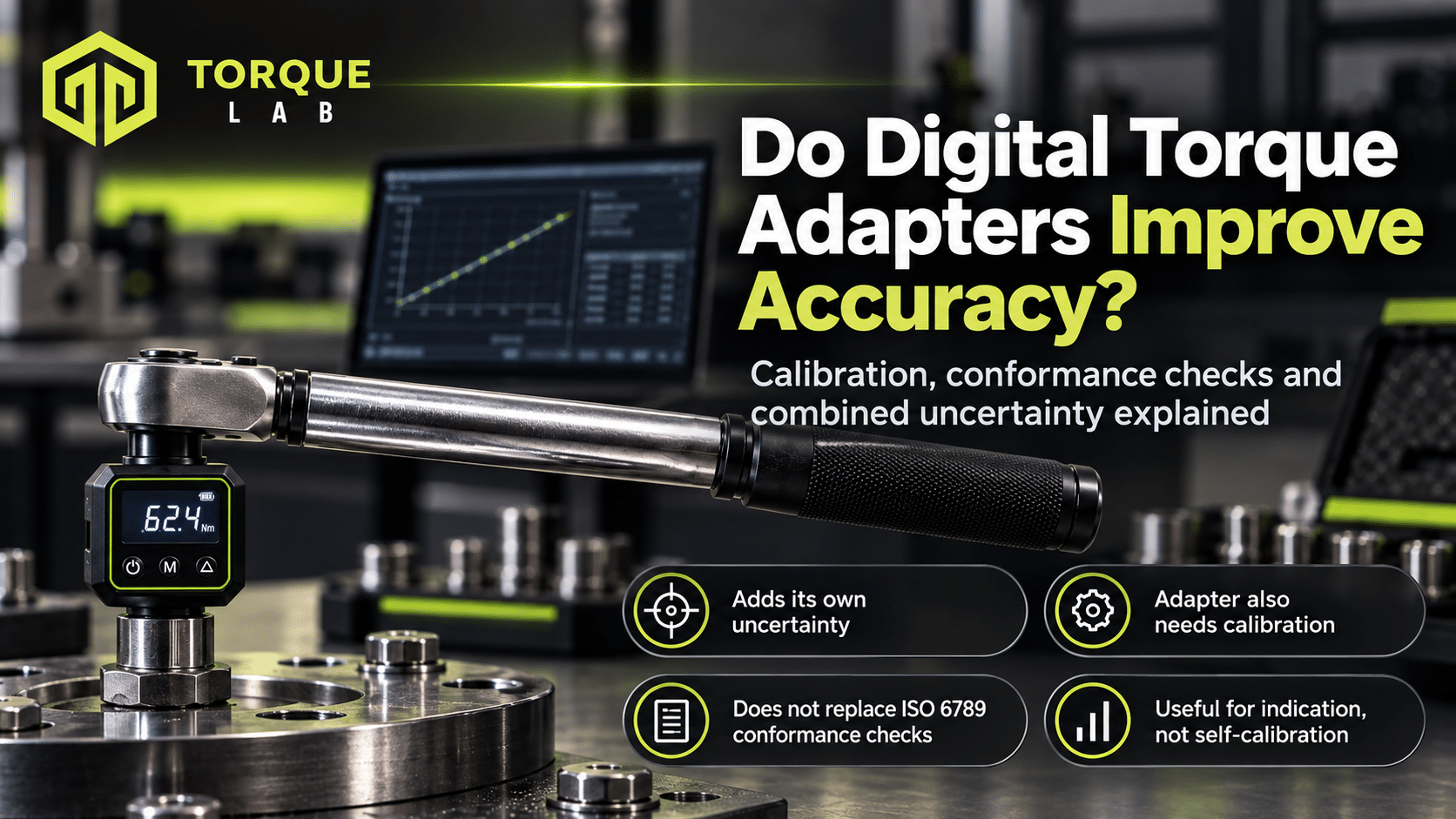
Digital torque adaptors are convenient little devices. Fit one between a ratchet and socket, apply torque, and a digital display tells you how much torque is being applied.
That naturally raises an interesting question: if you fit a digital torque adaptor to a torque wrench, does it make the torque wrench more accurate?
There is also a more important question for anyone responsible for tool compliance:
Can a digital torque adaptor replace a proper torque wrench calibration or conformance check?
The short answer to both questions is no, not automatically.
A digital torque adaptor can be useful as a checking device, a diagnostic aid, or even as the primary torque indicator when used with an ordinary ratchet. But adding a second measuring device does not magically improve the accuracy of the first one, and it certainly does not remove the need for an appropriate ISO 6789 conformance check or calibration.
What Is a Digital Torque Adaptor?
A digital torque adaptor is essentially a compact electronic torque measuring device.
One example is the Kincrome K8035 Digital Torque Adaptor, which has a range of 40–200 Nm and is currently specified by Kincrome as having an accuracy of ±2% of setting. It offers Peak and Trace modes and can store previous torque readings.
Placed between a ratchet and socket, the adaptor measures the torque passing through it.
That can be genuinely useful.
For example, an ordinary ratchet can effectively become a simple digital torque application tool, with the operator stopping when the adaptor indicates the required torque.
But things become more complicated when the adaptor is used alongside an existing torque wrench.
Does a Digital Torque Adaptor Improve Torque Wrench Accuracy?
Not necessarily.
Imagine a click-type torque wrench set to:
100 Nm
You install a digital torque adaptor between the wrench and socket.
You now have two devices involved:
- the torque wrench, which releases when its internal mechanism believes the set torque has been reached
- the digital adaptor, which independently measures the torque passing through it
The adaptor does not alter the calibration of the wrench.
If the wrench actually releases at 104 Nm when set to 100 Nm, fitting a digital display underneath it does not suddenly make the wrench release at 100 Nm.
What the adaptor can do is show you that the wrench appears to be releasing at approximately 104 Nm.
That is useful information.
It is not an improvement to the wrench’s accuracy.
What If I Use the Digital Adaptor as the Main Torque Indicator?
This is slightly different.
Suppose you fit a digital adaptor to an ordinary ratchet and ignore the ratchet as a measuring device entirely.
You then increase torque until the adaptor indicates 100 Nm.
In that arrangement, the adaptor has effectively become your torque measuring instrument.
The accuracy of the final indicated torque therefore depends primarily on the adaptor’s actual measurement performance, together with factors such as operator technique, loading rate, geometry, resolution and the fastening application itself.
But that still raises another question:
How do you know that your digital adaptor is actually measuring 100 Nm correctly?
A Digital Display Does Not Guarantee Accuracy
There is an unfortunate tendency to trust electronic equipment simply because it displays a precise number.
A display showing:
100.0 Nm
looks convincing.
But the additional decimal place tells you about resolution, not necessarily accuracy.
The actual applied torque might be:
97 Nm
or:
102 Nm
depending on the performance of the measuring system.
Electronic torque devices contain strain gauges, signal-conditioning electronics, analogue-to-digital conversion and calibration coefficients. Their performance can change with time, overload, mechanical damage, temperature and other factors.
The adaptor itself therefore needs to have known metrological performance if its readings are being relied upon.
Interestingly, Kincrome’s own K8035 instruction manual acknowledges this. It states that periodic recalibration is necessary to ensure accurate measurement and instructs the owner to take the adaptor to a specialist. It also states that recalibration is required following events such as dropping or knocking the adaptor.
So the digital adaptor is not an infallible reference standard simply because it is electronic.
Does the Digital Torque Adaptor Need Calibration?
If you are relying on its measurement, then its calibration status matters.
This becomes particularly important if you intend to use the adaptor to make decisions such as:
“My torque wrench is accurate because the adaptor says it is.”
The manufacturer’s ±2% specification describes the claimed performance of the product. It does not tell you the actual deviation of the individual adaptor sitting in your toolbox today.
A proper calibration of the measuring device provides evidence of its actual performance against suitable reference equipment.
There is therefore a slightly circular problem with attempting to use an uncalibrated adaptor to prove that another torque device is calibrated:
How do you know the device doing the checking is correct?
That question sits at the heart of measurement traceability.
Can You Calibrate a Torque Wrench With a Digital Torque Adaptor?
This is where some product marketing needs to be treated carefully.
Kincrome currently states on the K8035 product page:
“You can also use it to calibrate an existing torque wrench.”
If the word calibrate is interpreted simply as making an informal comparison, you can understand what the marketing department is trying to communicate.
But if it is interpreted as meaning that placing a torque wrench onto a K8035 constitutes a proper torque wrench calibration or ISO 6789 conformance check, that is not correct.
There is much more involved.
ISO 6789 distinguishes between a Declaration of Conformance under Part 1 and a more comprehensive calibration under Part 2.
A Part 1 conformance check determines whether a torque tool performs within its specified permissible deviation at defined points.
A Part 2 calibration goes further and includes evaluation of measurement uncertainty and additional metrological requirements. Torque Lab provides both services, depending on the level of measurement information and certification required.
Simply comparing a wrench against a handheld adaptor does not reproduce the complete ISO 6789 process.
Why Self-Checking Is Not the Same as a Conformance Check or Calibration
We have previously looked in detail at the problems associated with attempting to calibrate a torque wrench yourself.
One of the biggest problems is that apparently simple torque measurements are surprisingly sensitive to how the load is applied.
A makeshift arrangement may introduce:
- side loads
- bending forces
- wrench weight effects
- incorrect loading position
- inconsistent loading rates
- poor alignment
- unstable fixtures
- uncontrolled environmental conditions
- uncertainty in the reference measurement
- insufficient preload cycles or repetitions
Professional torque calibration equipment is specifically designed to control or minimise these effects.
A digital torque adaptor does not make those problems disappear.
What Happens to Measurement Uncertainty?
This is where things become particularly interesting.
When you use one measuring device to assess another, the reference device itself contributes uncertainty to the measurement.
It is tempting to say:
“The wrench is ±4% and the adaptor is ±2%, therefore the combination is ±6%.”
That is not how a proper measurement uncertainty calculation is normally performed.
Independent uncertainty contributions are commonly combined using the root-sum-of-squares method.
A simple hypothetical example makes the point.
Example: Checking a Torque Wrench at 100 Nm
Imagine we are trying to determine the torque at which a wrench operates.
For illustration, suppose the uncertainty budget contains:
| Contribution | Standard uncertainty |
|---|---|
| Digital torque adaptor/reference | 1.15 Nm |
| Repeatability of readings | 0.50 Nm |
| Resolution and other minor effects | 0.10 Nm |
The combined standard uncertainty would be:
Therefore:
If an expanded uncertainty were then calculated using a coverage factor of approximately :
At a nominal torque of 100 Nm, that represents an illustrative expanded uncertainty of approximately:
±2.5%
The precise uncertainty budget for a real calibration would contain the actual relevant contributions and appropriate probability distributions. This simple example is intended only to show why adding another measuring device does not give you “free accuracy”.
The reference device itself contributes uncertainty.
But Isn’t the Kincrome Adaptor Specified at ±2%?
Yes, but there is an important distinction between an accuracy specification and calibration uncertainty.
Kincrome currently specifies the K8035 at ±2% of setting over its 40–200 Nm range.
At 100 Nm, ±2% corresponds to a permissible error band of:
So based purely on that specification, an indicated 100 Nm could potentially correspond to something within the manufacturer’s stated range around that value.
But we cannot simply declare:
A manufacturer’s tolerance specification and a laboratory measurement uncertainty are not the same thing.
To establish the uncertainty associated with the individual adaptor, we would need appropriate calibration information and an uncertainty evaluation.
This distinction becomes particularly important when deciding whether the reference equipment is suitable for a torque wrench conformance check or calibration.
Can Adding the Adaptor Actually Make Things Worse?
Potentially, but again the answer needs some nuance.
The adaptor does not necessarily make the actual torque mechanically less accurate simply because it is installed.
However, if someone claims that the combined wrench-and-adaptor measurement system is more accurate, there must be evidence supporting that claim.
You have introduced another device with:
- its own calibration error
- its own measurement uncertainty
- its own resolution
- its own temperature sensitivity
- its own repeatability
- its own mechanical interfaces
You have also added another connection between the wrench and socket.
In some installations, changing the effective geometry of the torque system can also matter. This is particularly important where an adaptor or extension changes the effective lever length rather than remaining coaxial with the wrench.
So “more measuring equipment” does not automatically mean “more accurate measurement”.
Metrology rarely gives away free lunches.
Can a Digital Torque Adaptor Replace a Torque Wrench Conformance Check?
No.
A digital adaptor can be a useful intermediate check.
For example, suppose a wrench normally releases at approximately 100 Nm on your adaptor.
Several months later it suddenly appears to release at 112 Nm.
That is valuable information.
It would be entirely reasonable to remove the wrench from service and arrange an appropriate conformance check or calibration.
But the adaptor check does not itself provide the same evidence as an ISO 6789 assessment.
For many torque wrenches, an ISO 6789-1 Declaration of Conformance is the appropriate service. It verifies that the tool operates within its specified tolerance at the required test points.
Where a more detailed metrological assessment and measurement uncertainty are required, an ISO 6789-2 calibration is the appropriate option.
This is why we generally use the phrase conformance check or calibration rather than treating every torque wrench test as exactly the same service.
When Is a Digital Torque Adaptor Useful?
None of this means digital torque adaptors are bad products.
Quite the opposite.
They can be extremely handy for:
- converting an ordinary ratchet into an indicating torque tool
- quick comparative checks
- troubleshooting a torque wrench that appears suspicious
- checking for obvious changes between scheduled conformance checks or calibrations
- providing an additional torque indication
- measuring approximate breakaway torque
- workshop diagnostics
- identifying a wrench that may need to be removed from service
The key is understanding what the measurement does and does not prove.
If a regularly checked or calibrated adaptor suddenly shows that a wrench which normally operates around 100 Nm is now releasing around 115 Nm, that is useful diagnostic evidence.
But it still does not turn the workshop comparison into an ISO 6789 conformance check or calibration.
A Torque Adaptor Is Also a Measuring Instrument
Perhaps the easiest way to view a digital torque adaptor is to stop thinking of it as an accessory and start thinking of it as a torque measuring instrument.
Once you rely on its numerical reading, questions naturally follow:
- When was it last calibrated?
- What was its measured error?
- What is its measurement uncertainty?
- Has it been overloaded?
- Has it been dropped?
- Is it suitable for the torque range being measured?
- Is its resolution adequate?
- Is the setup applying torque correctly?
Those are exactly the kinds of questions we ask about any other torque transducer or reference measuring device.
Kincrome’s own instructions reinforce this point by describing the K8035 as a precision instrument and specifically calling for periodic recalibration.
Does Using an Adaptor Mean My Torque Wrench No Longer Needs Testing?
No.
If the torque wrench remains a controlled torque application tool in your quality system, its performance still needs to be established at the appropriate interval.
A second display does not change the internal mechanism of the wrench.
Springs still fatigue.
Lubrication still changes.
Components still wear.
Tools still get dropped.
Click mechanisms still drift.
Electronic torque wrenches still contain sensors and electronics that can move outside specification.
Regular conformance checks or calibrations provide evidence that the wrench itself continues to perform correctly.
Torque Lab generally recommends a 12-month starting interval for many applications, although usage, risk, manufacturer requirements and quality-system requirements may justify a different interval.
The Bottom Line
A digital torque adaptor can be an excellent workshop tool.
But there are three important things it does not automatically do:
It does not make an inaccurate torque wrench accurate.
It does not eliminate measurement uncertainty.
It does not replace an appropriate ISO 6789 conformance check or calibration.
If you use the adaptor as a measuring device, then the performance and calibration status of the adaptor itself also become relevant.
And although a manufacturer may describe an adaptor as being suitable for “calibrating” an existing torque wrench, an informal comparison against a handheld adaptor should not be confused with a formal torque wrench calibration or Declaration of Conformance carried out using suitable reference equipment and procedures.
A digital adaptor is best viewed as another useful measurement tool in the workshop.
Used properly, it can help identify problems.
Used incorrectly, it can simply add another very convincing-looking number to the measurement chain.
Need Your Torque Wrench Checked?
Torque Lab provides both ISO 6789-1 Declaration of Conformance testing and ISO 6789-2 torque wrench calibration, allowing the level of testing to be matched to your actual technical and quality requirements. Contact us today to discuss your torque requirements.