
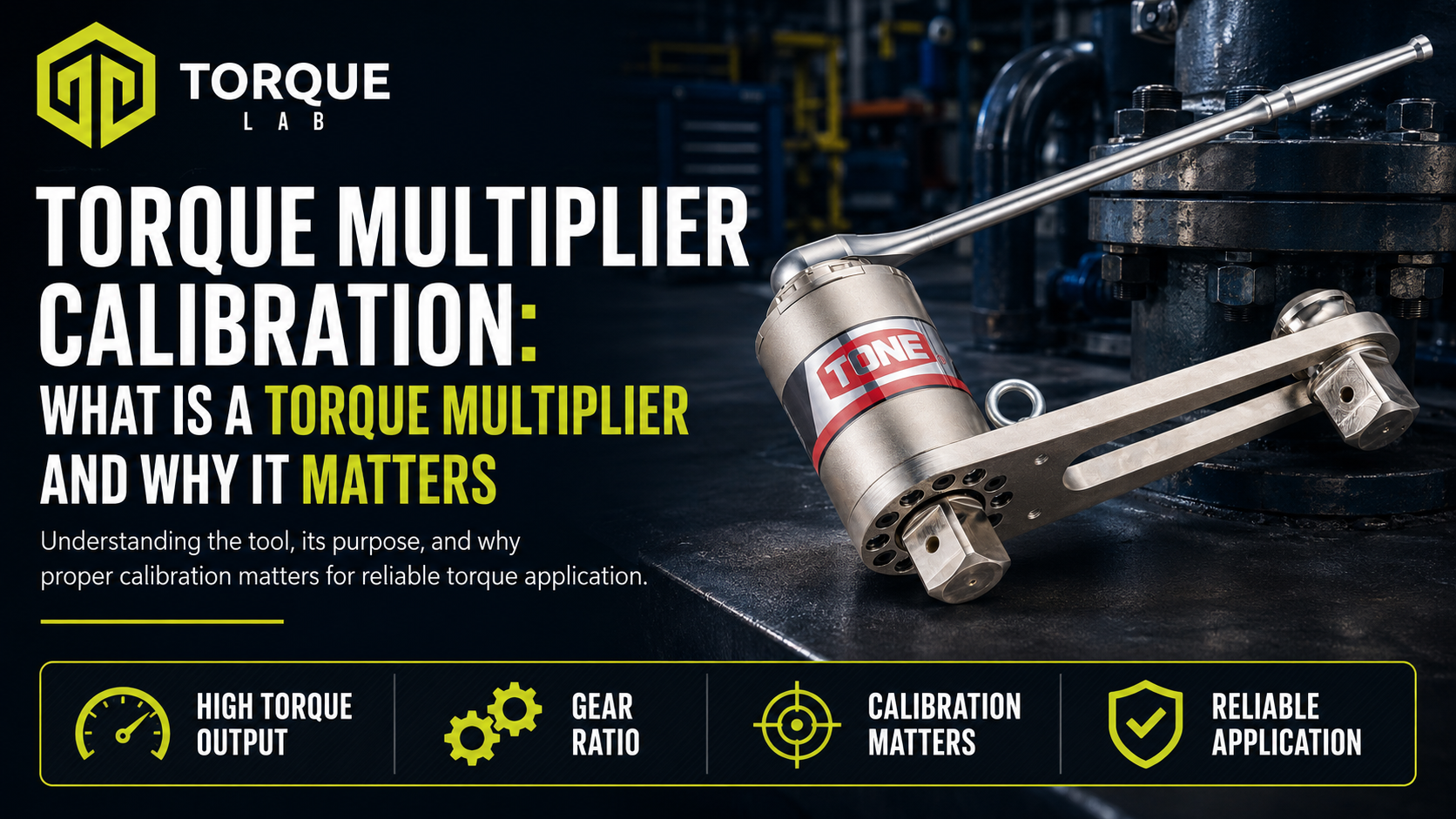
Torque multiplier calibration is essential if you want to rely on a torque multiplier for accurate results. A torque multiplier increases torque through a gear system, but its performance depends on how accurately that system maintains its ratio. Right from the start, it’s important to understand both how the tool works and why calibration plays a critical role.
How a torque multiplier works
A torque multiplier uses an internal gearbox—usually a planetary gear system—to increase the torque applied at the input.
In simple terms, you apply torque with a wrench, and the multiplier increases that torque at the output.
This relationship is defined by the gear ratio:
For example, a 4:1 multiplier converts 100 Nm input into 400 Nm output.
However, the tool also requires a reaction arm. This arm braces against a fixed point and prevents the multiplier from rotating under load. Without it, the system cannot transfer torque effectively.
Why the gear ratio is not always exact
Although manufacturers specify a gear ratio, real-world performance can vary. Manufacturing tolerances, internal friction, and wear all influence how accurately the multiplier delivers its stated ratio.
As a result, the actual output torque may differ slightly from the expected value.
This is exactly why torque multiplier calibration becomes necessary.
What torque multiplier calibration involves
Torque multiplier calibration verifies how accurately the tool reproduces its gear ratio.
During calibration, a technician measures:
- Input torque applied to the multiplier
- Output torque delivered by the multiplier
- Performance across multiple points in the operating range
This process reveals how closely the tool matches its nominal ratio. If deviations exist, the calibration report captures them so users can account for the difference.
Why torque multiplier calibration is necessary
Over time, several factors can affect multiplier performance. For example:
- Gear wear changes internal contact surfaces
- Friction increases or decreases depending on condition
- Backlash develops within the gear train
- Overloading can damage internal components
Because of this, a multiplier does not remain perfectly stable throughout its life.
Without torque multiplier calibration, these changes can lead to incorrect torque being applied. In turn, this creates a risk of under-tightening or over-tightening critical fasteners.
How torque multiplier calibration affects system accuracy
In most cases, a torque multiplier works alongside a torque wrench. Therefore, the final torque depends on the combined performance of both tools.
This includes:
- Torque wrench accuracy
- Multiplier ratio accuracy
- Setup conditions such as alignment and reaction point stability
Even if the torque wrench performs well, the multiplier can still introduce additional uncertainty. Consequently, regular torque multiplier calibration ensures the entire system remains reliable.
When calibration becomes especially important
Some applications demand tighter control than others. In particular, calibration becomes more critical when:
- Fasteners require strict torque tolerances
- Work must meet compliance or audit requirements
- Repeatability matters across multiple jobs
- High torque values amplify small percentage errors
In these situations, relying on an unverified multiplier is a risk that is easy to avoid.
Practical takeaway
A torque multiplier offers a straightforward way to achieve high torque. However, its accuracy depends on the condition and performance of its internal gearing.
For this reason, torque multiplier calibration should not be overlooked. Instead, it should be treated as a routine part of maintaining torque equipment.
Conclusion
Torque multipliers extend the capability of torque wrenches, but they also introduce another layer of uncertainty. By understanding how the gear ratio works and maintaining regular torque multiplier calibration, you can ensure consistent and reliable torque application.
Contact us to discuss your torque calibration requirements.