
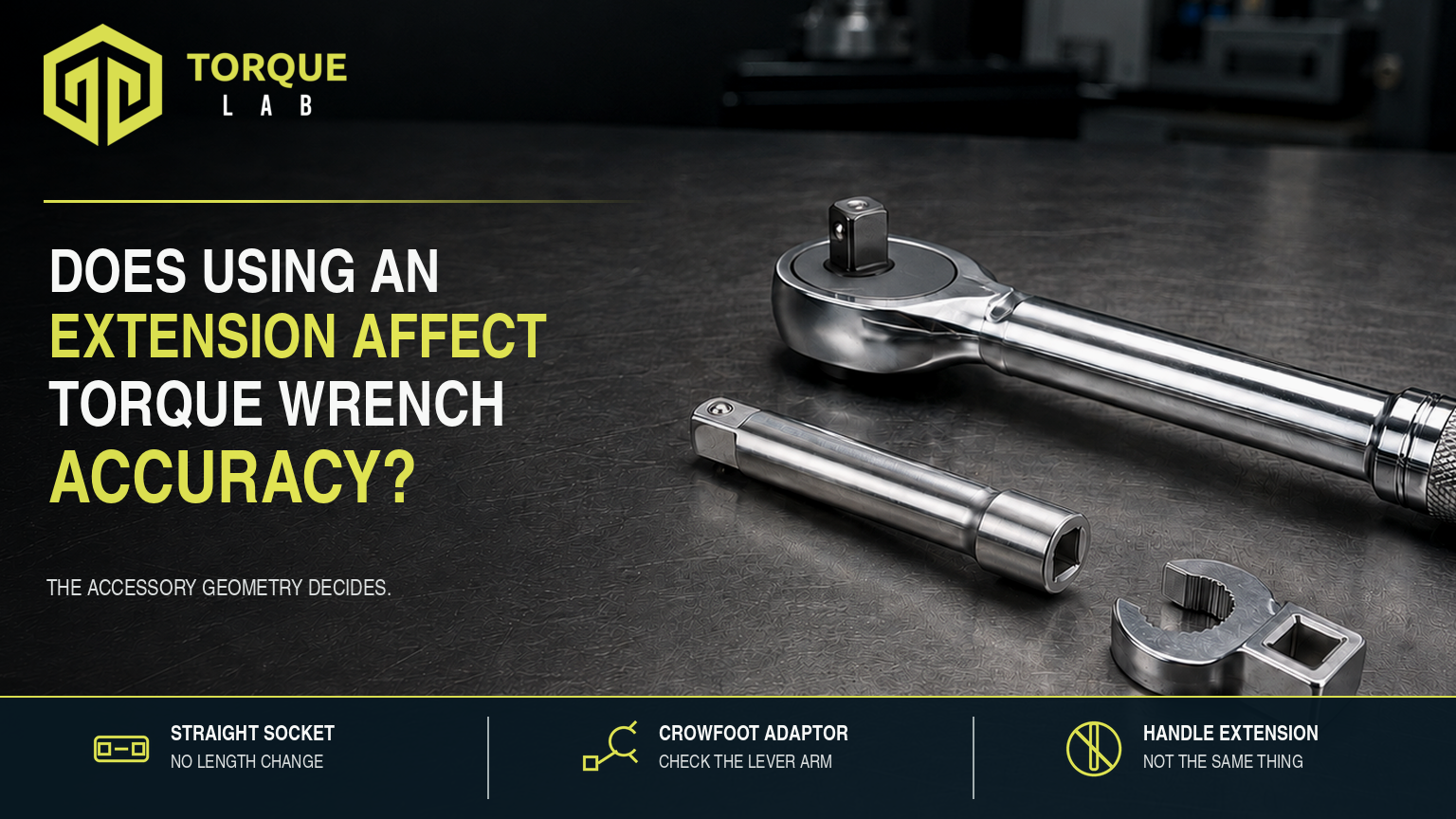
Torque wrench extension accuracy depends on what you attach and where it changes the tool’s geometry. A straight socket extension usually leaves the reading unchanged, while a crowfoot adaptor can alter the effective lever arm and require a torque setting calculation. Therefore, before using an extension on a torque wrench or tension wrench, identify whether it moves the fastener away from the square-drive axis or merely moves the socket along that axis.
Does using an extension affect torque wrench accuracy?
The short answer is: sometimes.
A conventional socket extension projects outward from the square drive along the fastener’s axis. Consequently, it does not lengthen the torque wrench in the direction that creates leverage. You normally use the same torque setting.
However, a crowfoot adaptor, dog-bone adaptor or another offset fitting can move the fastener centreline farther from—or closer to—the handle. That change alters the effective lever arm. As a result, the torque at the fastener can differ from the value shown on the wrench.
A tube fitted over the handle creates a third situation. It changes where the operator applies force and may overload or misuse the wrench. Therefore, never treat a handle extension as equivalent to a socket extension.
What does “extension” mean?
People often use the same word for accessories that work in completely different ways. First, identify which of these arrangements you have.
Straight socket extension
A straight socket extension fits between the square drive and the socket. It moves the socket farther away from the wrench head, but it keeps the fastener on the same rotational axis. Therefore, the socket extension does not add length to the handle’s leverage in the normal torque plane.
Offset adaptor or crowfoot
A crowfoot adaptor moves the point of torque application sideways from the wrench’s square drive. If the crowfoot points forward in line with the handle, it increases the working length. Conversely, if it points back towards the handle, it reduces that length.
Handle or cheater-bar extension
A handle extension moves the operator’s hand beyond the intended loading point. This arrangement can change the tool’s behaviour, encourage overloading and damage components. In addition, it takes the wrench outside the use intended by many manufacturers.
Why a socket extension usually needs no correction
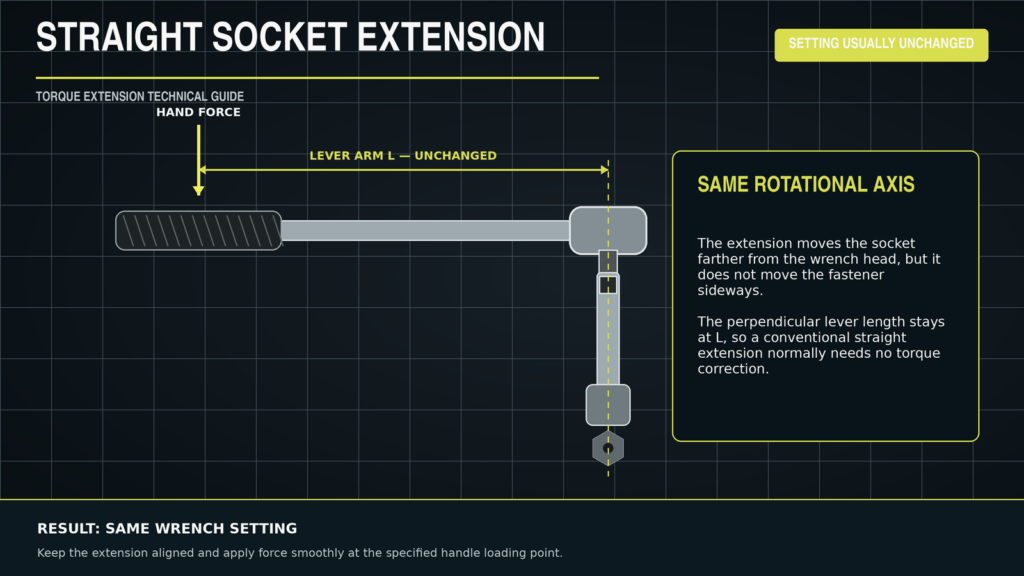
Torque equals force multiplied by the perpendicular distance from the turning axis. A normal socket extension changes the distance between the wrench and the fastener along the rotational axis, not the perpendicular lever length. Therefore, it does not create the simple leverage increase that an inline offset fitting creates.
Nevertheless, a long or slender socket extension can twist elastically under load. That twist may change how the pull feels and may require more angular movement before the wrench clicks. However, elastic twist alone does not create a new lever-arm ratio. At a stable load, the extension still transmits torque about the same axis.
Operator technique can still cause problems. For example, a poorly supported socket extension may tilt the wrench, introduce side loading or make the operator jerk the handle. Consequently, the practical result may become less repeatable even though the nominal torque setting remains correct.
In short, a straight socket extension normally needs no setting correction, but it still needs sound alignment and smooth operation.
How a crowfoot adaptor changes the effective lever arm
A crowfoot adaptor can change torque because it moves the fastener centre away from the wrench’s square-drive centre. The direction of the adaptor matters as much as its physical length.
When the crowfoot sits straight ahead of the wrench, the adaptor increases the effective lever arm. Therefore, the fastener receives more torque than the scale indicates if the operator leaves the original setting unchanged.
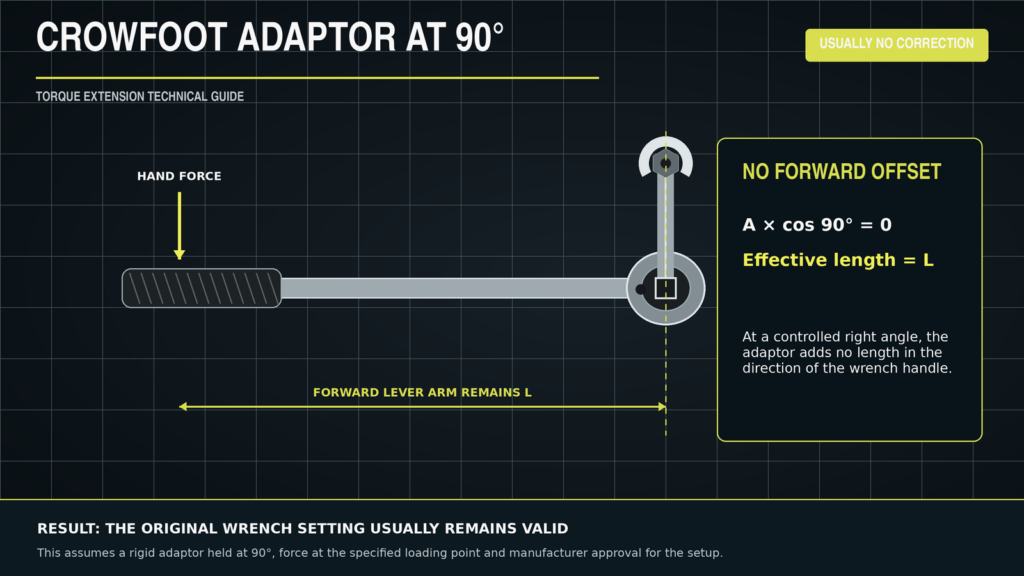
When the crowfoot sits at 90 degrees to the wrench, its length usually adds no forward component to the lever arm. In that common arrangement, the wrench setting normally remains unchanged. However, you should still follow the tool or adaptor manufacturer’s instructions because unusual head geometry, flexible joints or a different loading method can change the assumptions.
If the crowfoot points back towards the handle, it shortens the effective lever arm. Consequently, the required wrench setting can become higher than the desired fastener torque. Do not guess the correction from appearance alone.
Torque wrench extension formula for an inline adaptor
For a rigid crowfoot adaptor mounted directly in line with the wrench, use this torque setting calculation:
Adjusted wrench setting = desired fastener torque × wrench length ÷ (wrench length + adaptor length)
Use the same length unit for both measurements. Measure:
- the wrench length from the centre of the square drive to the centre of the specified hand-loading position; and
- the adaptor length from the centre of the wrench drive connection to the centre of the fastener.
For example, assume you need 100 N·m at the fastener. The torque wrench measures 400 mm from the square-drive centre to the loading point, while the inline crowfoot adaptor adds 50 mm.
Adjusted setting = 100 N·m × 400 mm ÷ 450 mm = 88.9 N·m
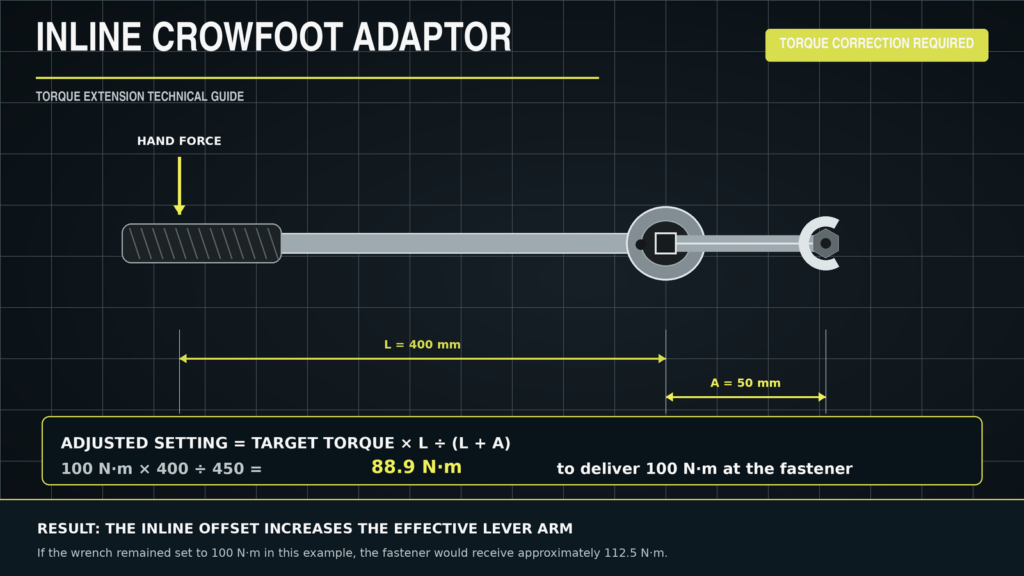
Therefore, set the wrench to approximately 88.9 N·m to produce 100 N·m at the fastener under those geometric assumptions. If you instead set the wrench to 100 N·m, the longer effective lever arm would produce approximately 112.5 N·m at the fastener.
This torque setting calculation assumes a rigid adaptor, a known loading point and force applied correctly to the handle. Moreover, it assumes the adaptor sits inline with the wrench. For other angles, use the manufacturer’s approved method or calculate the forward component of the offset only when your procedure supports that approach.
When an adaptor correction becomes unreliable
A simple formula cannot describe every accessory arrangement. Therefore, stop and review the setup when it includes:
- a universal joint, wobble joint or flexible extension;
- several adaptors connected together;
- an adaptor that bends or twists significantly;
- an uncertain hand-loading point;
- an offset that cannot remain at a controlled angle;
- a powered tool or digital system with its own accessory-compensation function; or
- a safety-critical procedure that specifies approved tooling.
In these situations, the effective lever arm may change during the pull. Also, friction, angular movement and side loading may influence the result. A basic crowfoot adaptor formula may then create false confidence.
The ISO overview of ISO 6789-1 describes the standard’s application to hand torque tools used for controlled tightening. However, the equipment manufacturer and the task procedure still determine how you should use a particular accessory in service.
Why a handle extension is different
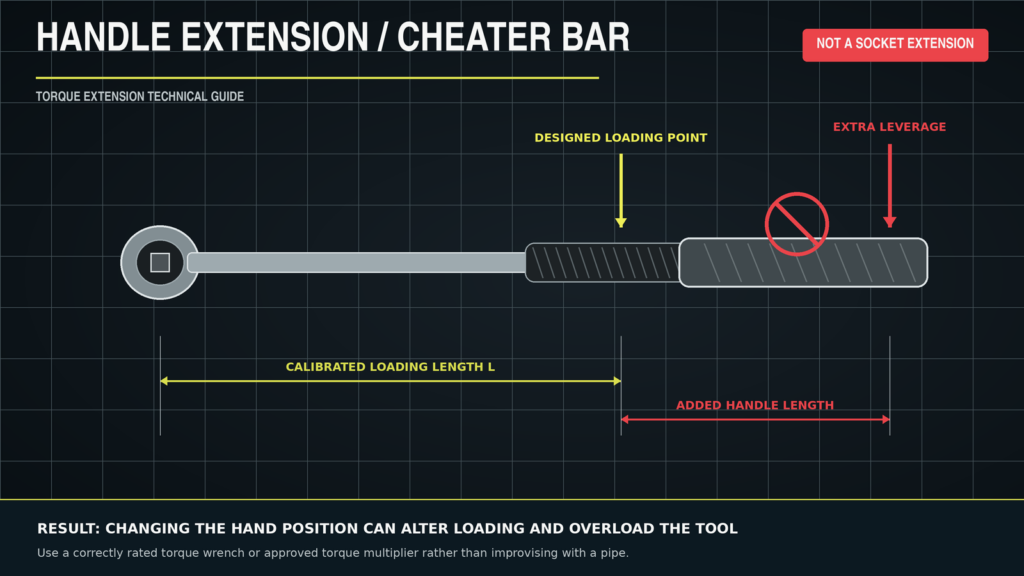
Never slide a pipe over the handle simply because the required torque feels difficult to reach. A cheater bar does not behave like a socket extension. Instead, it changes the loading position and can place excessive force into the ratchet, handle, spring or release mechanism.
Moreover, many torque wrenches rely on force applied through a designated grip or marked loading point. Moving beyond that location may alter the relationship between the applied force and the tool’s response. For this reason, use a wrench with the correct capacity or use suitable torque-multiplication equipment rather than improvising.
Our guide to the correct handle loading point explains why hand position deserves the same attention as the accessory fitted to the head.
Practical checks before using any extension
Before tightening a critical fastener, work through the setup in a consistent order:
- Identify the accessory. Confirm whether you have a straight socket extension, offset adaptor, crowfoot adaptor or handle extension.
- Check the square drives. Ensure the drive sizes match and the detents engage correctly.
- Confirm the geometry. Measure the effective lever arm when the adaptor shifts the fastener centreline.
- Complete the torque setting calculation. Record the lengths, target torque and adjusted setting when your procedure requires a correction.
- Control the adaptor angle. Keep the crowfoot in the calculated position throughout the pull.
- Use the correct loading point. Apply force at the centre of the specified grip area.
- Pull smoothly. Avoid jerking the handle or continuing to pull after a click-type wrench releases.
- Follow the manual. The manufacturer may restrict particular accessories or provide a model-specific correction method.
In addition, inspect the socket extension and adaptor for wear, cracking, rounded drive corners or distortion. Damaged accessories can introduce movement and increase the chance of a sudden release.
Does an extension change the wrench’s calibration?
An accessory does not normally alter the calibration stored within the torque wrench. Instead, it changes the relationship between the wrench indication and the torque that reaches the fastener.
That distinction matters. Calibration evaluates the wrench under defined conditions. However, an incorrect field setup can still produce the wrong fastener torque even when the wrench itself performs correctly.
Therefore, tell the calibration laboratory when a dedicated adaptor forms a permanent part of your working setup. The laboratory can then discuss whether you need the wrench assessed by itself, the complete assembly checked, or a documented correction for field use. This approach protects torque wrench extension accuracy without confusing an accessory correction with adjustment of the wrench.
Common extension mistakes
The most frequent mistakes include:
- applying a correction to a normal socket extension when no lever length changed;
- using an inline crowfoot adaptor without reducing the wrench setting;
- assuming every 90-degree arrangement needs no correction without checking the manual;
- measuring wrench length to the end of the handle instead of the specified loading point;
- mixing millimetres and inches in one torque setting calculation;
- allowing the crowfoot angle to move during tightening; and
- using a handle extension to exceed the wrench’s rated capacity.
Consequently, the word “extension” is not enough information. The geometry decides whether the setting changes.
The bottom line on torque wrench extension accuracy
A straight socket extension normally leaves the torque setting unchanged because it does not change the effective lever arm. In contrast, a crowfoot adaptor or other offset fitting can require a calculated correction. A handle extension creates a separate misuse and loading issue rather than a normal adaptor correction.
Overall, confirm the accessory type, measure from the correct centres, keep the angle controlled and follow the manufacturer’s procedure. If the setup changes the effective lever arm, complete the torque setting calculation before tightening the fastener.
Contact us to discuss your calibration requirements.