
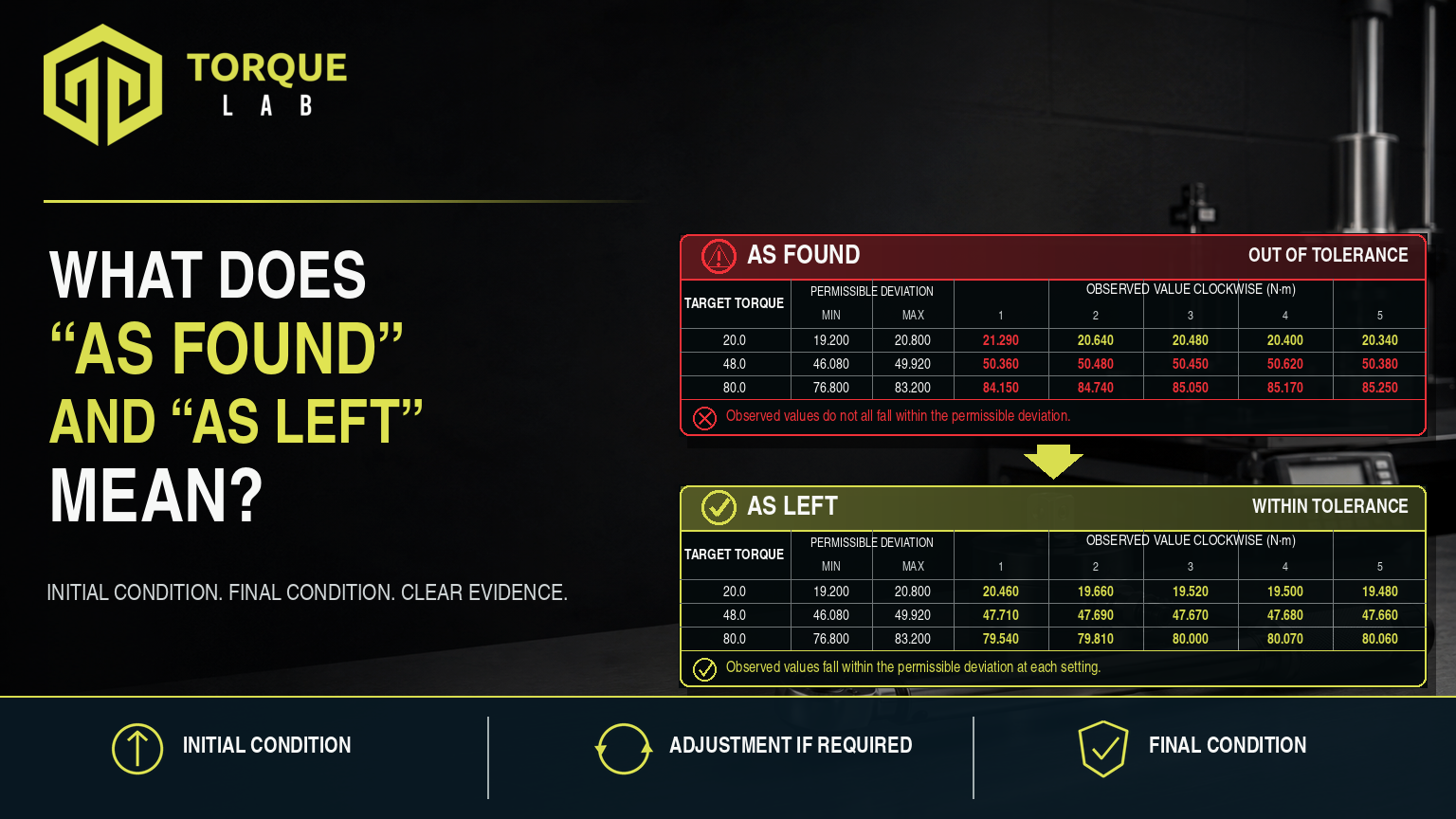
If you have ever looked closely at a torque wrench calibration certificate, you may have seen two sets of results labelled “As Found” and “As Left”.
At first glance, they can look like two versions of the same test. However, they tell you two very different things about the condition of the torque wrench.
As Found and As Left torque wrench calibration results show how the tool performed when it arrived for testing and how it performed when it left the laboratory. When a torque wrench requires adjustment or repair, having both sets of results provides an important record of what changed.
More importantly, the As Found result can tell you something that the final passing result cannot: what condition was the torque wrench actually in while you were using it?
What Do As Found and As Left Mean?
The simplest explanation is:
- As Found means the condition and performance of the torque wrench before adjustment or repair.
- As Left means its condition and performance after any required adjustment, repair and subsequent testing.
Therefore, As Found and As Left torque wrench calibration results provide a before-and-after record.
For example, a torque wrench may arrive at the laboratory applying significantly less torque than its setting indicates. The technician records those initial results as the As Found data.
If the wrench can be adjusted, the technician then corrects the tool and tests it again. Those subsequent measurements become the As Left results.
The two sets of data should remain separate because each serves a different purpose.
What Are As Found Torque Wrench Results?
As Found results record how the torque wrench performs before the laboratory makes changes to it.
This is effectively a snapshot of the tool in the condition in which the customer supplied it.
The technician should therefore avoid adjusting the tool before obtaining the relevant initial measurements where As Found data is required. Otherwise, valuable information about the tool’s previous condition may be lost.
An As Found test may reveal that the torque wrench is:
- within its specified tolerance;
- consistently reading high;
- consistently reading low;
- acceptable at some test points but outside tolerance at others;
- inconsistent or poorly repeatable; or
- showing signs that adjustment, servicing or repair may be required.
For businesses operating a controlled torque program, this information can be extremely useful.
Why As Found Results Matter
Imagine that a torque wrench is tested and found to be applying 5% less torque than expected.
If the laboratory simply adjusts it and issues a certificate showing that the wrench now performs correctly, the customer only knows the condition of the tool after the intervention.
The original problem has disappeared from view.
By recording the As Found results, the certificate preserves evidence of the wrench’s condition before adjustment.
This matters because an out of tolerance torque wrench may have been used on components before anyone knew that its performance had changed.
However, an out-of-tolerance As Found result does not automatically prove that every fastener previously tightened with the tool is incorrect.
There are too many other variables involved, including the torque setting used, the magnitude and direction of the error, fastener friction, joint design and the actual applications for which the wrench was used.
Instead, the As Found data gives the organisation evidence it can use to decide whether any further review is necessary.
For more detail, see our guide to what happens when a torque wrench fails calibration.
What Are As Left Torque Wrench Results?
As Left results show how the torque wrench performed at the completion of the laboratory work.
If the tool required torque wrench adjustment, servicing or repair, the As Left results show the performance achieved after that work.
For example, the sequence might be:
- Inspect and test the torque wrench.
- Record the As Found results.
- Determine that the wrench is outside its applicable limits.
- Adjust or repair the wrench.
- Exercise and retest the tool as required.
- Record the As Left results.
- Issue the relevant certificate or report.
Therefore, the As Left data answers the practical question:
How was the torque wrench performing when it was returned to the customer?
A Simple As Found and As Left Example
Consider a simplified example involving a torque wrench tested at a nominal setting of 100 N·m.
For illustration, assume the applicable acceptance limits are ±4%, giving a range from 96 N·m to 104 N·m.
| Test stage | Result | Interpretation |
|---|---|---|
| As Found | 94.9 N·m | Below the assumed acceptance limit |
| Adjustment performed | — | Tool corrected |
| As Left | 100.1 N·m | Within the assumed acceptance limit |
The final 100.1 N·m result is useful because it shows the tool’s performance after adjustment.
However, the 94.9 N·m As Found result is equally important because it preserves evidence that the wrench arrived applying less torque than expected.
That is why As Found and As Left torque wrench calibration should not be viewed simply as a pass result followed by another pass result. They document two different stages in the history of the tool.
This example is intentionally simplified. A formal calibration may also require multiple measurements, multiple torque settings and consideration of measurement uncertainty.
Does Every Torque Wrench Certificate Need As Found and As Left Results?
Not necessarily.
If a torque wrench is tested and performs satisfactorily without adjustment, there may be no meaningful difference between its incoming and outgoing condition.
Depending on the service performed and the laboratory’s reporting procedure, a separate As Left dataset may therefore be unnecessary.
The distinction becomes particularly valuable when something changes between the initial test and the final result.
For example:
- the wrench requires adjustment;
- components are replaced;
- the mechanism requires repair;
- servicing affects performance; or
- testing identifies a significant initial error.
In these situations, recording both stages creates a much clearer history.
As Found and As Left Does Not Mean Calibration and Adjustment Are the Same Thing
This distinction is important.
Calibration and adjustment are different processes.
Calibration determines the relationship between the torque wrench indication or setting and the reference torque measurement.
Adjustment physically changes the tool to improve its performance.
Therefore, a laboratory may calibrate or test a wrench and determine that it is outside tolerance without immediately changing it.
Once the initial results have been recorded, the wrench may then be adjusted and subsequently tested again.
That second set of measurements establishes its new condition.
Put simply:
As Found records what was measured. Adjustment changes the tool. As Left records what happened afterwards.
Keeping those concepts separate makes a torque wrench calibration certificate much easier to interpret.
How Does ISO 6789 Relate to As Found and As Left Results?
The current published ISO 6789 standard separates hand torque tool conformance testing from full calibration.
ISO 6789-1:2017 addresses conformance testing and declarations of conformance, while ISO 6789-2:2017 specifies the calibration method and determination of measurement uncertainty for hand torque tools. ISO also states that calibration-certificate requirements are addressed in Part 2 rather than Part 1.
It is important not to treat the words As Found and As Left themselves as some kind of magic ISO terminology.
What matters is that the report clearly identifies the measurements, the condition in which they were obtained and any changes made to the torque wrench between tests.
A good ISO 6789 calibration certificate should allow someone reviewing it later to understand exactly what happened.
For more information, see our guide to the features of an ISO 6789 calibration certificate.
Why the As Found Result Can Be More Important Than the Final Pass
Customers naturally want to see that their torque wrench has passed when it comes back from calibration.
However, from a quality-management perspective, the As Found result may contain more useful information.
Suppose a torque wrench arrives 7% low.
The laboratory adjusts it and the As Left results are excellent.
The final result confirms the wrench is suitable for return to service, but it does not change the fact that the tool arrived significantly outside its expected performance.
That information may prompt questions such as:
- When was the wrench last known to be performing correctly?
- What jobs has it been used on since then?
- Was it mainly used at torque values where the error was significant?
- Has the tool been dropped, overloaded or damaged?
- Has its calibration interval proved too long?
- Are similar torque wrenches showing the same pattern?
These questions are not evidence that previous work was defective. Instead, they form part of a sensible risk assessment.
Without As Found results, that investigation becomes much harder.
As Found Results Can Also Help Identify Long-Term Drift
Over several calibration cycles, As Found data can reveal patterns in the behaviour of a torque wrench.
For example, a particular wrench may gradually begin reading low before each scheduled calibration.
Another may remain remarkably stable year after year.
This history can help organisations make better decisions about calibration intervals, maintenance and replacement.
A single certificate provides one snapshot. Several years of As Found and As Left torque wrench calibration records can provide a much broader picture of tool performance.
For businesses operating large fleets of torque equipment, those trends can become especially valuable.
What Should You Look for on the Certificate?
When reviewing a certificate containing before-and-after results, check that the information is clearly labelled.
Ideally, you should be able to determine:
- which measurements are As Found;
- which measurements are As Left;
- the nominal torque values tested;
- the actual measured results;
- the applicable tolerance or acceptance criteria where relevant;
- whether adjustment or repair occurred;
- the direction and magnitude of any initial error;
- the method or standard used; and
- which results relate to the tool’s final condition.
A certificate should not force the reader to guess which measurements occurred before or after adjustment.
Clear reporting is part of what makes calibration records useful.
What If the As Found Result Fails but the As Left Result Passes?
This is a common outcome.
It means the torque wrench arrived outside the applicable performance requirement but was successfully corrected before being returned.
The key point is that both results remain relevant.
The As Found failure should not disappear simply because the As Left test passed.
Likewise, the As Found failure does not mean the wrench should remain classified as failed after successful adjustment and retesting.
Each result describes the tool at a different point in time.
That distinction is the entire purpose of reporting As Found and As Left data.
What If Both Results Are the Same?
If no adjustment, repair or other intervention occurs between tests, separate As Found and As Left results may add little value.
In some circumstances, the initial results effectively represent the final condition of the tool as well.
For that reason, certificate layouts and terminology can differ between laboratories and between different types of service.
Rather than looking for specific words alone, look at what the certificate actually demonstrates.
As Found and As Left Results Tell the Complete Story
The easiest way to understand As Found and As Left torque wrench calibration is to think of them as two snapshots.
The As Found result records the torque wrench as it arrived.
The As Left result records the torque wrench as it departed.
When adjustment or repair occurs, both pieces of information are valuable.
The As Left results confirm the final performance of the tool. Meanwhile, the As Found results preserve evidence of its previous condition and can help businesses identify drift, review calibration intervals and determine whether an out-of-tolerance result requires further investigation.
A good calibration certificate should therefore do more than tell you that a torque wrench passed.
It should help you understand what was measured, what changed and what condition the tool was in before and after the work was completed.
Contact us to discuss your calibration requirements.