
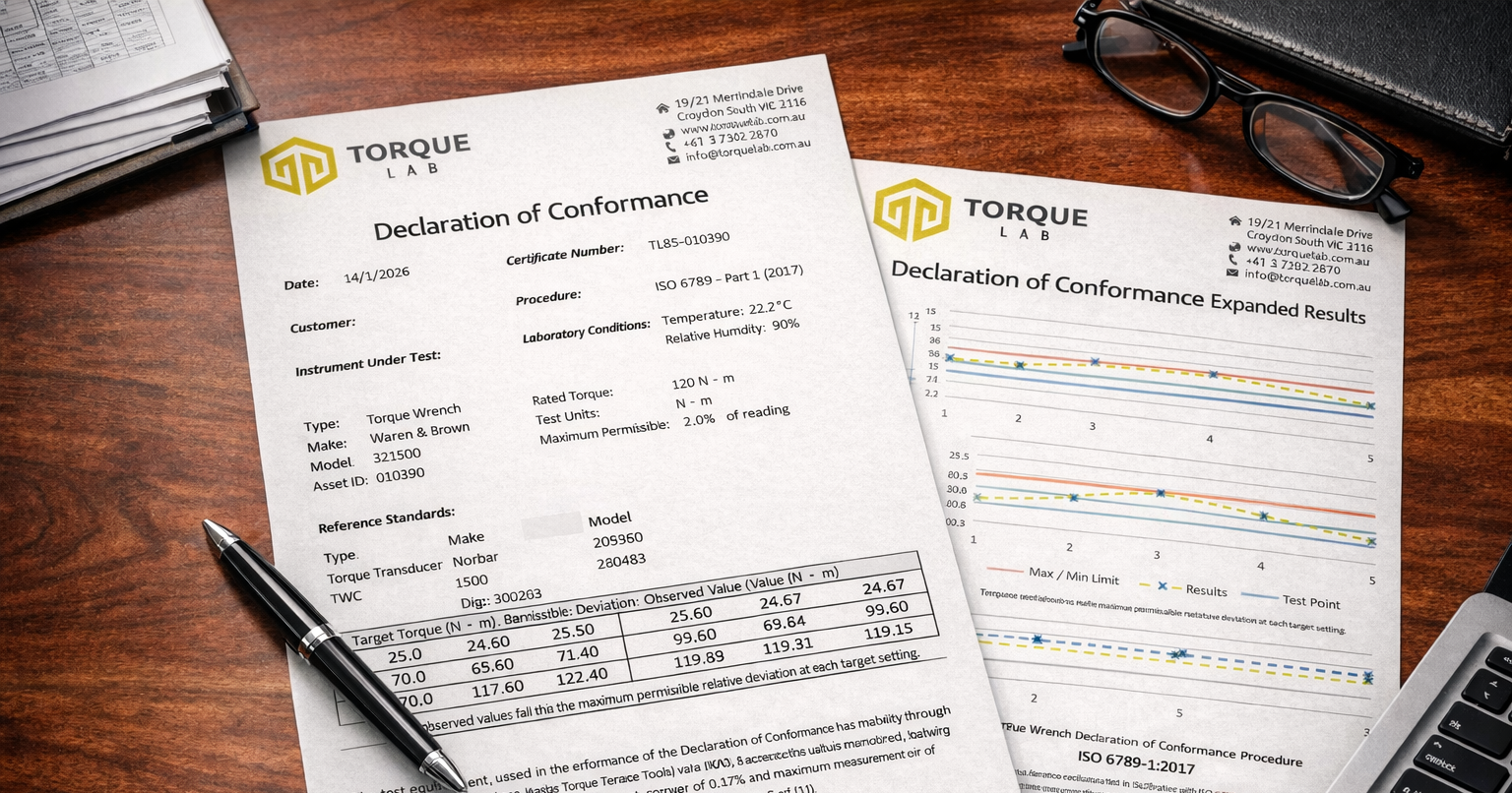
A Declaration of Conformance is the core verification service under ISO 6789-1:2017.
It is not an expanded calibration report.
Nor is it a full uncertainty analysis.
It is a formal statement that a torque wrench meets the manufacturers specified maximum permissible deviation.
For customers, the important question is simple:
What should a compliant Declaration of Conformance actually contain?
Below are the standard features that should appear, followed by a discussion of additional elements that sometimes appear but are not strictly mandated by ISO 6789-1.
Clear Identification of the Torque Tool
A compliant certificate must clearly identify the tool being verified, including:
- Tool type
- Manufacturer
- Model
- Serial number or asset ID
- Rated torque capacity
- Units of measurement
If these details are incomplete or vague, traceability becomes questionable. ISO 6789 compliance depends on unambiguous identification.
Reference to ISO 6789-1:2017
The certificate must explicitly state that testing was conducted in accordance with ISO 6789-1:2017.
The edition year is critical. ISO 6789 has evolved, and compliance with an earlier version does not automatically mean compliance with the 2017 revision.
A compliant Declaration should clearly reference the correct standard and edition.
Controlled Environmental Conditions
ISO 6789-1 Section 6.3 requires testing to be performed:
- Between 18°C and 28°C
- With temperature stability within ±1 K
- With relative humidity below 90%
A compliant Declaration should record environmental conditions during testing.
Torque wrenches are mechanical devices. Temperature fluctuations influence spring characteristics and internal friction. Environmental control is not cosmetic. It is fundamental.
Defined Test Points Across the Operating Range
ISO 6789-1 requires verification at approximately:
- 20% of rated capacity
- 60% of rated capacity
- 100% of rated capacity
These points represent the critical working range of the tool.
Testing at only one point does not satisfy the standard.
Five Measurements Per Test Point
At each selected test point, ISO 6789-1 requires five independent measurements.
This demonstrates repeatability and consistency.
A single reading per point is insufficient under the 2017 standard.
Preloading Before Measurement
The standard requires that the torque wrench be preloaded before formal measurements are taken.
This stabilises the internal mechanism and reduces initial mechanical drift.
A compliant process should include preload cycles prior to recording results.
Stated Maximum Permissible Deviation
The certificate must clearly state the maximum permissible relative deviation applicable to the tool classification.
This is typically expressed as a percentage of reading.
Without stating the tolerance, there is no benchmark for compliance.
Observed Results and Calculated Errors
A Declaration of Conformance should show:
- Target torque values
- Observed measurement values
- Calculated deviation or error
These values must demonstrate whether the tool remains within the defined tolerance.
Explicit Statement of Conformance
Most importantly, the certificate must clearly declare whether the tool conforms to ISO 6789-1.
A page of numbers without a clear pass statement is incomplete.
The Declaration exists to formally state compliance.
Additional Features Often Seen but Not Strictly Required
While ISO 6789-1 defines minimum requirements, many laboratories include additional information for transparency and defensibility.
These may include:
Measurement Uncertainty Percentages
The standard requires compliance with the “1/4 rule” for the measurement system’s relative uncertainty interval.
However, publishing a specific uncertainty value on a Declaration of Conformance is not strictly mandated. This level of detail is more commonly associated with full calibration reporting.
Detailed Procedural Narratives
Some certificates include:
- Step-by-step process descriptions
- References to specific clauses within ISO 6789-1
- Explanations of acclimatisation periods
The standard requires that these actions occur. It does not require a written narrative explaining each step.
Including it strengthens transparency, but it exceeds the minimum reporting requirement.
Graphical Data Plots
Charts showing the five readings at each test point are sometimes included.
Graphs are a reporting enhancement, not a compliance requirement.
Administrative and Document Control Statements
Statements restricting document reproduction, internal tracking numbers, or asset control references are quality system features.
They are not defined requirements within ISO 6789-1.
Why This Matters
A compliant Declaration of Conformance certificate should demonstrate:
- Correct identification
- Proper environmental control
- Required test structure
- Clear tolerance definition
- Documented results
- Explicit compliance statement
Anything less may look official, but it may not satisfy ISO 6789-1 under scrutiny.
Additional features such as uncertainty values, graphical data and procedural detail improve transparency. They are valuable. But they are not substitutes for the core ISO requirements.
When torque integrity affects safety, warranty and liability, the strength of the Declaration matters.
Contact us today to get your tools compliant