
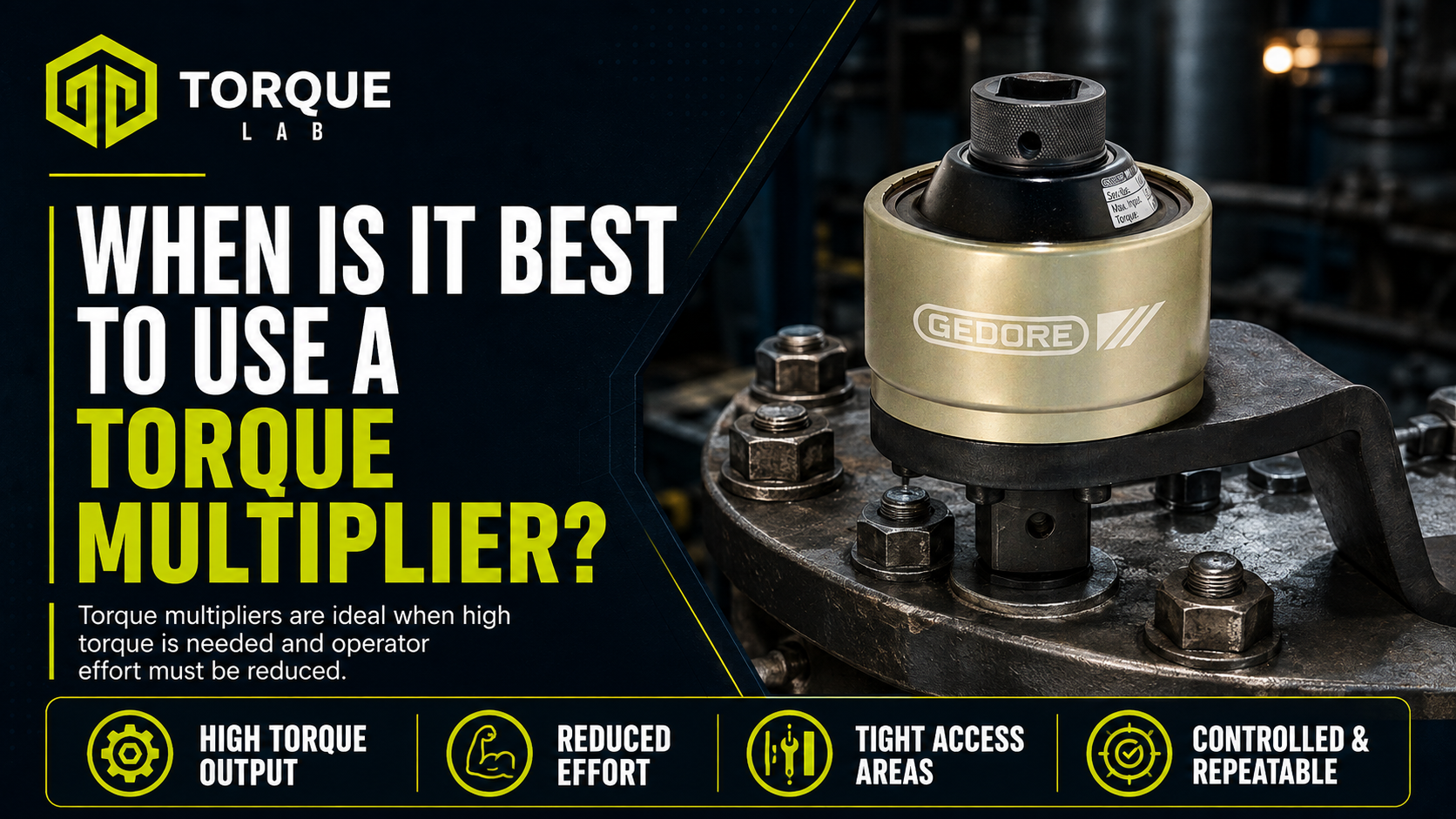
A torque multiplier is a practical solution when you need to achieve high torque values without excessive physical effort. But while it solves one problem, it introduces another—torque multiplier accuracy and how it affects the overall system.
Understanding when a multiplier is the right tool—and when it isn’t—can make a big difference to both performance and compliance.
What is a torque multiplier used for?
Torque multipliers are commonly used when required torque exceeds the comfortable or safe operating range of a standard torque wrench.
Typical situations include:
- Large fasteners requiring high torque (hundreds or thousands of Nm)
- Limited access where a longer torque wrench is not practical
- Field work where powered tools are not available
- Occasional high-torque applications where buying specialised equipment isn’t justified
In these cases, a multiplier allows a standard torque wrench to achieve much higher outputs using a gear ratio.
Torque multiplier accuracy in real-world use
This is where things start to get more nuanced. A torque multiplier has its own accuracy rating (often ±3% to ±5%), and your torque wrench also has its own accuracy (for example ±2%).
When used together, the system introduces combined uncertainty, not just a single figure.
A more realistic way to combine these is using the RSS (Root Sum Square) method:
For example:
So even under ideal assumptions, your system accuracy may sit around 4–5% rather than the wrench’s original 2%.
Why torque multiplier accuracy can be limiting
Even that calculation assumes ideal conditions. In practice, several additional factors can influence torque delivery:
- Gear backlash within the multiplier
- Movement or flex in the reaction arm
- Alignment issues at the reaction point
- Operator technique
- Differences between calibration setup and field conditions
All of these can further affect torque multiplier accuracy, especially at higher torque levels.
This is why multipliers are often considered a convenience tool rather than a precision tool.
When a torque multiplier is the right choice
Torque multipliers are well suited when:
- High torque is required but extreme precision is not critical
- The application allows for a slightly higher tolerance band
- Work is being done in the field without access to powered tools
- Budget constraints make other solutions impractical
- The tool is used occasionally rather than continuously
In these situations, the trade-off between usability and accuracy is usually acceptable.
When torque multiplier accuracy becomes a problem
There are cases where accuracy matters more than convenience. For example:
- Critical bolted joints with tight tolerances
- Compliance-driven industries requiring traceable uncertainty
- Applications where over- or under-tightening carries risk
- High-volume production where repeatability is essential
In these scenarios, relying on torque multiplier accuracy can introduce too much variability.
A better alternative: powered torque tools
When higher accuracy and repeatability are required, it’s often more suitable to move to a powered torque solution.
Options include:
- Hydraulic torque wrenches
- Pneumatic torque tools
- Electric or battery-powered torque tools
These systems are designed to deliver torque more directly, with fewer mechanical variables in the chain. As a result, they typically offer:
- Better repeatability
- Reduced operator influence
- Lower overall uncertainty
- Improved efficiency for high-volume work
While the upfront cost is higher, they can be the more reliable option where precision matters.
Practical takeaway
Torque multipliers are a useful and cost-effective way to achieve high torque, particularly in field applications. However, torque multiplier accuracy must always be considered as part of the overall system.
If accuracy is critical, a multiplier may not be the best choice. In those cases, upgrading to a powered torque tool is often the more appropriate long-term solution.
Conclusion
Choosing the right tool comes down to balancing torque requirements, accuracy, and practicality. Torque multipliers have their place, but they are not a one-size-fits-all solution.
Understanding the limitations of torque multiplier accuracy helps ensure you select the right equipment for the job and avoid unexpected performance issues.
Contact us to discuss your torque calibration requirements.