
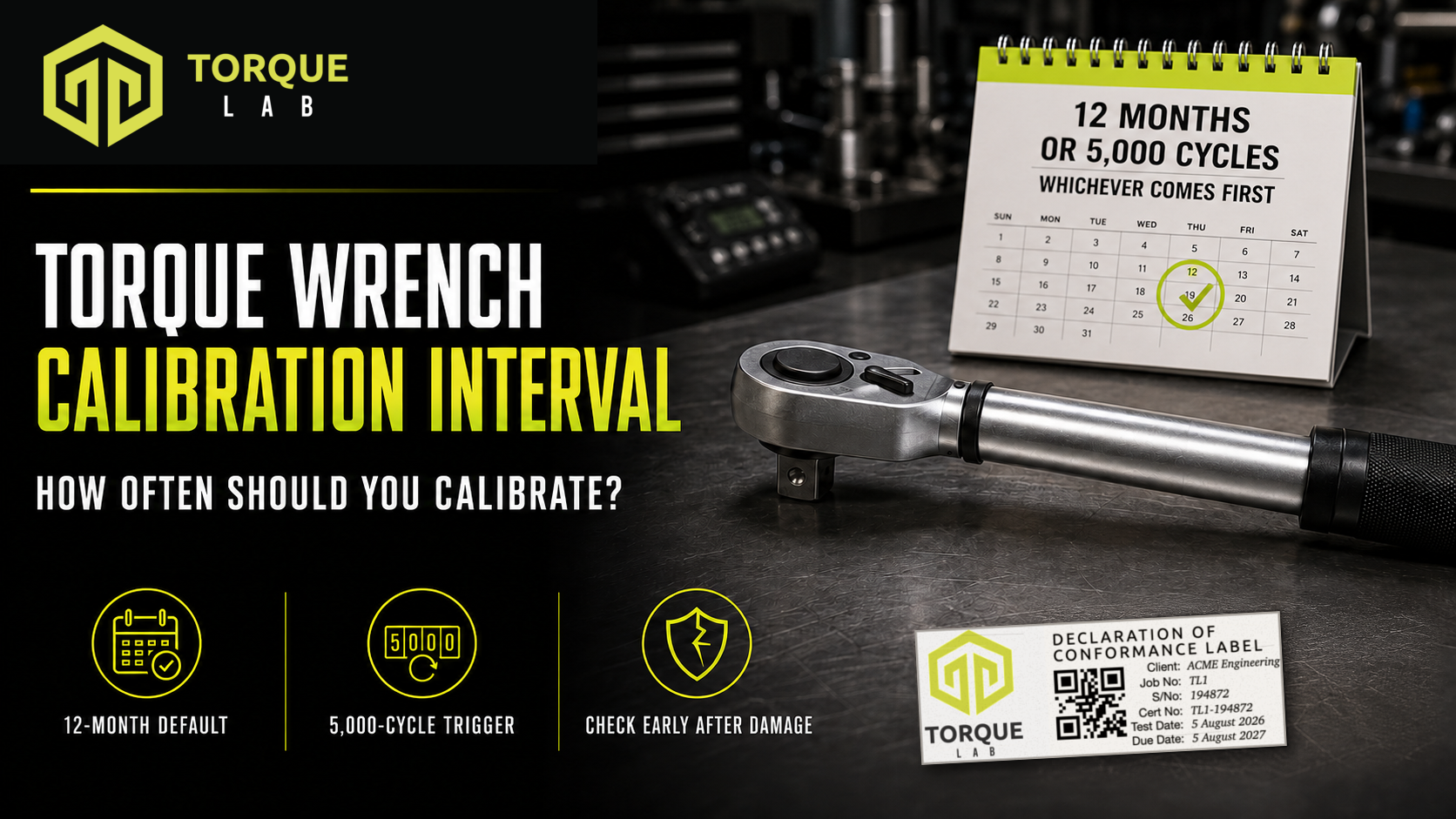
Choosing a torque wrench calibration interval starts with how the tool is actually used. If you are asking how often should a torque wrench be calibrated, annual torque wrench calibration gives many workplaces a practical starting point. However, a reliable calibration due date must also reflect usage, operating conditions, tool history and any torque wrench accuracy checks performed between scheduled services.
In short, 12 months suits many torque wrenches, but it is not a guarantee that every tool will remain accurate for a full year. A heavily used, dropped, overloaded or damaged wrench may need attention much sooner.
The short answer: a 12-month torque wrench calibration interval
For many workshops and maintenance teams, a 12-month torque wrench calibration interval is straightforward to manage. It creates a predictable annual cycle, works well with equipment registers and gives users a clear calibration due date to follow.
ISO 6789-2:2017 provides the recognised calibration framework for hand torque tools. Where the user does not apply a specific control procedure, the standard provides a default recalibration point based on 12 months or 5,000 cycles of use, whichever occurs first. Therefore, a calendar date alone does not always control the interval.
Most businesses do not count every use of every wrench. Consequently, annual torque wrench calibration often becomes the practical default. Nevertheless, a business that performs high-volume tightening may reach 5,000 cycles well before the annual date.
How often should a torque wrench be calibrated under ISO 6789?
So, how often should a torque wrench be calibrated when the same wrench can serve very different applications? The answer depends on more than elapsed time. The user should consider the required measurement performance, frequency of use, typical loading, working environment, storage conditions and previous results.
The official ISO 6789-2 overview explains that the standard covers calibration requirements and the determination of measurement uncertainty for hand torque tools. In practice, the owner remains responsible for selecting and reviewing the torque wrench calibration interval that suits the application.
The following factors can justify a shorter interval:
- frequent or high-volume use;
- regular operation near the upper end of the wrench’s range;
- safety-critical or quality-critical fastening;
- exposure to dust, moisture, vibration or temperature extremes;
- rough transport or poor storage;
- previous results showing drift or instability;
- a manufacturer, customer or internal procedure requiring earlier testing; and
- uncertainty about the tool after an unusual event.
By contrast, occasional use in controlled conditions may produce stable historical results. Even then, any decision to extend the interval should follow a documented review rather than an assumption that a lightly used tool cannot drift.
What does 5,000 cycles mean for a torque wrench?
A cycle generally represents one application of torque through the tool’s operating action. For a click-type wrench, each controlled loading and release contributes to its working history. Therefore, a production wrench can accumulate thousands of cycles surprisingly quickly.
For example, a tool used 25 times per working day could approach 5,000 cycles within a working year. A wrench used hundreds of times per shift may reach that point much sooner. Usage records can therefore produce a more suitable torque wrench calibration interval than a calendar-only approach.
Accordingly, cycle counting only helps when the record is reliable. If several operators share a tool and nobody records its use, the cycle total becomes an estimate. In that situation, a clear calibration due date remains easier to administer.
Why annual torque wrench calibration is a starting point
Annual torque wrench calibration gives a business a repeatable maintenance rhythm. It also helps quality teams plan costs, book work and prevent large groups of tools from becoming overdue without warning.
However, the annual date does not certify future performance. Calibration records how the wrench performed when the laboratory tested it. Afterward, wear, contamination, impact, misuse or internal movement can change its behaviour.
For that reason, annual torque wrench calibration works best as part of a broader control process. That process may combine scheduled laboratory work, operator inspections, careful storage, incident reporting and appropriate torque wrench accuracy checks.
Previous results also matter. If a wrench repeatedly returns comfortably within tolerance with stable readings, its history supports confidence in the selected interval. Conversely, repeated drift, adjustment or repair suggests that the organisation should review the schedule.
When torque wrench accuracy checks should happen early
Torque wrench accuracy checks should not wait for the printed due date when something may have changed the tool. Arrange an early conformance check or calibration after an event that could affect performance.
Examples include when the wrench:
- has been dropped or struck;
- has been overloaded or used beyond its rated capacity;
- has been used as a breaker bar or for uncontrolled loosening;
- no longer clicks, releases or indicates normally;
- feels rough, inconsistent or unusually stiff;
- has been dismantled, adjusted or repaired;
- has corrosion, contamination or visible damage; or
- produces a result that conflicts with another controlled tool or process.
In addition, torque wrench accuracy checks can help a high-use workplace monitor performance between formal services. A suitable intermediate check can identify a developing problem, but it does not automatically replace a documented calibration or declaration of conformance. The organisation should define what the check covers, what equipment it uses and what result triggers further action.
Operators should also exercise or pre-load a torque wrench as required by the applicable method or manufacturer before taking measurements. This step settles the internal mechanism and helps produce more representative results. Our guide to warming up a torque wrench before use explains why pre-clicking matters.
A calibration due date is not an accuracy warranty
The calibration due date gives users a planned service point. It does not promise that the wrench will remain within tolerance until midnight on that date, regardless of what happens in the meantime.
Therefore, treat the date as the end of the approved interval under normal conditions. If the wrench suffers an impact or begins behaving differently, the incident overrides the routine calibration due date. Continuing to use a questionable tool simply because its label remains current can create avoidable risk.
Likewise, an expired calibration due date does not prove that the wrench suddenly changed on that day. Instead, it means the organisation has moved beyond the period for which its control system planned to rely on the previous result. The responsible action is to remove the tool from controlled work and arrange the required service.
Should a rarely used torque wrench exceed 12 months?
Some organisations consider extending the torque wrench calibration interval for tools that receive very little use. That decision may be reasonable only when evidence supports it and the applicable manufacturer, customer, contract and quality-system requirements allow it.
A documented review should consider:
- the number and severity of uses;
- storage and environmental conditions;
- the importance of the fastening application;
- the wrench’s previous calibration history;
- access control and the reliability of usage records;
- the consequences of an incorrect torque result; and
- whether intermediate torque wrench accuracy checks provide useful evidence.
Without that information, extending the interval simply reduces how often anyone confirms performance. Therefore, annual torque wrench calibration remains the easier position to explain and administer for many businesses.
Calibration or declaration of conformance?
The correct service depends on what your quality system, customer or application requires. A declaration of conformance checks whether the tool meets the applicable performance requirements. A calibration under ISO 6789-2 provides measurement results together with evaluated measurement uncertainty and supporting traceability information.
Both services can form part of a torque wrench calibration interval program. However, they do not provide identical information. Before sending a tool, confirm whether you need a straightforward conformance decision or the additional measurement detail supplied by calibration.
Torque Lab’s service options for hand torque tools explain the practical difference.
Managing the calibration due date across a tool fleet
A simple system can prevent missed dates and unnecessary downtime. First, record each tool’s serial number, location, responsible person and calibration due date in an equipment register. Next, set reminders early enough to book the work before expiry.
For larger fleets, consider the following controls:
- stagger due dates instead of sending every wrench at once;
- keep a suitable spare tool available for critical work;
- record drops, overloads, repairs and unusual behaviour;
- separate overdue or questionable tools from serviceable equipment;
- check that the label matches the wrench and certificate; and
- review historical results when setting the next torque wrench calibration interval.
These steps turn the calibration due date into an active control rather than a sticker that nobody checks. Furthermore, a visible label helps operators confirm the tool’s status at the point of use.
How often should a torque wrench be calibrated in your workplace?
If you still need to decide how often should a torque wrench be calibrated, start with these questions:
- Does a manufacturer, customer, standard or internal procedure specify an interval?
- Could the tool reach 5,000 cycles before 12 months?
- Does the application involve significant safety, quality or financial risk?
- Has the wrench suffered an impact, overload, repair or unusual event?
- Do previous results show stable performance or recurring drift?
- Can your organisation support the interval with reliable records?
The answers may support a 12-month schedule, or they may show why an earlier service is sensible. Either way, document the decision and review it when the tool’s use or history changes.
Choosing the right torque wrench calibration interval
A 12-month torque wrench calibration interval remains a practical starting point for many users, especially where nobody tracks individual operating cycles. However, high use, harsh conditions, critical work, damage or unstable history can bring the required service forward.
Annual torque wrench calibration should therefore work alongside a controlled calibration due date, appropriate torque wrench accuracy checks and prompt action after any incident. Overall, the right schedule is the one that maintains justified confidence in the wrench between formal assessments.
Contact us to discuss your calibration requirements.