
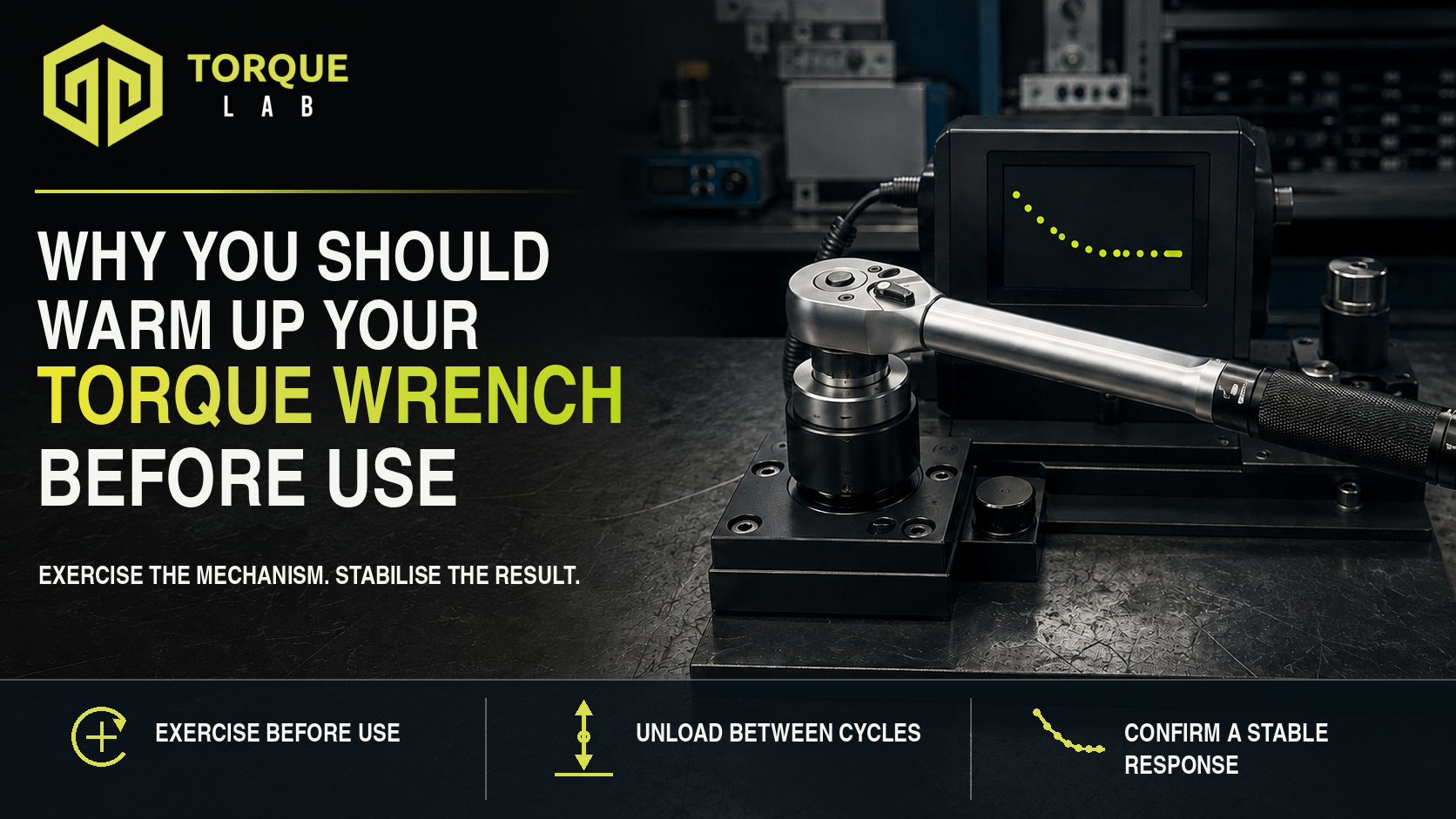
Before a critical tightening, warm up your torque wrench. A short series of torque wrench warm-up clicks can exercise a torque wrench and help stabilise its response. In other words, technicians should pre-load a torque wrench before relying on it, because torque wrench accuracy before use can differ from its settled performance. This simple routine applies to every torque wrench or tension wrench, regardless of its price, brand or age.
“Warm-up” does not mean heating the tool. Instead, it means loading and unloading the wrench through several controlled cycles before making the fastening that matters. For a click-type wrench, that normally means operating the release mechanism repeatedly on a suitable test fixture. However, indicating, digital, slipping and break-back tools also benefit from controlled exercise appropriate to their design.
What Does It Mean to Warm Up Your Torque Wrench?
When you warm up your torque wrench, you exercise its working components before taking a meaningful reading or tightening a critical fastener. The process allows springs, pivots, ratchets, release surfaces, bearings and lubricated contact points to move under load. Consequently, the tool begins the job in an operating condition rather than a resting condition.
For a click-type tool, torque wrench warm-up clicks also let the release mechanism cycle fully. Each cycle should start from zero load, rise smoothly to the selected torque and finish as soon as the wrench releases. Then, the operator should remove the load completely before starting the next cycle.
This process may also reveal an obvious problem. For example, an inconsistent release, unusual noise, sticking mechanism or changing feel can warn the operator that the tool needs inspection before use.
Therefore, warm up your torque wrench after storage, transport or a long period without use. Also repeat the process after a substantial setting change or a change in operating direction.
Why Every Torque Wrench Needs Exercise
All torque wrenches need exercise before use. Nevertheless, the correct method varies with the tool’s design. A click wrench needs several controlled releases, while an indicating wrench needs several controlled loading and unloading cycles. Likewise, an electronic wrench may need loading cycles as well as a zero and function check.
Moreover, warm up your torque wrench again before safety-critical work, even if another operator used it earlier in the day. You may not know its previous setting, direction, handling or storage conditions.
Several factors can affect the first few operations:
- Internal lubricants and contact surfaces may settle while the wrench sits unused.
- Springs, pivots and release components may respond differently during the first movement after storage.
- Transport, a large setting change or a change in direction can alter how the mechanism initially seats.
- Ratchets, square drives, adapters and interchangeable heads can introduce small mechanical movements under load.
- The operator may also need a few cycles to establish a smooth loading rate and correct hand position.
Therefore, a calibration certificate does not remove the need to exercise a torque wrench. Calibration describes the tool’s performance under a defined procedure and conditions. In contrast, warm-up prepares the tool for the conditions that exist immediately before the job.
A Real Norbar Example: About +50 N·m Before Warm-Up
During a recent calibration of a high-end Norbar torque wrench, Torque Lab clearly observed the effect of warm-up. At the first test, the wrench produced a result approximately 50 N·m above the target value.
The technician then performed repeated torque wrench warm-up clicks at the test setting. After each click, the error reduced. After around eight clicks, the readings stabilised and the wrench reached the expected performance level.
This example matters for two reasons. First, even a quality tool from a respected manufacturer can produce an unsettled initial result. Second, one or two clicks may not always provide enough exercise. In this case, the tool needed approximately eight cycles before its response became stable.
However, this result does not mean every Norbar wrench will start 50 N·m high or require exactly eight clicks. The size of the change depends on the individual tool, its range, its design, its condition, its setting and how long it has rested. Instead, the example demonstrates why an operator should never assume that the first click represents settled performance.
What Causes the First Results to Change?
Warm-up behaviour rarely points to one cause by itself. Instead, several mechanical effects can combine during the first loading cycles.
Many setting torque wrenches use a spring-loaded release system. While the tool rests, lubricated components remain stationary and contact points can settle. The first operation then moves those surfaces from rest and seats the mechanism under load. Subsequent cycles may produce a more consistent release.
In addition, the ratchet, square drive, socket and test fixture all settle under torque. The operator’s technique also becomes more repeatable after a few controlled pulls. As a result, warm-up can improve the consistency of the complete tool-and-operator system, not only the internal release mechanism.
Consistent torque wrench warm-up clicks provide useful reassurance that the release feels repeatable. However, they do not prove that the indicated or set torque agrees with a traceable reference.
Temperature can also influence precision equipment. However, operational warm-up should not become a substitute for allowing a tool to reach suitable environmental conditions after a major temperature change. If a wrench has arrived from a very hot vehicle or cold storage area, let it acclimatise before critical work.
How Many Warm-Up Clicks Does a Torque Wrench Need?
There is no single number that suits every tool and every situation. Therefore, follow the manufacturer’s instructions and your documented workplace procedure where either specifies a conditioning sequence.
For a click-type wrench, perform several smooth, complete activations at the intended test or working setting on a suitable fixture. Then, fully unload the tool between each activation. Watch and feel for the response to become consistent rather than treating a small fixed number as an automatic guarantee.
The Norbar example needed around eight torque wrench warm-up clicks. Consequently, it shows why a three-click or five-click habit may not always settle every wrench. If the response continues to change, do not keep cycling indefinitely and hope for the best. Instead, check the setup and arrange testing if you cannot confirm the tool’s performance.
How to Exercise a Torque Wrench Before Use
Use a controlled process whenever you exercise a torque wrench:
Before you pre-load a torque wrench, confirm that the fixture, socket and adapters can safely withstand the selected torque.
- Inspect the tool. Check the square drive, ratchet, handle, scale or display, locking system and attached accessories. Stop if you find damage, contamination or abnormal movement.
- Confirm the tool’s status. Check its identification, calibration due date and suitability for the required torque and direction.
- Choose a safe exercise point. Use the intended working setting unless the manufacturer or your procedure specifies another value. Do not automatically wind the wrench to maximum torque.
- Use a suitable fixture. A torque tester, joint simulator or properly designed non-critical exercise joint should withstand the selected load safely.
- Pre-load the torque wrench smoothly. Apply force at the marked loading point or centre of the hand grip, and keep the pull controlled and perpendicular to the wrench.
- Stop at the signal. For a click or break-back wrench, stop applying force as soon as the mechanism releases. Do not pull through the click.
- Unload fully and repeat. Remove the load before beginning the next cycle. Continue for the required number of cycles and confirm that the response feels consistent.
- Start the actual task. Once the wrench behaves consistently, use the same controlled technique on the intended fastener.
Do not perform repeated exercise cycles on the final critical fastener. Repeated tightening can change friction, seating and bolt preload, while pulling through a click can over-torque the joint. Therefore, warm up your torque wrench on a separate, suitable fixture.
Similarly, never pre-load a torque wrench against an improvised restraint or an assembly that may move, slip or fail. A stable exercise setup protects the operator as well as the tool.
Warm-Up for Different Torque Wrench Types
Click-Type and Other Setting Wrenches
Click-type, break-back and slipping tools contain mechanisms that signal or limit the selected torque. To exercise a torque wrench of this type, operate the mechanism repeatedly and unload it fully between cycles. These tools show the most obvious warm-up behaviour because the operator can feel or hear each activation.
Dial, Beam and Other Indicating Wrenches
An indicating wrench may not click. Nevertheless, load and unload it through the expected working range several times, then confirm that its pointer or display returns correctly to zero. Also check the viewing angle and memory pointer, where fitted, before relying on a reading.
When technicians pre-load a torque wrench of the indicating type, they should increase and remove the load smoothly rather than shock-loading the sensing element.
Electronic Torque Wrenches
Electronic tools combine sensing electronics with mechanical drives, handles and adapters. Therefore, controlled loading cycles still matter. In addition, confirm the battery condition, units, zero, direction, target setting and any programmed mode before use.
How Warm-Up Affects Torque Wrench Accuracy Before Use
Torque wrench accuracy before use depends on more than exercise. A warm-up routine can stabilise a functioning wrench, but it cannot establish traceability or confirm the size of its measurement error. Only appropriate testing against suitable reference equipment can do that.
For this reason, torque wrench accuracy before use cannot be confirmed by feel alone. Stable cycling indicates repeatable operation, whereas calibration compares the tool’s result with a suitable reference standard.
In addition, torque wrench accuracy before use may remain unacceptable even after the response stabilises. A consistently releasing wrench can still produce a consistently high or low result.
Likewise, pre-load clicks cannot repair wear, damage, overload or poor adjustment. Stop using the wrench and arrange an accuracy check if:
- the release point keeps changing after repeated cycles;
- the wrench feels rough, sticky or inconsistent;
- the tool has been dropped, overloaded or damaged;
- the pointer or electronic display fails to return to zero;
- the ratchet, square drive or interchangeable head has excessive movement;
- the calibration due date has passed; or
- the result conflicts with another controlled measurement or known-good tool.
The ISO 6789-2:2017 calibration framework covers calibration and measurement uncertainty for hand torque tools. Although shop-floor exercise is not a calibration, the use of controlled loading before meaningful measurements reflects the same practical principle: first stabilise the system, then assess or use it.
Make Warm-Up Part of the Job
A good process makes warm-up routine rather than optional. For example, include it in the work instruction, train operators to use a separate fixture and record any unusual behaviour. Moreover, repeat the routine after storage, transport, a substantial setting change, a direction change or any event that could disturb the tool.
Most importantly, do not reserve warm-up for cheap or old tools. The Norbar example shows that quality does not eliminate the need to exercise a torque wrench. Every torque wrench needs controlled exercise before use because every tool begins from a resting condition.
A Few Clicks Can Protect the Result
Warm up your torque wrench before every critical use. A short, controlled exercise routine helps the mechanism settle, improves repeatability and gives the operator an opportunity to detect abnormal behaviour.
However, do not assume that a certificate, premium brand or one token click makes the tool ready. Perform the correct pre-load sequence, unload between cycles and confirm a stable response. If the wrench does not settle, check it before trusting the result.
Contact us to discuss your calibration requirements.