
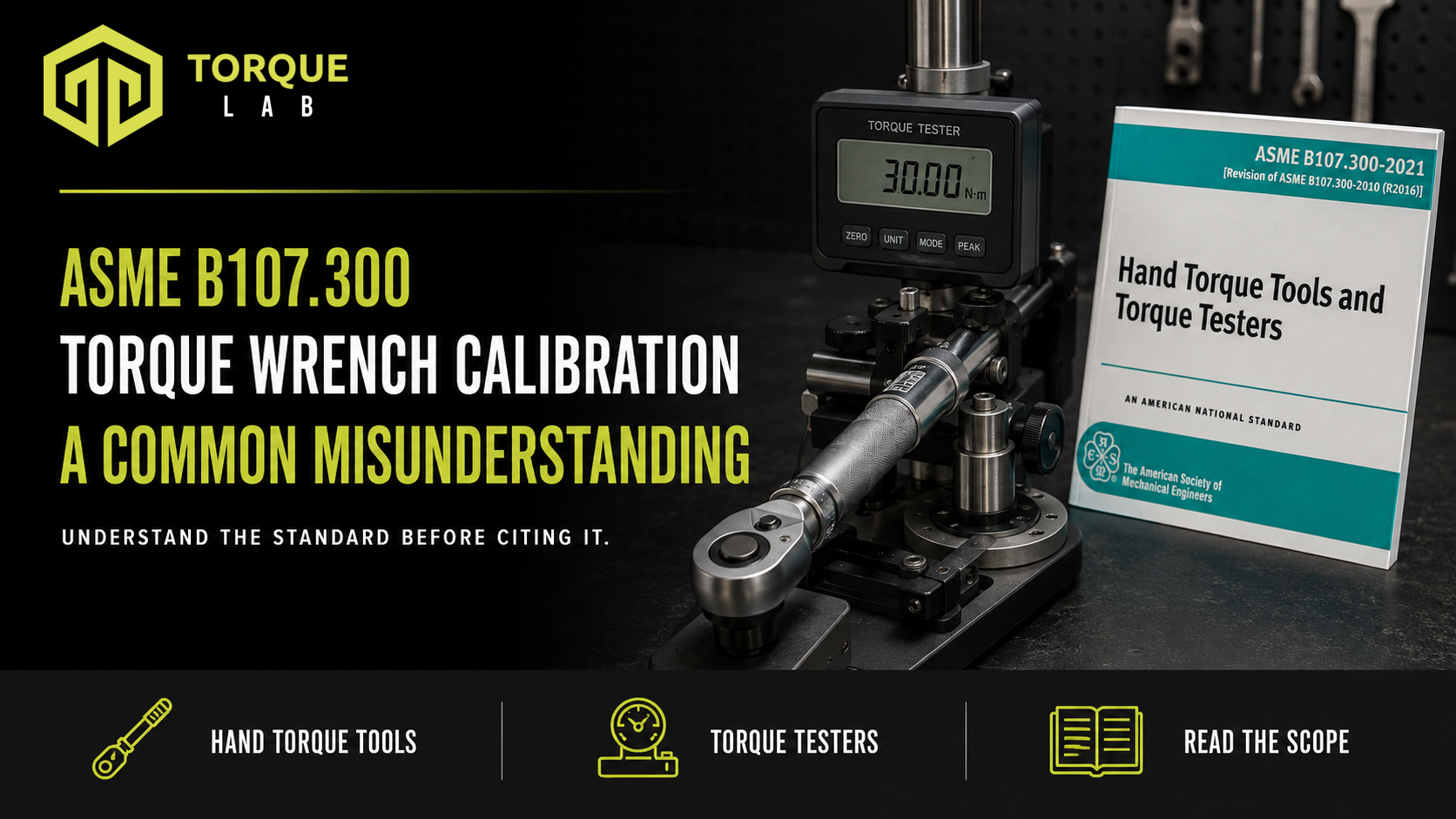
It is becoming increasingly common to see torque wrench “calibration” certificates that reference ASME B107.300.
At first glance, that sounds technical and impressive. The problem is that ASME B107.300 is not a calibration standard. It was never written to define laboratory calibration procedures for torque wrenches.
Let’s look at what the document actually covers.
What ASME B107.300 Really Is
The title of the standard is Hand Torque Tools and Torque Testers ASME B107.300-2021. Its scope explains that it provides performance and safety requirements for:
-
- Hand-operated torque instruments
- Electronic torque instruments
- Torque testers used to check torque wrenches
It focuses on design performance, endurance, accuracy limits, and safety of the tools themselves.
This makes it a product performance standard, not a metrological calibration standard.
Where “Calibration” Appears in ASME B107.300
Despite being used by some companies to justify calibration services, the word “Calibration” appears just three times, and each time it relates to durability or life testing, not laboratory calibration procedures:
-
- “Calibration Life and Overload — Category 14” ASME B107.300-2021
- “Calibration and Cycle Life Test — Category 28” ASME B107.300-2021
- A single checklist item for torque testers labelled “Calibration.”
None of these sections describe:
-
- Measurement uncertainty
- Traceability requirements
- Laboratory environmental conditions
- Laboratory calibration methods
- Calibration certificates
Instead, they refer to how well a tool maintains its performance after repeated loading. That is durability testing, not calibration in the metrology sense.
What ASME B107.300 Does NOT Contain
ASME B107.300 does not define:
-
- A formal calibration procedure for torque wrenches
- How to calculate measurement uncertainty
- Requirements for traceable calibration certificates
- Calibration intervals or metrological traceability chains
Those are the core elements of a true calibration standard.
How ISO 6789 Changed the Landscape
Today, the internationally recognised standards for torque wrench verification are:
-
- ISO 6789-1 — Declaration of Conformance (design and performance verification)
- ISO 6789-2 — Full laboratory level Calibration including measurement uncertainty
ISO 6789-2 specifically defines calibration methods, measurement uncertainty calculations, and traceability requirements. ASME B107.300 does none of this.
Because ISO 6789 now covers both tool conformance and metrological calibration in detail, ASME B107.300 should effectively be considered obsolete. It remains a product performance reference, not a calibration standard.
Why This Matters
Using the wrong standard for torque wrench calibration is not just a technical detail. It can create serious legal, financial, and compliance risks.
Risk of Equipment Damage
Torque settings directly affect the integrity of bolted joints. If a torque wrench is incorrectly verified under a standard that does not define proper calibration methods, the tool may be operating outside acceptable accuracy limits without anyone realising.
That can lead to:
-
- Over-tightened fasteners causing thread damage or component distortion
- Under-tightened fasteners leading to loosening, vibration damage, or joint failure
- Premature failure of machinery, vehicles, or structural components
When failures occur, investigators often trace the problem back to assembly torque records. If the torque wrench was “calibrated” using a standard that does not actually define calibration, that documentation may not hold up under scrutiny.
Liability and Legal Exposure
If equipment damage, injury, or product failure occurs and the torque tools involved were verified using ASME B107.300 instead of a recognised calibration standard, several problems arise:
-
- The calibration process may be challenged as technically invalid
- The organisation may be seen as not following recognised international practice
- Liability may shift toward the company that specified or accepted that calibration method
In legal or insurance investigations, the question is rarely “Was a certificate issued?” The question is “Was the tool verified using an appropriate and recognised calibration method?” ASME B107.300 does not provide one.
Audit and Compliance Failure
Many quality systems rely on traceable calibration of measuring equipment. Auditors typically expect calibration procedures that include:
-
- Defined measurement methods
- Traceability to national or international standards
- Stated measurement uncertainty
These are all core elements of ISO 6789-2, and they are completely absent from ASME B107.300.
If an auditor reviews torque wrench records and finds they are based on ASME B107.300, it can result in:
-
- Non-conformances raised against the quality system
- Rejection of calibration records
- Requirements for immediate re-calibration under a recognised standard
- Loss of customer confidence or approval status
In regulated industries, that can escalate quickly into contractual or certification issues.
The Real Issue
The danger is not that ASME B107.300 is a bad standard. It simply serves a different purpose. It addresses product performance and safety, not metrological calibration.
Using it as a substitute for ISO 6789 calibration is like using a vehicle design standard as proof that a speedometer is accurate. The document was never intended for that role.
When torque accuracy affects safety, reliability, or compliance, only ISO 6789 Part 1 conformance checks or ISO 6789 Part 2 calibration provide defensible, recognised verification.
The Bottom Line
ASME B107.300 is about tool performance and safety, not calibration methodology. The very limited use of the word “calibration” in the document refers to life and overload testing, not laboratory calibration.
For recognised, traceable torque wrench calibration, ISO 6789 is the correct and current standard.
Contact us to discuss your calibration requirements.