
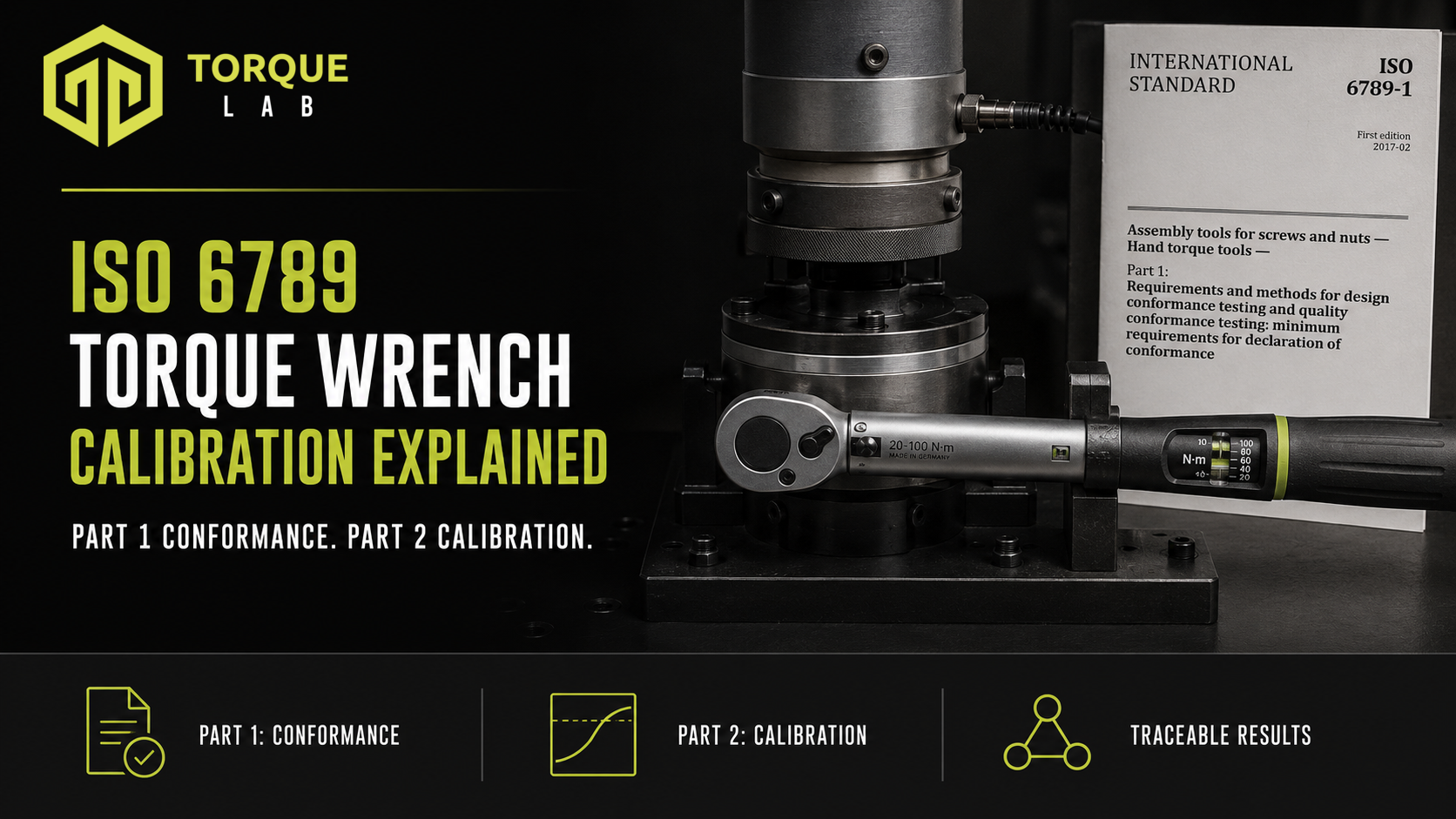
ISO 6789 Torque Wrench Calibration and the Withdrawal of AS 4115
For many years in Australia, torque wrench calibration was carried out under AS 4115. That standard was withdrawn in 2017. It was replaced by the international ISO 6789 standard.
This change did more than update a document number. It changed terminology and expanded technical requirements.
Understanding the difference helps you choose the correct service for your torque tools.
What Happened to AS 4115?
AS 4115 covered hand torque tools and included procedures that Australian industries commonly referred to as torque wrench calibration.
When AS 4115 was withdrawn, its role did not disappear. Instead, it was effectively replaced by ISO 6789-1 for tool conformance and ISO 6789-2 for laboratory calibration.
The important detail is this:
What used to be called a calibration under AS 4115 is now called a Declaration of Conformance under ISO 6789-1.
ISO 6789-1: The New Name for the Old “Calibration”
ISO 6789-1 covers design and production verification of torque tools.
For most users, this is the direct replacement for what they previously received as a “calibration certificate” under AS 4115.
Has the procedure changed?
In practical terms, the testing procedure is largely the same as what was performed under AS 4115. The tool is checked at defined torque points and verified against allowable tolerances.
What has changed is the terminology and documentation:
| Under AS 4115 | Under ISO 6789-1 |
|---|---|
| Called a calibration | Called a Declaration of Conformance |
| Focused on tool accuracy | Focuses on conformity to design and performance limits |
| Often assumed to cover everything | Clearly limited to conformance at time of test |
So if you were satisfied with an AS 4115 calibration certificate before 2017, an ISO 6789-1 Declaration of Conformance is now the equivalent service.
ISO 6789-2: Where Calibration Really Changed
ISO 6789-2 is very different from the old AS 4115 approach.
This part of the standard covers metrological calibration performed by calibration laboratories. It introduces a major requirement that did not exist in the same way under AS 4115:
Measurement Uncertainty
Every Calibration result must now include a calculated measurement uncertainty. This accounts for:
- Equipment accuracy
- Repeatability
- Resolution
- Mechanical influences
- Environmental conditions
This analysis is not optional. It is required for compliance with ISO 6789-2.
Why does this matter?
Because of the added uncertainty calculations and stricter method requirements, an ISO 6789-2 calibration typically takes at least four times longer than a traditional AS 4115 style calibration.
It is a deeper, laboratory-level evaluation rather than a simple conformity check.
Which Service Do Most Customers Actually Need?
For most industrial users who previously requested a “torque wrench calibration” under AS 4115, the correct modern equivalent is:
An ISO 6789-1 Declaration of Conformance
This confirms the tool meets the performance limits defined by the ISO standard, using a procedure very similar to what was done before 2017.
ISO 6789-2 calibration is usually required only when:
- A quality system specifically demands uncertainty values
- The tool is used in high-risk or highly regulated applications
- Full metrological traceability is required
The Practical Difference in Simple Terms
- AS 4115 calibration → Now called ISO 6789-1 Declaration of Conformance
- ISO 6789-2 calibration → A more complex laboratory calibration with uncertainty calculations
- Time required → An ISO 6789-2 Calibration can take at least four times longer due to additional measurement analysis
Both services have a place, but they are not interchangeable.

Contact us today to discuss your requirements