
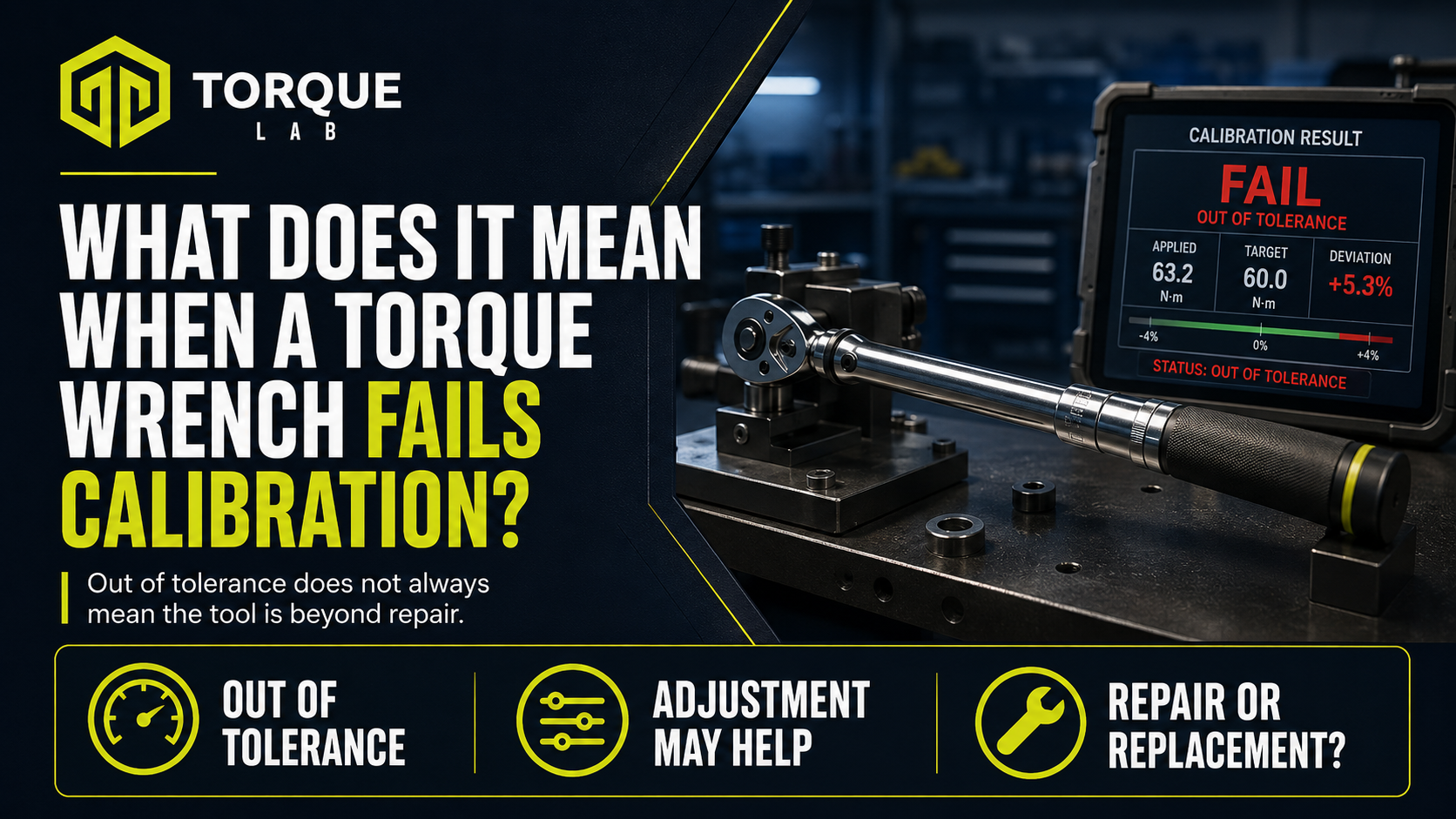
What happens if your torque wrench fails calibration? It’s a common situation, and in most cases, it doesn’t mean the tool is unusable or needs immediate replacement.
However, it does mean the tool is no longer operating within its specified tolerance—and action is required.
What Does It Mean When a Torque Wrench Fails Calibration?
When a torque wrench fails calibration, it means the measured output does not meet the manufacturer’s stated accuracy requirements.
In simple terms, the torque being applied is no longer what the tool indicates.
This can lead to:
- under-torqued fasteners
- over-torqued components
- inconsistent assembly results
Therefore, the tool cannot be relied upon until it has been assessed and, if possible, corrected.
What Happens If Your Torque Wrench Fails Calibration During Testing?
What happens if your torque wrench fails calibration during testing depends on the nature of the results.
The first step is to assess the “As Found” data. This shows how the tool was performing before any adjustments were made.
When reviewing these results, we look for patterns such as:
- whether the error is linear or non-linear
- whether the results are consistent or sporadic
- whether the deviation is predictable across the range
This analysis helps determine whether adjustment is possible or likely to be successful.
Assessing Whether Adjustment Is Possible
Not all failed torque wrenches can be adjusted.
However, many can be corrected if the error pattern is stable and predictable. For example, a consistent offset across the range is often easier to adjust than irregular or erratic behaviour.
On the other hand, if the results are highly inconsistent or non-linear, this may indicate internal wear or damage that cannot be corrected through adjustment alone.
What Happens During Adjustment?
If adjustment is possible, the next step is to bring the tool back within tolerance.
This typically involves:
- making controlled internal adjustments
- fine-tuning the mechanism
- stabilising performance across the operating range
Once the adjustment is complete, the tool is re-tested.
“As Found” and “As Left” Results Explained
After adjustment, the torque wrench is verified again to produce “As Left” results.
This means you receive:
- As Found results – how the tool performed before adjustment
- As Left results – how the tool performs after adjustment
This provides full transparency and traceability, showing exactly what has been corrected.
What If Adjustment Isn’t Possible?
In some cases, adjustment is not practical.
This may be due to:
- excessive internal wear
- damaged components
- inconsistent or unpredictable results
- lack of available parts
When this happens, continuing to use the tool is not recommended.
Instead, we can work with you to identify a suitable replacement that meets your requirements and application.
Why You Shouldn’t Ignore a Failed Calibration
It might be tempting to keep using a torque wrench that has failed calibration, especially if it still feels normal in use.
However, this introduces unnecessary risk.
Incorrect torque can lead to:
- mechanical failures
- safety issues
- compliance problems
- potential liability if failures occur
Addressing the issue early helps avoid more serious consequences later.
Final Thoughts
What happens if your torque wrench fails calibration? In most cases, it can be assessed and, if suitable, adjusted and returned to service.
The key is understanding the nature of the failure and taking the appropriate next step—whether that is adjustment or replacement.
Either way, acting on the results ensures your torque tools remain accurate, reliable, and fit for purpose.
Contact us to discuss your calibration results or arrange an assessment of your torque equipment.