
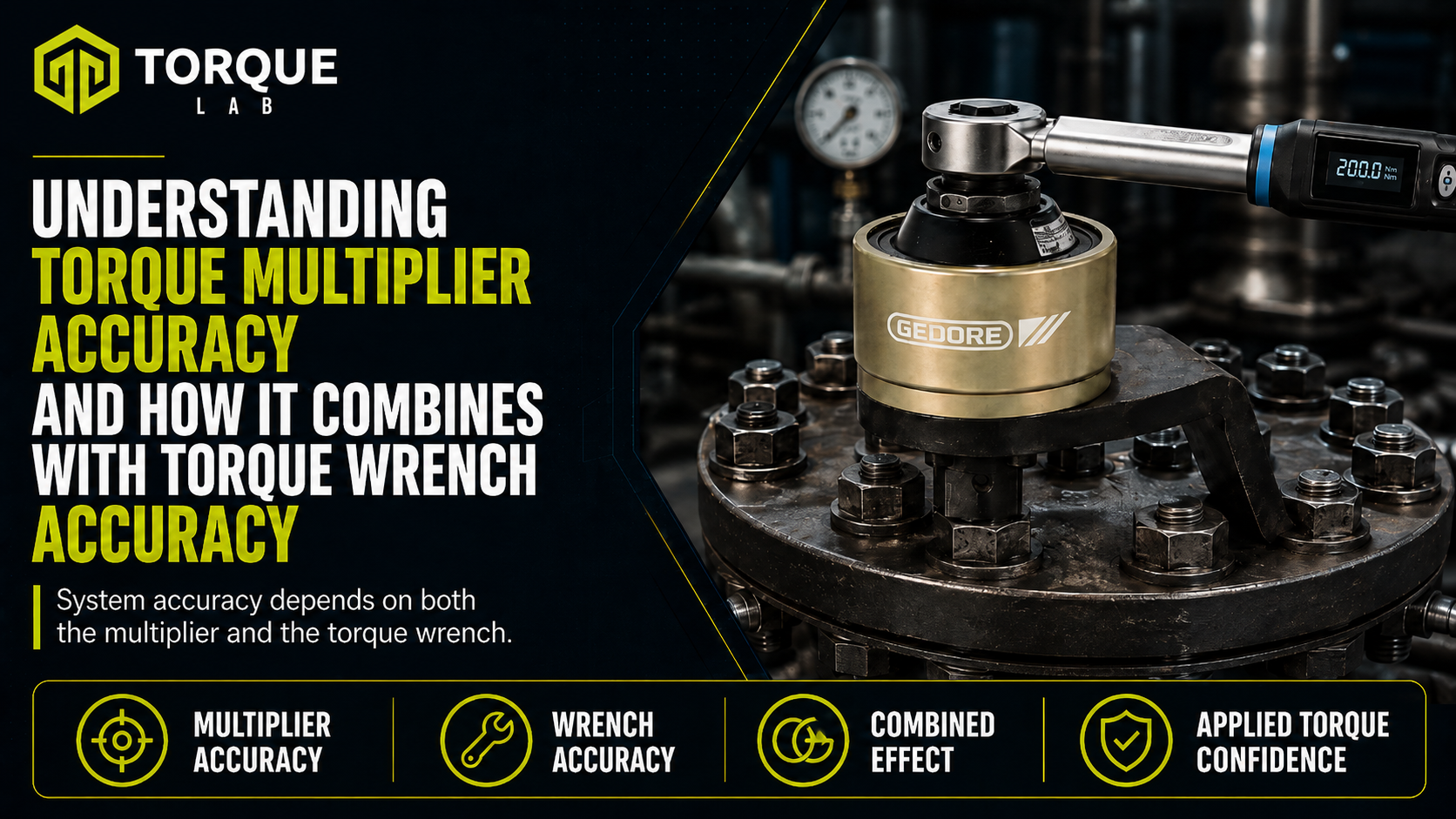
When you start pairing a torque wrench with a torque multiplier, it’s natural to ask how the overall system accuracy is affected. After all, both tools have their own stated tolerances, and the result you care about is the final torque delivered to the fastener.
This is where torque multiplier accuracy becomes important, especially when you’re trying to understand whether errors simply add together or behave in a more complex way.
What torque multiplier accuracy actually means
A torque multiplier is typically specified with a accuracy, for example ±4%. This refers to how accurately the multiplier reproduces its stated gear ratio under ideal conditions.
Separately, a torque wrench might have an accuracy such as ±2% of reading.
Individually, both figures are straightforward. The complication comes when they are used together in a system.
Torque multiplier accuracy vs torque wrench accuracy in a system
A common assumption is to simply add the two uncertainties:
- Torque wrench: ±2%
- Torque multiplier: ±4%
- Total assumed: ±6%
This is known as a worst-case linear approach. It assumes both errors always align in the same direction at the same time. It’s simple, but often overly conservative.
In reality, torque multiplier accuracy and torque wrench accuracy behave as largely independent variables. That means their errors are not guaranteed to stack in the same direction.
A more realistic approach: combining uncertainties
In calibration and metrology, independent uncertainty sources are usually combined using a root-sum-square method rather than simple addition.
For a typical example:
So instead of 6%, the combined system is closer to about 4.5% under a statistical model.
This gives a more realistic view of overall torque multiplier accuracy when used with a torque wrench.
Why the real world can still be different
Even the Root Sum Square method assumes clean, well-defined conditions. In practice, additional factors can influence performance:
- Gearbox backlash in the multiplier
- Reaction point movement or flex
- Alignment of the reaction arm
- Wear in internal components
- Calibration conditions vs field use
These effects don’t always appear in the stated accuracy of either tool, but they can influence the real-world outcome.
This is why two systems with identical stated torque multiplier accuracy can still behave slightly differently in the field.
When to use worst-case vs statistical thinking
Both approaches have their place:
Worst-case addition (2% + 4% = 6%)
- Useful for safety-critical applications
- Common in conservative engineering specifications
- Simple and easy to document
Statistical combination (~4.5%)
- More realistic for calibration and measurement uncertainty
- Better reflects independent error sources
- Common in metrology environments
The choice often depends on how much risk margin is required rather than which method is “correct”.
Practical takeaway
When using a torque wrench with a torque multiplier, it’s important not to assume the final error is simply the sum of both tools. The concept of torque multiplier accuracy needs to be treated as part of a combined system, not an isolated specification.
In most practical cases, the real combined uncertainty sits somewhere between the statistical result and the worst-case assumption, depending on setup quality and calibration discipline.
Conclusion
Understanding torque multiplier accuracy in combination with torque wrench accuracy helps you avoid both underestimating and overestimating system performance. A structured approach to uncertainty gives a clearer picture of how the tools behave together in real use.
If you need help assessing torque tool performance, calibration intervals, or combined system accuracy, it’s worth getting a proper evaluation rather than relying on simple percentages alone.
Contact us to discuss your torque calibration requirements.