
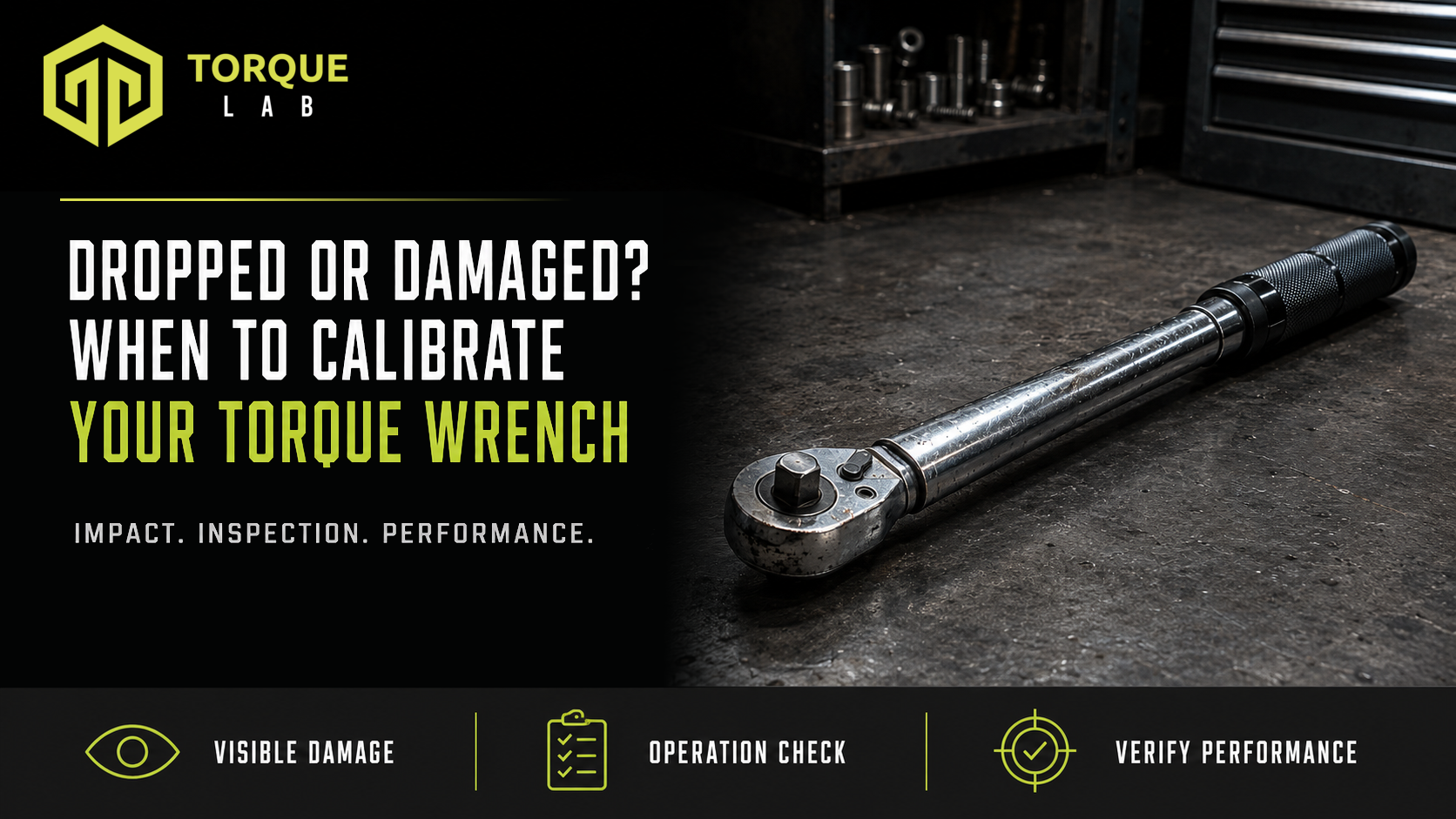
A torque wrench is a precision tool, so a hard drop or visible damage should never be ignored. If the wrench falls onto a hard surface, is overloaded or begins behaving differently, remove it from service and have it checked before using it on another critical fastener. You may need to calibrate a dropped torque wrench even when it appears normal from the outside, because appearance alone cannot confirm its torque output.
This does not mean that every light knock has changed the wrench’s accuracy. It means the impact has introduced doubt, and controlled testing is the practical way to resolve it.
Should You Calibrate a Dropped Torque Wrench?
If the wrench has experienced a significant impact, the safest practical answer is yes: it should be inspected and its performance verified before returning to service. Manufacturers of some torque tools specifically instruct users to verify calibration after a tool has been dropped.
The urgency depends on the circumstances. A wrench that shifts inside a closed protective case has not experienced the same event as one that falls from a workbench onto concrete. Consider:
- the height of the fall;
- the surface it struck;
- whether the ratchet head, square drive or handle took the impact;
- the tool type and torque range;
- whether the wrench was set or loaded at the time;
- any visible or functional change; and
- the consequences of an incorrect torque result in the application.
Where the impact was substantial, the history is uncertain or the tool is used for safety-critical or quality-controlled work, testing is preferable to assuming it remains accurate.
Why Can a Drop Affect Torque Wrench Performance?
Different torque wrench designs respond differently to impact, but all contain components that must work together consistently.
A mechanical click-type torque wrench uses an internal spring, adjustment mechanism and release system to produce a tactile or audible signal at the selected torque. An impact may disturb the adjustment components, damage the locking mechanism, affect the ratchet head or change how consistently the tool releases.
Dial and beam-type wrenches rely on the relationship between the tool body, sensing element and indicator. A bent component or displaced pointer may affect the displayed result. Electronic torque wrenches also contain sensing elements, wiring, batteries and displays that can be affected by shock or physical damage.
The wrench may therefore look acceptable while producing a shifted or less repeatable result. Conversely, a wrench may have cosmetic scuffing while its torque performance remains within tolerance. Testing separates appearance from actual performance.
What Should You Do Immediately After Dropping a Torque Wrench?
Do not simply pick it up and continue with the job. Use a controlled process:
- Remove the wrench from service. Mark or quarantine it so another person does not use it unknowingly.
- Record what happened. Note when it was dropped, the approximate height, the surface and which part of the wrench took the impact.
- Inspect the complete tool. Check the ratchet head, square drive, shaft, handle, scale, locking mechanism and any batteries or display.
- Check its operation without using a critical fastener as the test. If there is visible damage, looseness, binding or unusual operation, do not load the tool further.
- Arrange inspection, repair assessment and performance testing as appropriate. Keep the as-found result where possible, because it shows how the wrench performed before adjustment or repair.
If you need to calibrate a dropped torque wrench, avoid adjusting it first. Premature adjustment removes useful evidence about the wrench’s condition immediately after the incident.
Signs That the Wrench Needs Repair Before Calibration
Calibration measures performance; it does not repair a mechanical fault. A damaged wrench may need to be inspected and repaired before a final calibration or conformance test can be completed.
Remove the wrench from service if you notice:
- a bent shaft or visibly distorted body;
- a cracked, loose or damaged handle;
- a loose ratchet head or damaged square drive;
- a scale that has shifted or no longer aligns correctly;
- an adjustment handle that feels rough, tight or inconsistent;
- a locking mechanism that no longer holds its setting;
- an unusually weak, strong or inconsistent click;
- a dial pointer that does not return correctly;
- display errors, intermittent operation or battery damage; or
- rattling or loose components inside the tool.
Visible damage does not automatically mean the wrench is beyond repair. It does mean that continuing to use it without assessment is difficult to justify, particularly where fastener torque affects safety, reliability or product quality.
Does Every Minor Knock Require Immediate Calibration?
There is no useful universal rule for every light bump. The decision should reflect the severity of the event, the manufacturer’s instructions, your quality procedures and the risk associated with the work.
A minor contact that causes no functional change may be handled differently from a fall onto concrete. Some organisations use an in-house torque tester to perform an interim performance check after an incident. This can be useful for identifying an obvious change, provided the tester, method and acceptance criteria are suitable.
An interim check is not automatically the same as a full calibration. If the result is questionable, the tool has visible damage, or your procedure requires documented calibration after an abnormal event, send it for professional assessment.
What Can Post-Impact Calibration Tell You?
Testing can show whether the wrench’s indicated or set values agree with measured torque at selected points across its range. It can also reveal poor repeatability, direction-specific problems or a result that has shifted outside the applicable tolerance.
An as-found result is especially valuable after a drop because it records performance before intervention. If the wrench is outside tolerance, it can then be adjusted or repaired where practical and tested again to document its as-left condition.
Depending on your requirements, the appropriate service may be an ISO 6789 Part 1 declaration of conformance or an ISO 6789 Part 2 calibration. The important point is to select a service that provides the evidence required by your quality system and the risk of the application.
What About Fasteners Tightened After the Wrench Was Dropped?
If the wrench was used after the incident, identify the affected work rather than assuming every joint is acceptable or defective. Review:
- when the drop occurred;
- which jobs and fasteners were completed afterwards;
- the torque settings used;
- whether the joints are safety-critical;
- whether another controlled inspection method is available; and
- what your engineering or quality procedures require.
Do not automatically apply the torque wrench to completed fasteners again. Reapplying torque can rotate or over-tighten a fastener, depending on the joint and the method used. Any reinspection or corrective action should follow an approved engineering or quality process.
The as-found calibration result can support this review, but it cannot by itself prove the exact torque applied to every fastener since the incident.
Reducing the Risk of Future Damage
Good handling helps protect the wrench and reduces unplanned downtime:
- return the wrench to its protective case after use;
- store it where it cannot roll or be knocked from a bench;
- carry long or heavy wrenches with adequate support;
- do not use a torque wrench as a breaker bar;
- avoid exceeding the wrench’s rated capacity;
- keep electronic tools dry and protect their displays; and
- require users to report drops, overloads and unusual operation promptly.
Incident reporting is important. A wrench that is quietly returned to the toolbox may be used on many more fasteners before anyone realises its performance is uncertain.
The Practical Answer
The decision to calibrate a dropped torque wrench should be based on the impact, the tool’s condition, the manufacturer’s instructions and the risk of the work. A substantial fall, visible damage, abnormal operation or uncertain history is a strong reason to remove the wrench from service and have it assessed.
Calibration provides evidence of performance. Repair addresses physical or mechanical faults. Used together when required, they provide a controlled basis for deciding whether the wrench can return to service.
Contact us today to discuss your calibration needs.