
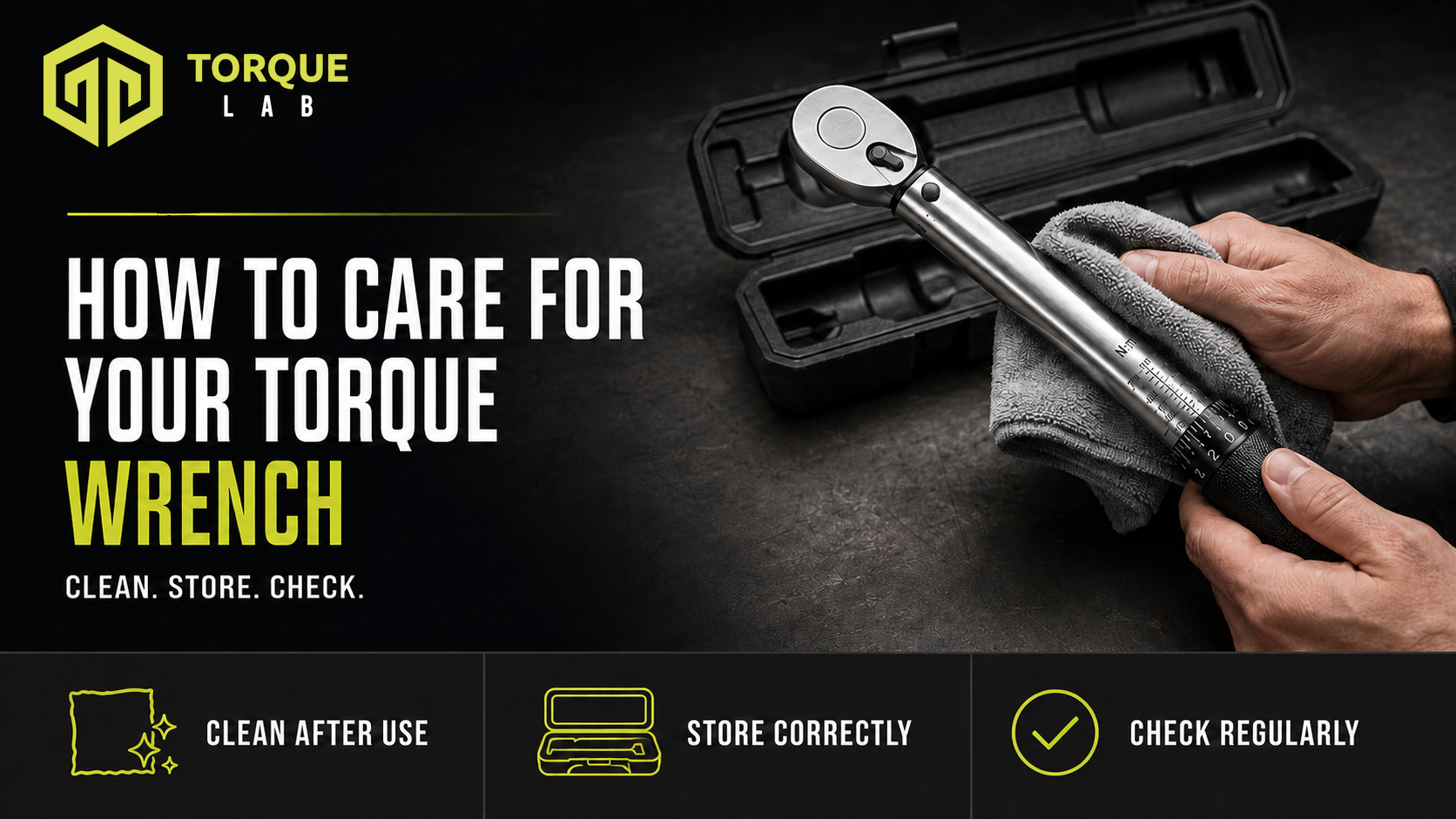
A torque wrench is a precision tool, not just another ratchet. Used and maintained correctly, it helps you apply controlled torque consistently. Neglected, overloaded or stored poorly, it can give unreliable results without an obvious external sign.
Learning how to care for a torque wrench is therefore about more than keeping it clean. Good care combines correct use, appropriate storage, regular inspection and calibration at an interval that reflects how the tool is actually used.
Clean Your Torque Wrench After Use
Wipe the outside of the wrench with a clean, dry cloth before returning it to its case. Remove dirt, grease and moisture from the handle, shaft, ratchet head and adjustment area. This simple habit makes damage easier to spot and reduces the chance of contamination entering moving parts.
Avoid immersing the wrench in cleaning fluid or spraying solvents, degreasers or lubricants into its mechanism unless the manufacturer specifically instructs you to do so. Internal components may depend on particular lubricants, clearances and seals. Unapproved products can damage markings, attack seals or change how the mechanism operates.
If the tool has been exposed to water, corrosive chemicals or heavy contamination, do not assume that an external wipe is enough. Isolate it from service and arrange an appropriate inspection before using it on important fasteners.
For electronic torque wrenches, clean the display and controls gently. Keep battery compartments dry and follow the manufacturer’s guidance for batteries and long-term storage.
Store It Correctly
A torque wrench should be stored in its protective case in a clean, dry location. The case helps protect it from impact, contamination and accidental adjustment. Avoid leaving the tool loose in a drawer, on a workshop bench or on the floor of a vehicle where it can be knocked, loaded by other equipment or exposed to vibration and temperature extremes.
Storage requirements vary by tool design:
- For many adjustable click-type wrenches, return the setting to the lowest marked value recommended by the manufacturer before storage. This helps relieve sustained load on the internal spring.
- Do not force the adjustment below the marked scale or past a mechanical stop.
- Split-beam, fixed-setting, dial and electronic designs may have different storage requirements and should not automatically be treated like a conventional click wrench.
- Switch electronic tools off after use and follow the manual regarding battery removal during extended storage.
The tool’s instruction manual takes priority because the correct procedure depends on its mechanism. For more detail, see our guide on how to store a torque wrench properly.
Use the Correct Wrench for the Job
Good torque wrench care starts before the fastener is tightened. Select a wrench with a range suited to the target torque rather than working at an unsuitable extreme of its capacity. Use compatible sockets and accessories in good condition, and account for extensions or adaptors when their geometry changes the effective lever length.
Apply force smoothly at the handle position specified by the manufacturer. Pull steadily and keep the loading direction aligned with the tool. Side loading, jerking or gripping the wrench in the wrong place can affect the applied torque and place unnecessary stress on the mechanism.
With a click-type wrench, stop applying force when the tool signals that the setting has been reached. Continuing to pull, repeatedly clicking the wrench or using the click as a starting point for further tightening can overtighten the fastener and overload the tool.
Most importantly, do not use a torque wrench as:
- a breaker bar for loosening seized fasteners;
- a general-purpose ratchet;
- a hammer or striking tool; or
- a lever fitted with an improvised pipe extension.
These practices can damage the ratchet, bend components or apply loads beyond the wrench’s rated capacity. Loosen difficult fasteners with a suitable breaker bar, then use the torque wrench only for the controlled tightening operation.
Exercise the Mechanism Before Important Work
After a torque wrench has been stored, cycling it before use can help redistribute internal lubricant and settle the mechanism. This is often called exercising or warming up the wrench.
The appropriate procedure depends on the tool and the work instruction. A common approach for a mechanical wrench is to operate it several times at a nominated setting using suitable torque-testing equipment. This is not a substitute for calibration and should not be performed by repeatedly tightening an actual assembly.
Always follow the manufacturer’s instructions or your workplace procedure. Our article on why you should warm up your torque wrench before use explains the purpose in more detail.
Protect It from Drops, Impacts and Overload
A torque wrench may look undamaged after a drop but still have a shifted mechanism, bent component or damaged ratchet. If a wrench is dropped, struck, used beyond its rated capacity or subjected to an abnormal event, remove it from service until its condition has been assessed.
The response should match the event and the risk of the work. It may include a visual inspection, functional check, repair and calibration. If the tool feels different, gives an inconsistent signal or has visible damage, do not keep using it to see whether the problem disappears.
The same principle applies when the wrench has been used on a fastener that would not move or when the operator may have continued loading after the signal. An overload can affect both the tool and the assembly. Recording the incident helps the person responsible for the equipment decide what needs to be checked.
Inspect the Wrench Regularly
A brief inspection before and after use can identify many problems early. Check that the tool is clean, complete and suitable for the job. Look and feel for:
- a worn, loose or damaged square drive;
- a ratchet that slips, binds or changes direction poorly;
- cracks, corrosion, bending or impact marks;
- a handle, grip or end cap that is loose or damaged;
- a scale that is difficult to read or appears misaligned;
- an adjustment mechanism that is rough, unusually loose or difficult to lock;
- a click, break or release that feels weak or inconsistent;
- a dial pointer that does not return as expected; or
- display, button, battery or error-message problems on an electronic wrench.
Do not dismantle the tool unless you are authorised, trained and equipped to service that model. Uncontrolled repairs can change the tool’s performance and make its previous calibration status meaningless. If you notice any warning signs, see our guide to the signs your torque wrench may need repair.
Keep Useful Identification and Usage Records
If your business relies on multiple torque tools, give each wrench a unique asset number and record its serial number, range, location and service history. A label can show its identification and next scheduled action, but it should not cover the scale, safety markings or controls.
Usage records do not need to be complicated. Depending on the risk and workload, they may include:
- the date the tool entered service;
- approximate tightening cycles or frequency of use;
- calibration and repair history;
- drops, overloads or other abnormal events; and
- the jobs or work areas in which it is used.
These records make it easier to identify heavily used tools, investigate an unexpected result and choose a more suitable calibration interval.
Calibration Is Part of Torque Wrench Care
Cleaning and careful storage cannot confirm that a wrench is performing within tolerance. That requires suitable torque-testing or calibration equipment, a controlled method and results that can be evaluated against the applicable requirement.
There is no single interval that suits every torque wrench. Twelve months is a common starting point in many workplaces, and some manufacturers or procedures also refer to a number of operating cycles. However, the appropriate interval should reflect:
- the manufacturer’s recommendation;
- frequency and severity of use;
- tool type, age and condition;
- storage and environmental conditions;
- previous calibration results;
- drops, overloads and repairs; and
- the risk associated with an incorrect torque result.
A lightly used wrench kept in controlled storage may present a different risk from a production tool used throughout every shift. Earlier assessment may be sensible after an incident, when results begin to drift or when the wrench is used for safety-critical work. Read more about whether to recalibrate a torque wrench earlier than 12 months.
It is also useful to distinguish between service activities. Testing checks performance at selected points. Calibration determines the relationship between indicated and applied torque under defined conditions. Adjustment changes the tool, while repair corrects a fault. If adjustment or repair is performed, the wrench should be calibrated afterwards so its post-service performance is known.
A Practical Torque Wrench Care Checklist
After Each Use
- Wipe the wrench clean and dry.
- Check for visible damage or unusual operation.
- Return an adjustable click wrench to the manufacturer’s recommended storage setting.
- Switch off electronic models.
- Place the tool in its protective case.
Before Use
- Confirm the range and drive size suit the task.
- Check the calibration status and identification.
- Inspect the ratchet, handle, scale and adjustment lock.
- Exercise the wrench if required by the manufacturer or work procedure.
- Use the correct socket and apply load at the specified handle position.
After a Drop, Overload or Fault
- Stop using the wrench.
- Record what happened.
- Quarantine or clearly identify the tool.
- Arrange inspection, repair or calibration as appropriate.
Look After the Tool and the Result
Knowing how to care for a torque wrench protects both the tool and the decisions made from it. Clean it after use, store it correctly, avoid impacts and overload, inspect it regularly and base calibration intervals on real operating conditions. Small, consistent habits are far more effective than waiting for a fault to become obvious.
Torque Lab provides torque wrench calibration and can help you determine the appropriate service path for your equipment.
Contact us to discuss your calibration requirements.