
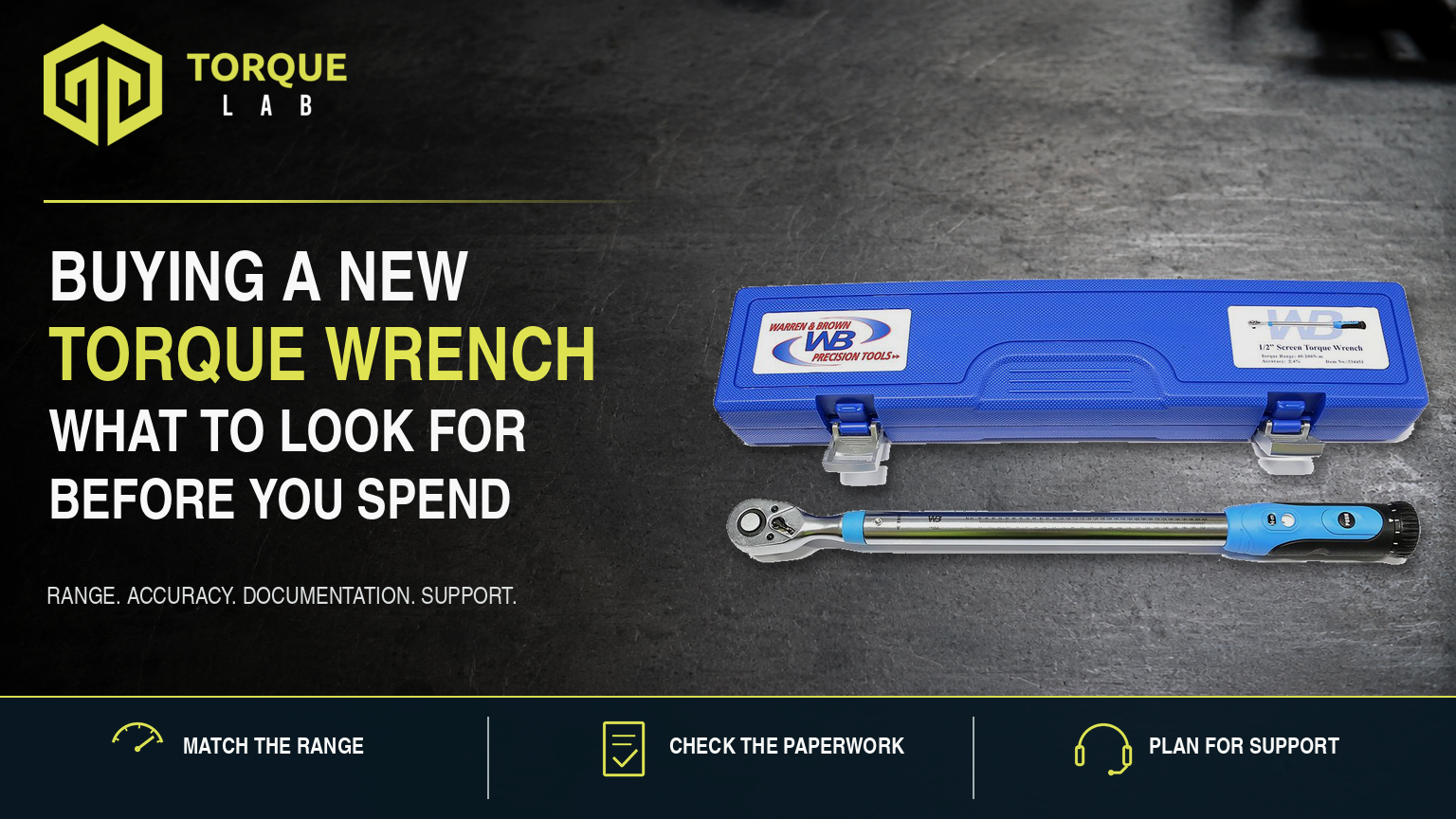
Buying a new torque wrench involves more than choosing a familiar brand or the lowest price. To understand how to choose a torque wrench, you need to compare torque wrench range, torque wrench accuracy, drive size, operating direction and after-sales support. You should also confirm whether the tool includes a declaration of conformance or a genuine torque wrench calibration certificate, because those documents serve different purposes.
A good wrench should suit the work you actually perform. Therefore, start with your fasteners, torque settings and operating conditions rather than the tool catalogue. A carefully chosen wrench will feel easier to use, cover the correct working range and fit into your maintenance system.
Buying a new torque wrench starts with the application
Before comparing models, list the tasks that the wrench must perform. Record the required torque values, fastener sizes, available access and normal direction of tightening. Also consider how often technicians will use the tool and what could happen if a joint receives the wrong torque.
These details quickly narrow the field. For example, a compact wrench may suit low-torque work in a confined assembly, while a larger tool may provide the leverage required for heavy fasteners. However, one wrench rarely covers every job well. Trying to buy one extremely wide-range tool can compromise readability, handling or practical coverage at one end of the range.
Ask these questions first:
-
What are the lowest and highest torque settings used in normal work?
-
Do technicians tighten clockwise, anticlockwise or in both directions?
-
Which socket drive sizes does the workshop already use?
-
Is access restricted around the fastener?
-
Does the job require a click, visual, audible or electronic indication?
-
Will the tool work in a clean assembly area, a mobile service vehicle or a harsh workshop?
-
Do customer procedures or internal quality plans specify a tool type or accuracy requirement?
Once you know those answers, buying a new torque wrench becomes a technical selection process rather than a guess.
1. Choose the right torque wrench range
The marked torque wrench range must cover the settings you need. Yet coverage alone does not make the tool suitable. A target value that sits at the very bottom or top of the scale may prove awkward to set, read or operate repeatedly.
Avoid applying a universal percentage rule to every model. Instead, check the manufacturer’s stated operating range, scale markings and instructions. Then select a wrench that places your common settings in a comfortable, clearly readable part of that range.
For example, if most jobs sit near the lower limit of a large wrench, a smaller model may offer better resolution and control. Conversely, a tool that regularly operates near maximum capacity may require more effort and leave little capacity for higher settings. Therefore, compare the actual torque wrench range with the distribution of your work, not only its single highest value.
If your workshop covers widely separated settings, two well-selected wrenches may work better than one compromise. Although that costs more initially, it can improve handling and reduce setting mistakes.
2. Understand the torque wrench accuracy statement
Manufacturers may present torque wrench accuracy in different ways, so read the specification carefully. Check whether the tolerance relates to the indicated value, set value, reading or full-scale capacity. Also confirm the direction, range and conditions to which the statement applies.
A percentage without context tells you very little. For instance, an accuracy claim may apply only over a stated portion of the range or only in the primary operating direction. Consequently, you should obtain the technical data sheet or manual before ordering.
When comparing torque wrench accuracy, look for:
-
the stated tolerance and how the manufacturer expresses it;
-
the portion of the range covered by that claim;
-
clockwise and anticlockwise performance;
-
scale resolution or display resolution;
-
operating temperature or environmental limitations, where relevant; and
-
any instructions about preloading, exercise cycles or correct loading technique.
Do not confuse a finer display with better accuracy. A digital wrench can show many decimal places without necessarily providing a smaller measurement error. Likewise, a coarse mechanical scale may still suit the job if its range, resolution and declared performance meet the application.
3. Match the drive size to the sockets and workload
The square-drive size should suit your socket system and the physical demands of the job. Common drive sizes support different fastener and torque applications; however, drive size alone does not define the wrench’s capacity or accuracy.
Reducing unnecessary adapters usually makes the setup simpler and easier to control. Coaxial square-drive adapters do not automatically change the applied torque ratio, but they can introduce clearance, strength and fit considerations. By contrast, an inline extension that changes the effective lever length can change the torque delivered unless the procedure accounts for it.
Therefore, check the complete setup rather than the wrench in isolation. Make sure the ratchet head, sockets and accessories suit the intended load and access. Also confirm that replacement or interchangeable heads remain available if the tool uses them.
4. Decide which torque-wrench type suits the work
Understanding how to choose a torque wrench also means choosing an operating style. Each type gives the user torque information differently.
Click-type or setting torque wrench
A click-type wrench releases or signals when it reaches the set value. It suits many workshop tasks because technicians can operate it without watching a dial. However, the user must stop applying force when the tool signals. Continuing to pull after the click can add torque to the joint.
Deflecting-beam or indicating wrench
An indicating wrench shows the applied torque through a beam, pointer, dial or display. It can help the user observe torque as it rises. However, the operator must see or interpret the indication correctly, which may become difficult in restricted positions.
Electronic torque wrench
Electronic models may provide visual, audible or vibration alerts, data capture and multiple units. These features can support process control, but they also introduce batteries, menus, software and environmental limits. Therefore, consider how the workshop will manage charging, settings, records and repairs.
No type is automatically best. Instead, choose the design that supports the task, operator and quality system.
5. Check direction, ratchet operation and access
Some wrenches apply their stated performance in one direction only, while others support both clockwise and anticlockwise tightening. As a result, you must confirm the required direction before purchase. Do not assume that reversing the ratchet selector means the torque mechanism works or meets the same specification in reverse.
Head size also matters. A large ratchet may not fit around recessed fasteners, nearby pipework or vehicle components. Similarly, the handle length may create interference even when the socket reaches the joint.
If possible, trial the tool in a representative position. Check that the operator can grip the designated loading point, read the scale and apply force smoothly. This practical test often reveals more than a brochure.
6. Compare scale design, units and locking method
A usable scale should remain clear under workshop lighting. Therefore, inspect the graduation spacing, contrast and adjustment method. A scale that looks acceptable in a product photograph may become difficult to read once oil, glare or poor access enters the job.
Also check the available units. Using a wrench marked in the same unit as the work instruction reduces the chance of a conversion error. If the tool displays several units, confirm how it identifies the active selection and whether users can accidentally change it.
The locking system should hold the selected value without becoming awkward. In addition, it should give the operator confidence that routine handling will not move the setting. These details affect how to choose a torque wrench for daily use, even though they do not appear in the headline specification.
7. Declaration of conformance or torque wrench calibration certificate?
Documentation deserves close attention when buying a new torque wrench. A new tool may include a manufacturer’s declaration of conformance, a test statement, a calibration certificate or only general product paperwork. These documents are not interchangeable.
The official ISO overview for ISO 6789-1:2017 explains that Part 1 covers conformance testing, marking and minimum requirements for a declaration of conformance. Importantly, ISO also states that Part 1 does not specify requirements for calibration certificates. The official overview for ISO 6789-2:2017 describes the calibration method and determination of measurement uncertainty for hand torque tools.
Therefore, ask exactly what the seller supplies. A useful torque wrench calibration certificate should identify the individual tool, not merely describe the product model. Depending on your requirements, you may need results, test direction, units, procedure, dates, reference equipment, traceability information and measurement uncertainty.
However, do not assume that every new wrench needs the same document. A manufacturer’s declaration may meet one organisation’s purchasing requirement, while another may require calibration data for the individual asset. Define that need before ordering, because arranging additional work later can delay the tool’s introduction.
8. Do not assume a new tool is automatically correct
New tools can arrive outside the expected performance limit. Shipping, storage, manufacturing variation or initial mechanical settling can all affect what you observe. Therefore, a new condition and a valid result are separate questions.
Exercise the wrench before use according to the manufacturer’s instructions and your procedure. Repeated operation helps distribute internal lubrication and settle the mechanism before a check or critical task. This point applies to mechanical and electronic tools, although the correct routine depends on the design.
For important applications, consider an incoming check or independent calibration before releasing the wrench to production. A current torque wrench calibration certificate can establish a useful starting point for the asset history. Later results then show whether the tool remains stable or begins to drift.
9. Consider serviceability and whole-of-life cost
The purchase price represents only one part of ownership. A cheap wrench may become expensive if nobody can supply parts, repair the mechanism or provide suitable documentation. Conversely, the most expensive model may add features that your workshop never uses.
When reviewing value, ask:
-
Can a competent provider service, adjust and repair the tool?
-
Are ratchet kits, batteries or accessories available?
-
Does the manufacturer publish clear instructions and specifications?
-
Does the tool have a permanent, readable serial number?
-
Does the case protect the wrench during transport and storage?
-
Can your usual provider calibrate its type, direction and torque wrench range?
-
How long can the workshop operate while the tool is away?
These questions help you compare whole-of-life cost rather than the checkout price alone. They also reduce the risk of buying a disposable tool for a process that requires long-term records.
10. Pay attention to ergonomics and correct loading
The operator must apply force at the intended loading point. Therefore, the handle should provide a clear, comfortable grip without encouraging the user to pull from the wrong position. A long or heavy wrench can also increase fatigue, especially during repetitive work.
Balance matters as well. The tool should allow a smooth, controlled pull rather than a sudden jerk. Moreover, the operator should be able to keep the load reasonably perpendicular to the wrench while supporting the socket and reaction as required.
Ergonomics cannot compensate for unsuitable torque wrench accuracy or range. Nevertheless, poor handling can undermine a technically capable tool. Include likely users in the selection process when possible.
11. Buy from a source that can identify and support the product
A reputable supply channel should provide a clear model number, specification, warranty position and documentation. In addition, the seller should answer basic questions about operating direction, included paperwork and service support.
Be cautious when a listing relies on broad accuracy claims but provides no manual, test conditions or identifiable manufacturer. Also check that product photographs, model numbers and stated ranges agree with each other. These simple checks form an important part of how to choose a torque wrench online.
Brand reputation can offer useful context, but it should not replace technical assessment. Compare the tool against your application and records requirement, regardless of the name on the case.
Ultimately, learning how to choose a torque wrench means matching documented capability to real workshop conditions.
A practical buying checklist
Before placing the order, confirm:
-
The required working values fit comfortably within the marked torque wrench range.
-
The stated torque wrench accuracy applies over the range and direction you intend to use.
-
The square drive, sockets, head size and handle length suit the task.
-
The scale or display uses suitable units and remains easy to read.
-
The locking and adjustment systems suit frequent workshop use.
-
The tool includes the required declaration or torque wrench calibration certificate.
-
The serial number appears permanently on the individual wrench.
-
Suitable calibration, adjustment, repair and spare parts remain available.
-
The case protects the tool without forcing it to stay at a high setting.
-
Your incoming inspection or calibration plan is ready before the tool enters service.
This checklist turns buying a new torque wrench into a controlled asset decision. It also gives purchasing staff, technicians and quality managers a common set of requirements.
Spend money on suitability, not marketing claims
The best wrench is not automatically the model with the widest range, smallest advertised tolerance or longest feature list. Instead, it is the tool that fits the required torque values, working space, direction, documentation and support needs.
In short, buying a new torque wrench should begin with the application and finish with a plan for verification, care and recalibration. When you compare torque wrench accuracy, usable range, documentation and serviceability together, you are far more likely to buy a tool that remains useful long after the first job.
Contact us to discuss your calibration requirements.