
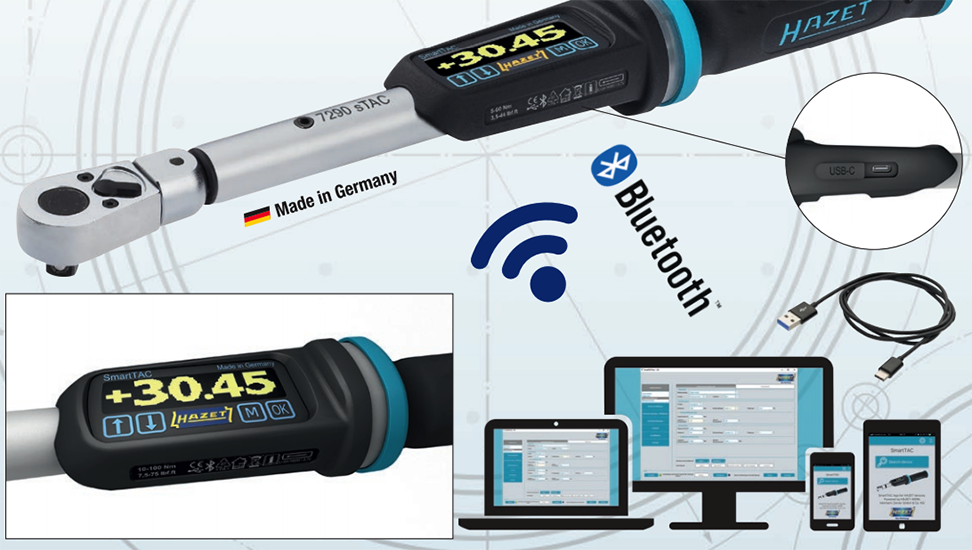
Once upon a time, a torque wrench had one job. You set it. You pulled it. It clicked. You moved on with your life.
Now the humble wrench has developed opinions, memory, wireless connectivity and, in some cases, a mild obsession with documentation.
The click still exists. It just files paperwork afterwards.
The shift from torque application to torque verification
The biggest change is philosophical. Historically, torque tools were about applying a value. Emerging torque wrench technologies focus on proving that value was achieved.
Digital models now store results internally, attach timestamps, and export reports. That subtle change transforms the wrench from a hand tool into part of a quality system. Instead of “we tightened it”, the conversation becomes “here is the data.”
For industries facing audits, warranty claims or compliance reviews, that difference is not cosmetic. It is protective.
Wireless connectivity and ecosystem integration
Bluetooth-enabled torque wrenches are no longer rare. Higher-end models connect to mobile apps or cloud platforms, allowing:
- Automatic result capture
- Tool identification by serial number
- User tracking
- Job-based reporting
- Centralised record storage
This reduces manual transcription errors and lost paperwork. However, it also introduces a new dependency. If the software work flow is poorly managed, the tool’s sophistication becomes theatre rather than control.
A connected wrench is only as reliable as the measurement chain behind it.
Torque and angle as a combined strategy
More premium tools now measure both torque and angle in the same tightening sequence.
Torque alone is an indirect indicator of clamp force. Angle control can add repeatability in joints where friction variation makes pure torque control unreliable.
As electronic processing becomes standard, torque-angle functionality is increasingly expected rather than considered exotic. For certain engine, gasket or structural applications, this dual measurement approach is quietly becoming baseline practice.
Smarter feedback systems
Older electronic torque tools relied on a beep and a screen. Emerging designs use multiple feedback channels:
- Progressive LED indicators
- Audible alerts
- Vibration feedback
- Larger backlit displays
This is not cosmetic. In noisy workshops or awkward access positions, improved feedback reduces missed targets and over-torque events. It makes the tool harder to ignore.
That said, no LED array can compensate for a poorly calibrated instrument.
Data logging and audit trails
Internal memory and report export features are increasingly common. Some systems allow pre-set locking, password protection and restricted operating modes.
From a governance perspective, this improves traceability. From a practical perspective, it can prevent unauthorised setting changes.
The upside is tighter process control.
The downside is that complexity increases, and with complexity comes configuration risk.
Battery fastening tools borrowing torque discipline
Another noticeable trend is the convergence between powered fastening tools and traditional torque wrenches.
Certain battery-operated systems now provide torque control modes and downloadable tightening data. In production environments, this can eliminate secondary verification steps and speed up workflows.
However, it also means more organisations are relying on electronically controlled torque values without fully understanding calibration intervals, drift behaviour or uncertainty.
Convenience often moves faster than caution.
Where this is heading
Emerging torque wrench technologies are likely to continue evolving in three directions:
Greater traceability.
Deeper software integration with maintenance and asset systems.
More automated decision support based on usage history and performance patterns.
These developments are promising. They are also unforgiving if the underlying calibration regime is weak.
When torque data becomes central to warranty, safety or compliance decisions, measurement integrity becomes more critical, not less.
What this means for businesses using torque tools
If your work involves regulated industries, warranty-sensitive assemblies or high-liability components, smart torque tools can reduce risk when implemented properly.
However:
- Digital reporting does not replace calibration.
- Connectivity does not guarantee accuracy.
- Stored data does not prove correctness if the instrument has drifted.
The tool may look advanced. The physics remain stubborn.
As torque wrenches evolve into connected measurement devices, organisations need to treat them as part of a controlled measurement system, not just upgraded spanners.
Technology is improving rapidly. Measurement discipline still determines whether that technology protects you or merely impresses visitors.
Contact us to discuss your calibration requirements.