
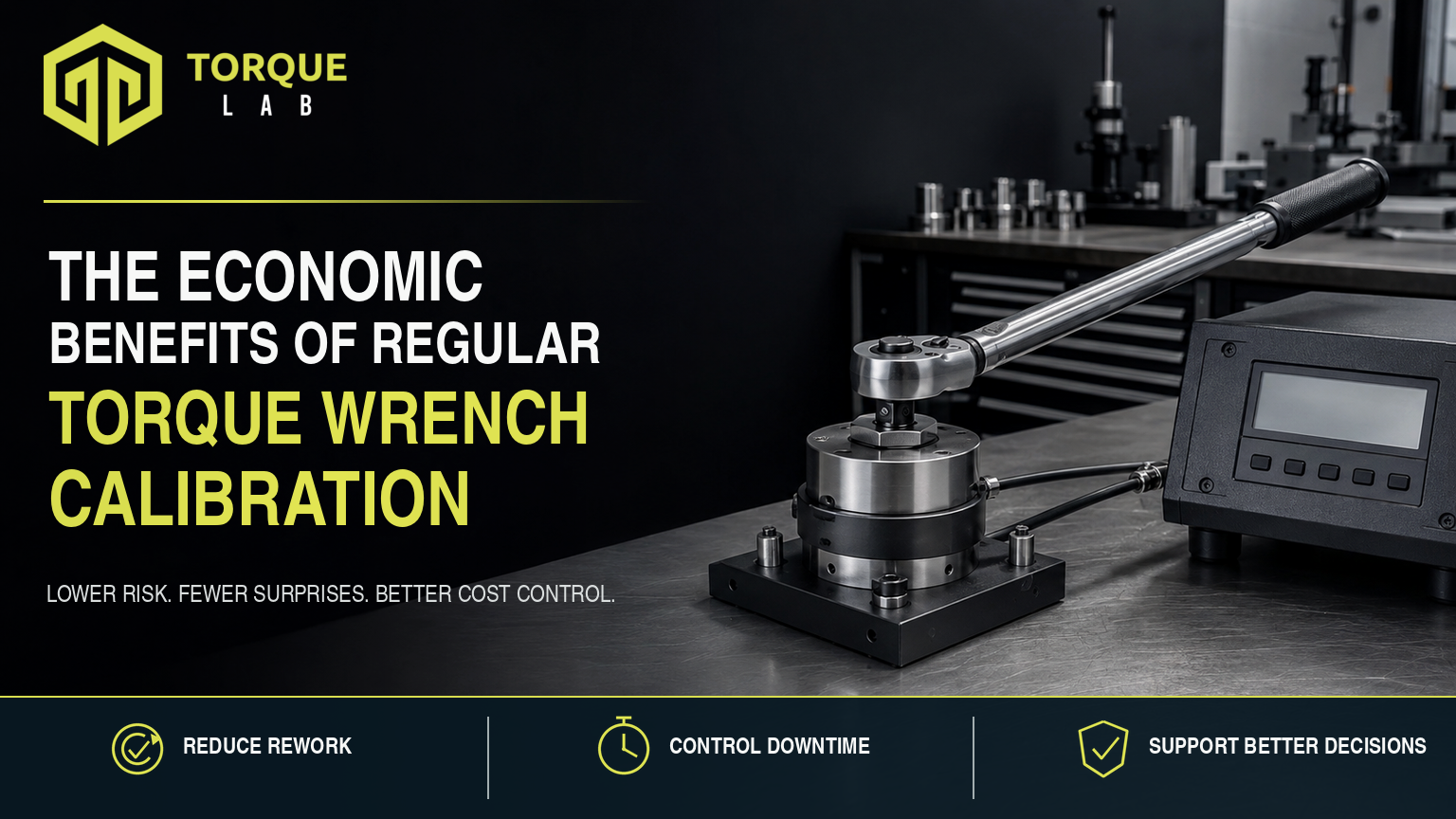
The economic benefits of torque wrench calibration reach well beyond the service invoice. A planned program can create torque wrench calibration cost savings, reduce torque rework, support preventive torque tool calibration and limit torque wrench downtime. For businesses that depend on repeatable tightening, these gains can protect labour, materials, schedules and customer confidence.
Calibration does not guarantee that every fastening task will succeed. However, it gives your business objective information about tool performance. That evidence helps you identify drift, make informed maintenance decisions and contain a problem before it affects a larger body of work.
In practice, the economic benefits of torque wrench calibration depend on how well your business uses that information.
Where the economic benefits of torque wrench calibration come from
Regular calibration compares a torque wrench with a suitable reference system under defined conditions. Therefore, the result shows how the tool performed at the time of calibration. If you also request a declaration of conformance, the service provider can assess the reported result against an agreed specification or acceptance limit.
That distinction matters commercially. Calibration supplies measurement data, while adjustment changes the tool and repair corrects a fault. Consequently, a useful service history can show whether a wrench remains stable, needs adjustment or deserves closer monitoring.
The official ISO overview of ISO 6789-2:2017 explains that the standard specifies calibration methods for hand torque tools and addresses measurement uncertainty. Likewise, Australia’s National Measurement Institute explains measurement traceability as an unbroken chain of calibrations to primary measurement standards. Together, a defined method and traceable results support better technical decisions without turning calibration into a guarantee about every joint.
1. Torque wrench calibration cost savings start with less rework
An inaccurate wrench can create work that appears complete but may not meet the intended torque requirement. If a later check raises doubt, the business may need to identify affected products, quarantine stock, inspect joints and repeat work. Therefore, the true cost can include far more than the original fastening task.
Regular checks can reduce torque rework because they shorten the period in which an unnoticed tool problem can influence production. For example, a stable calibration history gives a quality manager a clearer last-known-good point. As a result, the team may investigate a smaller and better-defined group of jobs if a later result falls outside the chosen acceptance limit.
The main torque wrench calibration cost savings may include:
- fewer labour hours spent reopening and retightening assemblies;
- less inspection and containment work after a suspect result;
- fewer replacement fasteners, seals or components;
- less production time lost while staff resolve uncertainty; and
- better evidence when reviewing a warranty or customer concern.
These outcomes depend on the tool, process and application. Nevertheless, the principle remains useful: the more work a tool influences, the more valuable an early warning can become.
2. Calibration can help control scrap and component damage
Too little torque can leave a joint loose, while too much torque can overstress a fastener, thread or mating component. However, the final joint also depends on friction, lubrication, fastener condition, tightening method and operator technique. Calibration only addresses the wrench’s torque indication or release behaviour; it does not remove those other variables.
Even with that limitation, preventive torque tool calibration gives your maintenance team a reliable way to monitor one important part of the process. When results show drift, the team can investigate the tool before continued use increases the exposure. In addition, technicians can use the calibration report to decide whether adjustment, repair or replacement makes economic sense.
This approach can reduce torque rework and avoid unnecessary component replacement. It also discourages a common false economy: continuing to use a questionable wrench because taking it out of service feels inconvenient.
3. Planned service reduces disruptive torque wrench downtime
Every calibration requires some time away from the work area. Yet planned torque wrench downtime usually creates less disruption than an unexpected failure, urgent investigation or production hold. Therefore, businesses should treat calibration as a scheduling task rather than an emergency response.
You can manage that time by:
- staggering due dates across the tool fleet;
- maintaining suitable spare tools for critical work;
- grouping tools by workshop, project or risk level;
- booking service before a major shutdown or production run; and
- recording expected return dates and tool locations.
This planning supports preventive torque tool calibration without removing every wrench at once. Moreover, it gives supervisors time to assign replacement tools and preserve workflow. For busy workshops, lower torque wrench downtime may protect more productive hours than a small difference in the calibration invoice.
4. Good records make investigations faster and more defensible
A calibration certificate provides a record of the tool, procedure, conditions, reference equipment and reported results. Although the exact content depends on the service and agreed scope, a useful certificate helps staff understand what the laboratory checked and what it found.
Those records can support torque wrench calibration cost savings during an internal review, customer query or audit. Instead of relying on memory, the team can compare serial numbers, dates, results and service history. Consequently, staff spend less time reconstructing events and more time making a proportionate decision.
The records also support asset control. For example, a business can identify tools with repeated drift, recurring damage or unusually frequent adjustment. That pattern may justify a shorter interval, a change in storage or a different tool for the application.
5. Regular calibration can protect your tool investment
A quality torque wrench or tension wrench represents a business asset, not a disposable consumable. However, rough handling, overload, contamination, incorrect storage and normal mechanical wear can change its performance. A sensible inspection and calibration program can reveal developing issues before the business automatically replaces the tool.
In some cases, adjustment or repair may restore suitable performance. In other cases, the service history may show that replacement offers the better commercial decision. Either way, preventive torque tool calibration replaces guesswork with evidence.
This does not mean that every tool needs the same schedule. Instead, set the interval according to use, risk, history, environment, manufacturer guidance, customer requirements and any procedure that governs the work. Our guide to choosing a suitable service interval explains those factors in more detail.
6. Calibration supports consistent productivity
Technicians work more efficiently when they trust the tools assigned to the job. By contrast, a questionable wrench can lead to repeated checking, tool swapping and informal comparisons that consume time without providing a traceable result. A current service history cannot replace correct technique, but it can support confidence in the tool’s known performance.
Regular checks can also reduce torque rework by helping supervisors separate a tool issue from an application or operator issue. For example, if the wrench performs consistently during calibration, the team can examine joint preparation, access, reaction forces, tightening sequence or work instructions. Therefore, calibration can narrow the investigation instead of leaving every variable in doubt.
Over time, these improvements contribute to torque wrench calibration cost savings through more focused troubleshooting and fewer repeated tasks. They also help the business use skilled labour where it adds the most value.
7. A risk-based program avoids both under-servicing and over-servicing
More calibration is not automatically better. If a low-use tool has stable results, careful storage and a low-risk application, an unnecessarily short interval may add cost without providing a proportionate benefit. Conversely, a heavily used wrench in a critical process may need more frequent checks than the default annual cycle.
A risk-based program balances those competing costs. First, review how often staff use the tool and how many fastenings it influences. Next, consider the consequence of an incorrect result, the tool’s service history and any unusual events. Finally, update the interval when evidence changes.
This approach makes preventive torque tool calibration more targeted. It can also limit torque wrench downtime because the business services each tool according to justified need rather than habit alone.
Calculate the cost of uncertainty, not only the calibration fee
When comparing service costs, consider the full business exposure. A simple review can include:
- direct rework labour;
- inspection, segregation and documentation time;
- scrapped fasteners or components;
- lost production or delayed delivery;
- warranty assessment or field-service activity;
- tool repair or premature replacement; and
- administrative time spent tracing affected jobs.
You do not need to invent a dollar return to see the relationship. If one wrench influences hundreds of fastenings, the investigation after an out-of-tolerance result may cost more than the planned check. Therefore, the most meaningful economic benefits of torque wrench calibration often come from limiting uncertainty and acting earlier.
However, choose a service on technical suitability as well as price. Confirm that the provider can test the required tool type and range, uses an appropriate method, reports useful results and explains the service scope clearly. A low price offers little value if the certificate does not support your decision.
Practical steps for better economic outcomes
To improve the return from your program:
- Identify every torque wrench or tension wrench by serial number or asset ID.
- Match the service interval to usage, risk, history and governing requirements.
- Schedule tools in manageable groups to control torque wrench downtime.
- Inspect tools between calibrations and check them after a drop, overload, repair or suspected damage.
- Review results for drift instead of filing certificates without analysis.
- Record adjustments and repairs so you can recognise recurring problems.
- Train users to warm up, operate, store and transport each tool correctly.
These steps can reduce torque rework while strengthening the value of each calibration record. In addition, they help management distinguish a genuine measurement need from a routine date on a calendar.
A planned calibration program supports better cost control
The economic benefits of torque wrench calibration come from better information and earlier decisions. Regular calibration can help contain rework, manage tool availability, protect components and support faster investigations. At the same time, a risk-based interval prevents the program from becoming an automatic expense with no link to actual use.
Ultimately, the best program combines suitable calibration, interim checks, correct tool care, competent use and clear records. That combination produces practical torque wrench calibration cost savings and keeps torque wrench downtime proportionate to the risk of the work.
Contact us to discuss your calibration requirements.