
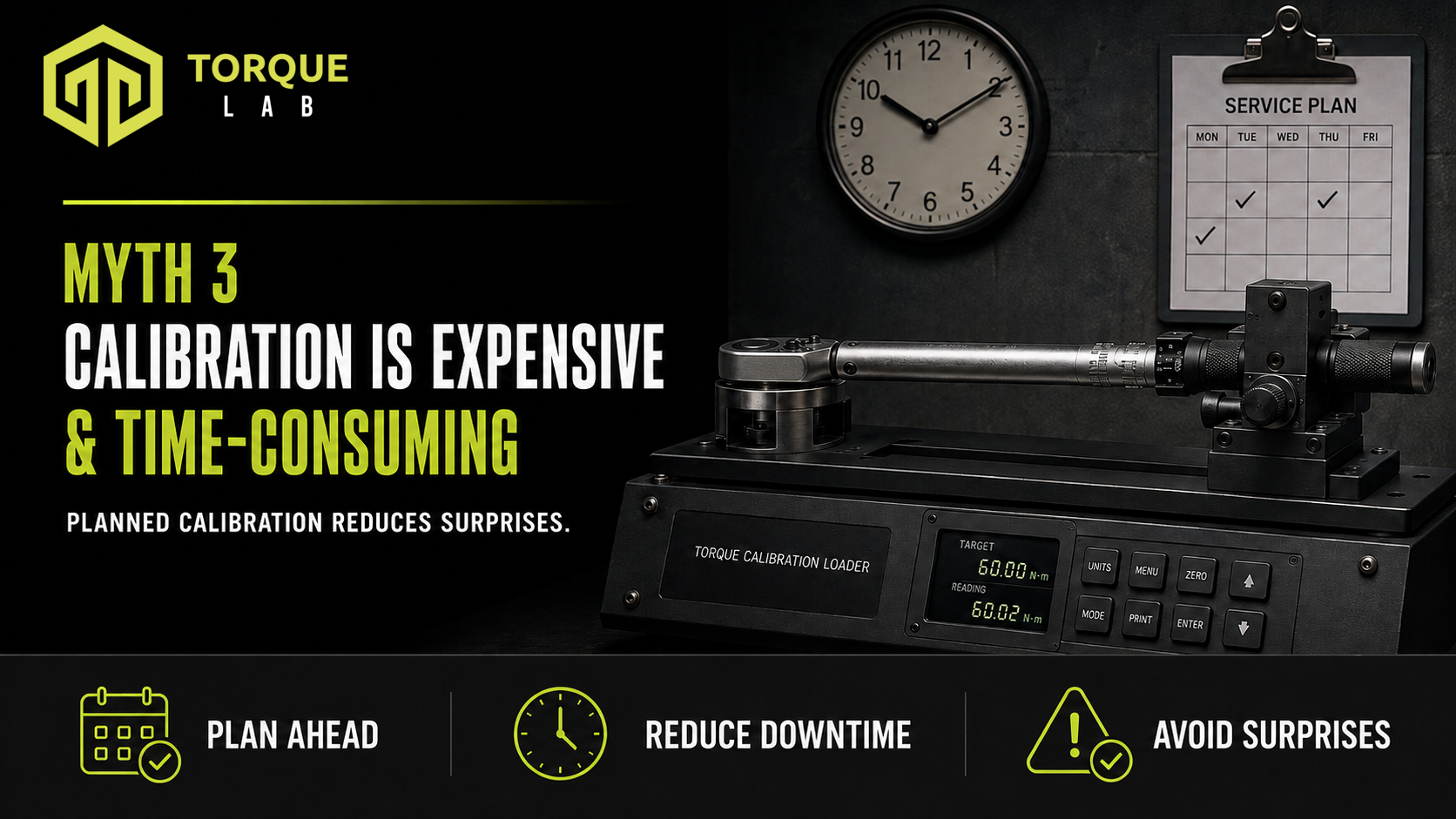
It is easy to look at calibration as an added cost and an inconvenience, particularly when a torque wrench must be taken out of service. However, the torque wrench calibration cost is only one part of the picture. Poor planning, unexpected tool failures, repair work and delays caused by unreliable results can create far more disruption than a scheduled calibration.
Calibration is not free, and no laboratory can promise that every tool will be returned immediately. The practical question is whether the work is planned, appropriate for the tool and proportionate to the risk of the application.
What Does Torque Wrench Calibration Cost Actually Cover?
A calibration is a controlled measurement process, not simply a quick check followed by a certificate. Depending on the service requested and the procedure used, the work may include:
- identifying the tool, its range, units and direction of operation;
- inspecting its general condition before testing;
- exercising or pre-clicking the mechanism so it is properly conditioned;
- applying torque at defined points under controlled conditions;
- comparing the tool’s indication or release point with a reference measurement system;
- recording the results and any relevant measurement uncertainty; and
- preparing documentation that clearly identifies the tool and the results obtained.
Where adjustment or repair is required, that is additional work rather than an automatic part of calibration. This distinction matters when comparing prices or estimating how long a tool may be unavailable.
For hand torque tools calibrated to ISO 6789-2, the procedure also includes requirements for the calibration method and the determination of measurement uncertainty. The certificate is therefore the outcome of a defined technical process, not the main product by itself.
Why Calibration Can Appear Time-Consuming
The time spent applying torque on the calibration equipment is only one part of the job. Turnaround can also be affected by transport, booking schedules, incoming inspections, documentation, approval for additional work and the condition of the tool.
A clean, serviceable wrench with clear identification and a confirmed service requirement is generally easier to process than a damaged tool arriving without instructions. A tool that needs parts, repair or customer approval will naturally take longer than one that produces acceptable results as received.
This is why calibration is best treated as planned maintenance. Waiting until a wrench is already overdue—or until it is needed for an urgent job—turns a routine process into an operational problem.
The Cost of an Unexpected Result
The calibration fee is visible. The cost of unreliable torque is often harder to see.
An inaccurate wrench may contribute to under-tightened or over-tightened fasteners. Depending on the application, that can lead to rework, damaged components, product holds, interrupted production or uncertainty about work that has already been completed. Calibration cannot eliminate every tightening problem, but it provides evidence of how the tool performed when tested.
There is also value in finding a problem before the wrench is required for critical work. A scheduled calibration gives the business time to assess the result and decide whether adjustment, repair or replacement is appropriate. Discovering the same problem during an urgent shutdown or customer job is usually much less convenient.
What Affects Price and Turnaround?
Not every torque tool requires the same amount of work. Factors that may affect price or turnaround include:
- Tool type and capacity: A standard hand torque wrench is different from a high-capacity, hydraulic, pneumatic or electrically powered torque tool.
- The service requested: A declaration of conformance, a calibration with measurement uncertainty, adjustment and repair are different services.
- Tool condition: Damage, corrosion, worn components, inconsistent release or a seized adjustment mechanism may require further assessment.
- Required range and direction: The requested test range and whether testing is needed in more than one direction can affect the work involved.
- Identification and records: Clear serial numbers, asset details, purchase orders and service instructions reduce avoidable administration.
- Additional equipment: Some tools require particular reaction components, adaptors or accessories to be tested correctly.
- Scheduling and transport: Freight time and waiting until a large group of tools is simultaneously due can create unnecessary downtime.
A useful quotation therefore starts with accurate information about the tool and the required service. Comparing only the lowest price can be misleading if the scope, procedure or documentation is different.
How to Keep Torque Wrench Calibration Cost Under Control
The best way to manage torque wrench calibration cost is to remove avoidable surprises from the process.
Maintain a Tool Register
Record each wrench’s identification, range, location, service history and next due date. This makes it easier to organise work before certificates expire or a tool is required for a major job.
Stagger Due Dates
If every torque wrench is sent away at once, the workshop may lose too much capability at the same time. Staggering service dates can keep suitable tools available while others are being tested.
Confirm the Required Service
Tell the laboratory what procedure, documentation and test range are required. A request for “a certificate” does not always establish whether the customer needs conformance testing, calibration, adjustment or another service.
Look After the Tool
Keep the wrench clean, dry and protected in storage. Follow the manufacturer’s instructions for unloading an adjustable click wrench after use, and do not force the mechanism below its marked range. Good care cannot prevent all drift, but it can reduce avoidable damage.
Pre-Click the Wrench Properly
Before use or testing, exercise the wrench in accordance with the applicable procedure or manufacturer instructions. Several preliminary operations help the internal mechanism settle after storage. This is particularly important for click-type tools and helps produce more consistent results.
Investigate Drops and Damage Early
Do not wait for the scheduled due date if a wrench is dropped, overloaded, damaged or behaving inconsistently. Remove it from critical use and arrange an appropriate check. Early action may prevent an uncertain tool from remaining in service.
Use Intermediate Checks Sensibly
More frequent accuracy checks can help identify drift between calibrations, particularly where usage is high or the application carries greater risk. These checks do not automatically replace a formal calibration, but they can provide useful evidence that the tool remains stable.
Calibration Should Be Proportionate to the Application
The appropriate service interval and level of testing depend on factors such as frequency of use, tool history, manufacturer guidance, customer requirements, governing procedures and the consequence of an incorrect torque result. A lightly used workshop wrench and a production tool used throughout every shift should not automatically be treated as identical.
For many businesses, the most economical approach is a planned program based on risk and evidence. That allows calibration dates, intermediate checks, maintenance and tool availability to be managed together.
Planned Calibration Is Easier to Manage
Calibration becomes expensive and time-consuming when it is left until the last moment, when tools arrive in poor condition or when the required service has not been defined. With a current tool register, sensible scheduling and appropriate care, it becomes a predictable part of maintaining reliable torque equipment.
The objective is not to calibrate every tool as often as possible. It is to maintain suitable evidence that each tool is fit for its intended use without creating avoidable cost or downtime.
Contact us today to discuss your compliance needs.