
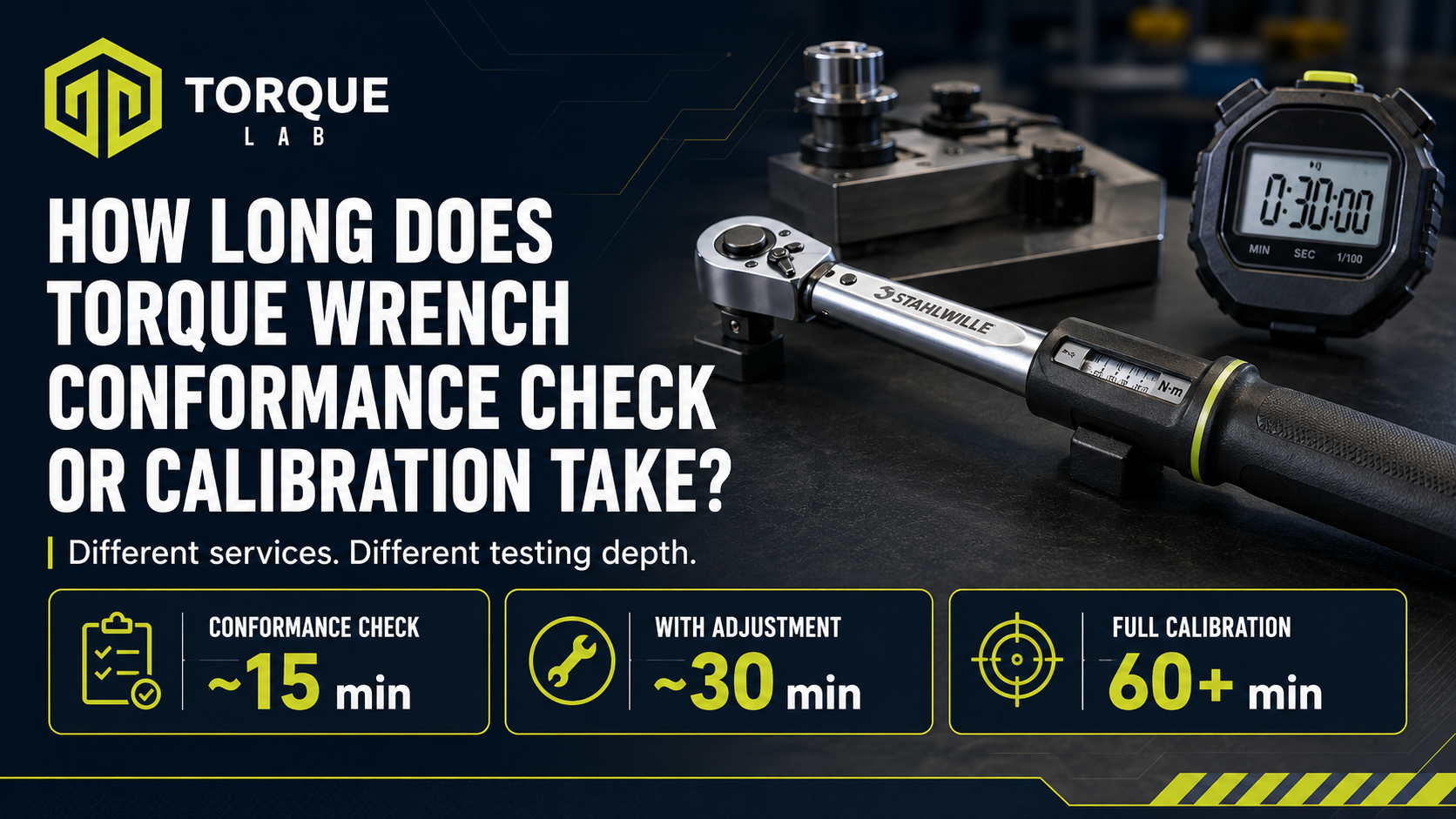
How long does torque wrench conformance check or calibration take? The answer depends on which service you choose, as a conformance check and a full calibration are two separate processes with very different levels of testing.
In most cases, the time required comes down to how much data is collected and whether adjustments are needed.
How Long Does a Torque Wrench Conformance Check Take?
How long does it take when performing a conformance check? Typically, a conformance check takes around 15 minutes per tool.
During this process, the torque wrench is tested across its operating range to confirm it meets the manufacturer’s specified tolerance. In most cases, between 15 and 30 results are recorded.
This procedure aligns with ISO 6789 Part 1 and is suitable for the majority of applications.
However, if the tool is found to be out of tolerance, additional time may be required.
What If the Tool Requires Adjustment?
If the torque wrench fails the initial conformance check, adjustment may be possible.
In this situation, the total time can extend to around 30 minutes per tool. This is because the process now includes:
- assessing the initial “As Found” results
- performing the necessary adjustment
- re-verifying the tool to produce “As Left” results
This ensures the tool is returned to specification and that you receive clear before-and-after data.
How Long Does a Torque Wrench Calibration Take?
How long does it take to perform a full calibration? A full calibration in accordance with ISO 6789 Part 2 takes significantly longer—typically at least 60 minutes per tool.
The main reason is the volume and depth of data collected.
During a full calibration:
- a minimum of 120 results are recorded
- this can increase to around 150 if adjustment is required
This level of testing provides a much more detailed assessment of the tool’s performance.
Why Does Calibration Take Longer?
A full calibration does more than just confirm whether the tool is within tolerance.
It also requires the calculation of several contributing factors, including:
- repeatability (consistency under the same conditions)
- reproducibility (variation under different conditions)
- uncertainty of the tool and measurement system
- geometric effects, such as variation in the loading point
These factors are combined to determine the overall measurement uncertainty.
What Is Measurement Uncertainty?
Measurement uncertainty defines the range within which the true value is expected to lie.
In practical terms, it tells you how confident you can be in the result.
Even a well-performing torque wrench has some level of uncertainty due to limitations in equipment and testing conditions. A full calibration quantifies this, providing a higher level of traceability and technical detail.
Do You Need a Conformance Check or a Full Calibration?
For most users, a conformance check is sufficient.
It confirms that the torque wrench is operating within tolerance and is suitable for general use. As a result, it offers a faster and more cost-effective option.
A full calibration is typically only required when:
- detailed uncertainty data is needed
- strict quality systems are in place
- the application is highly critical
Choosing the appropriate service ensures you are not paying for unnecessary complexity.
Final Thoughts
How long does torque wrench conformance check or calibration take? A conformance check typically takes around 15 minutes, or up to 30 minutes if adjustment is required.
In contrast, a full ISO 6789 Part 2 calibration takes at least 60 minutes due to the depth of testing and analysis involved.
Understanding the difference between these services helps you choose the right option for your needs without overcomplicating the process.
Contact us to discuss your calibration requirements and determine whether a conformance check or full calibration is right for your torque equipment.