
There was a time when tightening a bolt meant leaning on a spanner and hoping for the best. Mechanics worked by feel. Some had wrists calibrated by experience. Others simply had optimism. Neither is traceable to a standard.
The torque wrench arrived when industry realised that “tight enough” was not a measurement. It was a gamble.
Before Measurement, There Was Muscle
In the late nineteenth and early twentieth centuries, machinery grew more complex and more expensive to repair. Steam engines, early auto mobiles, rail infrastructure and heavy plant demanded consistency. Uneven bolt tension caused leaks, cracked castings and mechanical failures.
However, no practical method existed to measure applied torque directly. Mechanics relied on leverage and intuition. This worked, until it did not.
The First Patents Appear
In 1918, Conrad Bahr, a foreman for the New York City Water Department, patented one of the earliest torque wrench designs. His goal was simple: prevent damage to water mains caused by over tightening. His wrench deflected under load, giving a visual indication of applied torque.
Around the same time, J. H. Sharp patented another early design. These early tools were mechanical and relatively simple. They did not click or beep, they bent.
This was the birth of the beam-type torque wrench.
The Beam Era
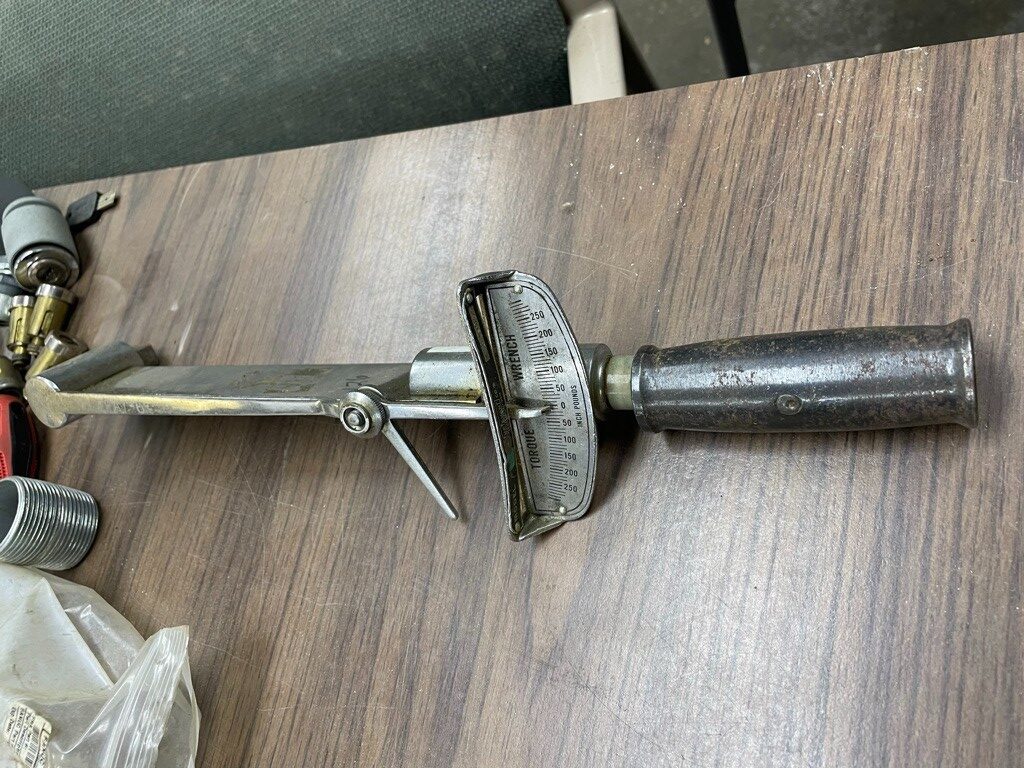
The beam torque wrench became the workhorse of mid-twentieth century workshops. A long steel beam would flex proportionally to applied torque, while a pointer indicated the reading on a scale.
It was elegant in its simplicity. No moving parts beyond the beam itself. There were no springs to fatigue. No internal clutch mechanisms.
For decades, this design set the standard in automotive and industrial environments.
Yet it required concentration. The user had to watch the scale while applying force. In tight spaces, that was not always convenient. Human error still lurked in the margins.
The Click Mechanism Changes Everything
The next major leap was the micrometer-adjustable, click-type torque wrench. Instead of watching a pointer, the user pre-set the desired torque. When that value was reached, an internal clutch mechanism released with a distinctive “click.”
Suddenly torque control became repeatable, efficient and less dependent on visual alignment. This design became dominant in automotive workshops worldwide.
The click wrench turned torque application into a controlled event rather than a continuous judgement call. It reduced over-tightening and improved assembly consistency across industries.
Aerospace Raises the Stakes
As aviation matured, particularly during and after World War II, torque control became critical rather than merely desirable. Fasteners in aircraft structures and engines required precise preload to prevent fatigue failures.
The aerospace sector drove improvements in accuracy, documentation and calibration traceability. Torque was no longer just a workshop concern. It became part of formal quality systems.
Standards began to evolve. Calibration intervals became defined. Certificates became expected. Torque measurement stepped into the world of metrology.
The Electronic Revolution
Late twentieth century electronics transformed torque measurement again. Digital torque wrenches introduced strain gauges and electronic load sensing.
Instead of a beam deflecting visibly, internal sensors converted strain into electrical signals. Results could be displayed numerically, stored digitally and even transmitted to quality control systems.
Some tools added programmable torque and angle measurement. Others integrated directly with production lines.
Torque became data.
Modern Standards and Compliance
Today, torque wrenches are governed by international standards such as ISO 6789, which defines requirements for design verification, calibration and conformance testing of hand torque tools.
Modern torque control involves uncertainty budgets, environmental considerations and documented traceability to national measurement standards. The tool is only part of the story. The calibration system behind it carries equal weight.
In regulated industries, a torque wrench without proper verification is little more than a hopeful lever.
Where We Stand Now
From bending beams in 1918 to Bluetooth-enabled digital torque systems, the evolution of the torque wrench mirrors the broader journey of industrial precision.
It began with preventing broken pipes. It now supports aerospace, automotive manufacturing, mining, medical devices and infrastructure.
Yet the principle remains unchanged: a bolt must be tightened neither too little nor too much. Between those two lies reliability.
And reliability, as history has shown, prefers numbers over guesswork.
If your business relies on accurate torque application, contact us to discuss your calibration requirements.